


How to Stop Waiting for Accounting and Have Management Data the Moment an Invoice Arrives?
Echo is a real-time management accounting system. Every invoice is automatically parsed, categorized, and assigned to a cost center before it even reaches the books. A human confirms. The system does the rest — generates payment orders, updates cash flow forecasts, powers dashboards, and compares actual performance with the financial model.
The Problem — What the Client Was Looking For
Most companies operate in the same trap: invoices arrive, go to accounting, get booked — and only after the month is closed does the company find out what it actually spent. Data from the financial accounting system is designed for tax and reporting purposes, not for management. Ledger accounts are not cost centers. Posting is not a project description. From an accounting report, you can infer that something cost money — but rarely why, where, and whether it should have.
The effect is always the same. When a manager asks about project margin, the cost of a specific machine, or the budget status in a category — the reconstruction begins. A call to accounting. Searching for invoices. Patching together a spreadsheet. Several days of work. An approximate result. And repeat next month.
On top of that, there is a structural problem that most companies have never clearly named: the lack of a standardized invoice description procedure. Everyone describes invoices differently. One writes the project name, another uses an abbreviation, the third writes nothing. Without a standardized procedure, every invoice is a separate interpretation — and controlling is built on sand.

The Solution — What is Echo
Echo is a real-time management accounting system. Both a tool and a procedure at the same time.
It is not enough to build an application — you first need to answer what information the company should capture from every invoice and why.
Origami Effect designs this procedure together with the client, drawing on analytical experience from evaluating businesses from an investment and financial perspective. The procedure is then embedded in a system that automatically enforces its compliance — regardless of who confirms the invoice and when.

The operating principle is simple: an invoice arrives, Echo automatically parses its content, recognizes the supplier, and suggests assignment to cost categories based on the procedure and history of previous decisions.
A person opens an Excel spreadsheet, sees a ready proposal, and confirms with one click. Or makes corrections. Whatever was corrected once — Echo remembers. The rest happens automatically.
Echo is not an accounting system. It operates in the layer that precedes accounting and answers completely different questions: what does this expense mean for the company’s result right now, whether the costs are within the plan, what will leave the account and when, where the deviations are before they become a problem.
How Echo Works — System Architecture
Automatic Invoice Parsing
Echo identifies the supplier, invoice number, payment dates, line items, and amounts without manual data entry. Each line item is assigned to the correct cost center according to the procedure designed for the organization.
Categorization and Confirmation in Excel
The system suggests category assignment. The user confirms or corrects it in an Excel spreadsheet — in a familiar tool. This is not data entry. It is ensuring consistency.
Verification and Control
Echo detects duplicates, missing assignments, and budget overruns before the invoice moves forward. Problems are visible at the moment when something can still be done about them.
Automatic Payment Orders
An approved invoice automatically generates a payment order with the supplier’s account, amount, title, and due date. One approving decision. All transfers.
Cash Flow Forecast
Every invoice with a payment deadline goes into the liabilities calendar. Echo, together with the financial model, builds a real-time outflow forecast. Cash flow is no longer a surprise.
Updating the Company Picture
Every confirmed invoice immediately updates cost reports, budget comparisons, fixed assets history, and the Delta in the Performance vs Target summary.
Management Accounting vs Financial Accounting System — Key Distinction
Echo does not replace the accounting system. It works in the layer that precedes it.
The financial accounting system answers the question: was the invoice booked in accordance with regulations? Echo answers the questions a manager asks every day: how much does a given project, department, machine, or supplier cost — and is it within the norm.
An invoice described by Echo goes to accounting already categorized and assigned. No questions for the person who described it. No reconstructing context. Full documentation ready for posting.
Two-Dimensional Description of Every Invoice
Every invoice in Echo is described simultaneously for two purposes:
Management Accounting — assignment to cost center, department, project, category. Data ready for analysis before anyone asks. Distinction between direct and indirect costs. Allocation of shared costs according to a defined key.
Performance vs Benchmark Analysis — description structure consistent with the requirements of financial-operational models (Demeter, Artemis, Athena, Metis). Actual costs are automatically compared with norms and forecasts calculated by the model. No extra work. No manual data merging.
Dashboards in Iris — Analytical Environment
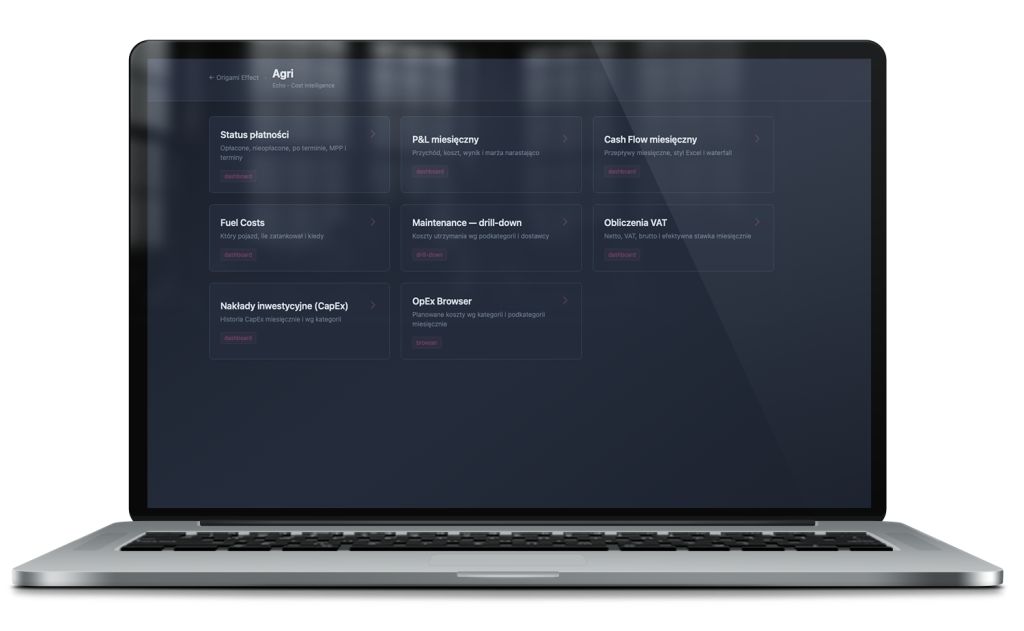
Echo powers interactive dashboards in Iris. Each module answers a specific management question that previously required reconstruction:
- Payment Status — paid, unpaid, overdue, MPP, and deadlines
- Monthly P&L — revenue, cost, result, and margin cumulatively broken down by cost categories
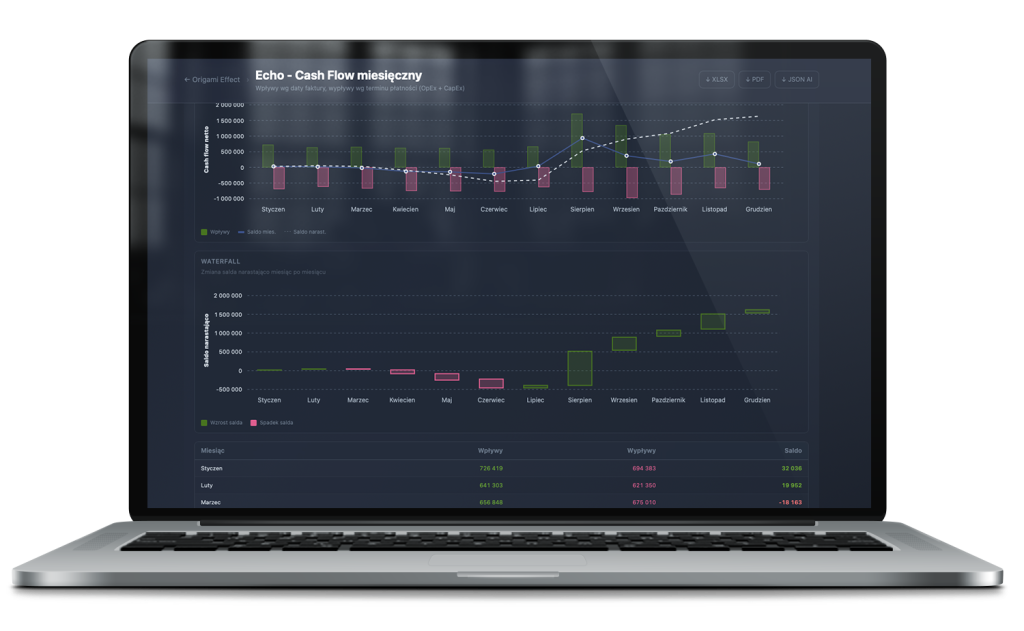
- Monthly Cash Flow — inflows and outflows in three views: base, Excel-style, and waterfall
- Maintenance — drill-down — maintenance costs for each machine or component separately
- Fuel Costs — which vehicle, how much it refueled, when, and for how much
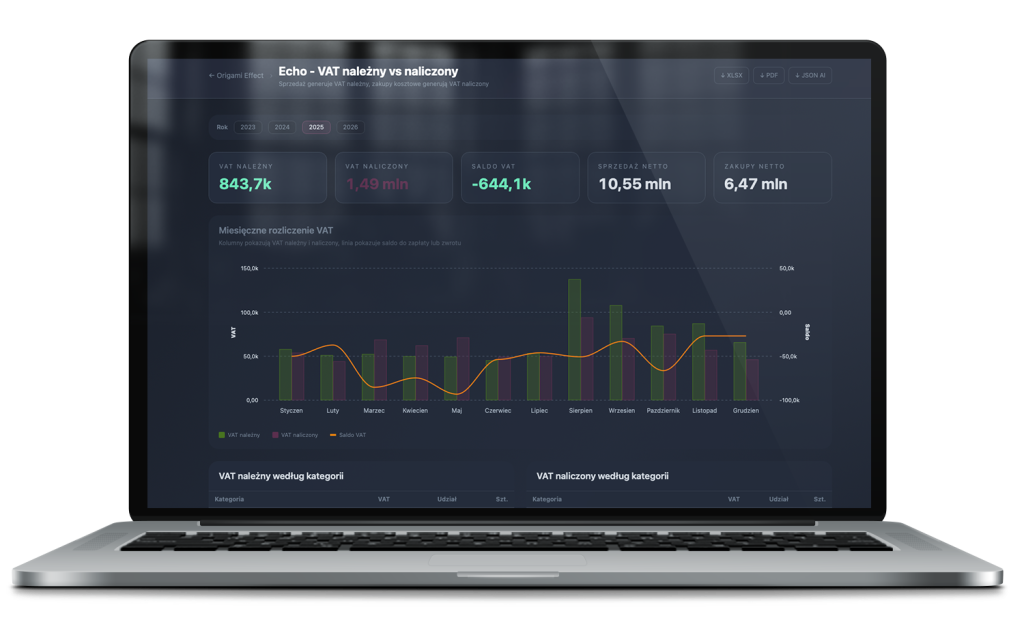
VAT Calculations — output VAT vs input VAT, monthly balance, effective rate - OpEx — planned costs by category and subcategory on a monthly basis
- CapEx — history and structure of investments separated from operating costs
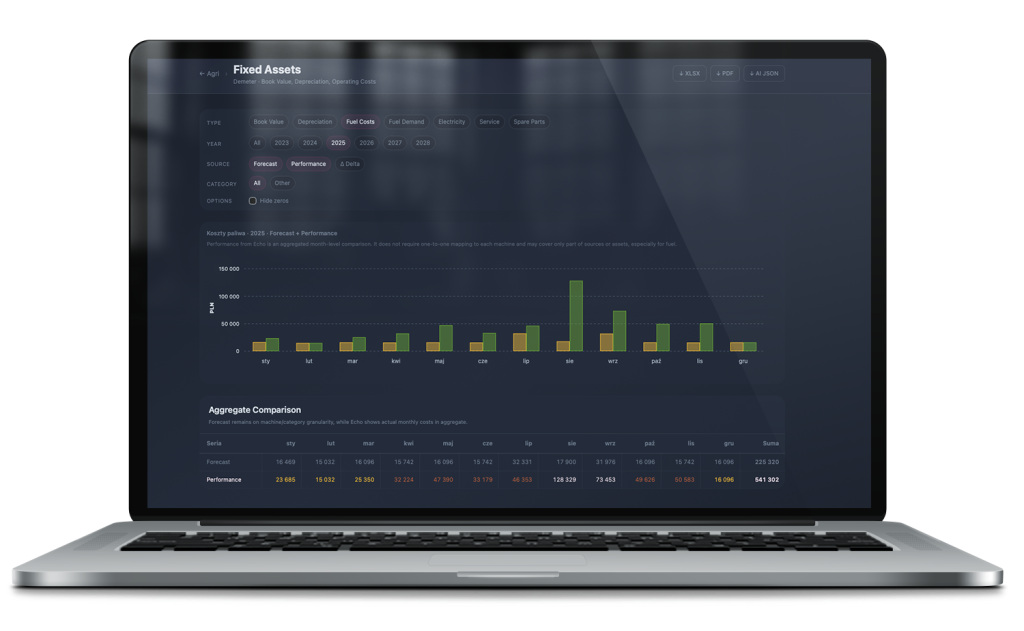
- Fixed Assets — fixed assets register with Forecast, Performance, and Delta modes
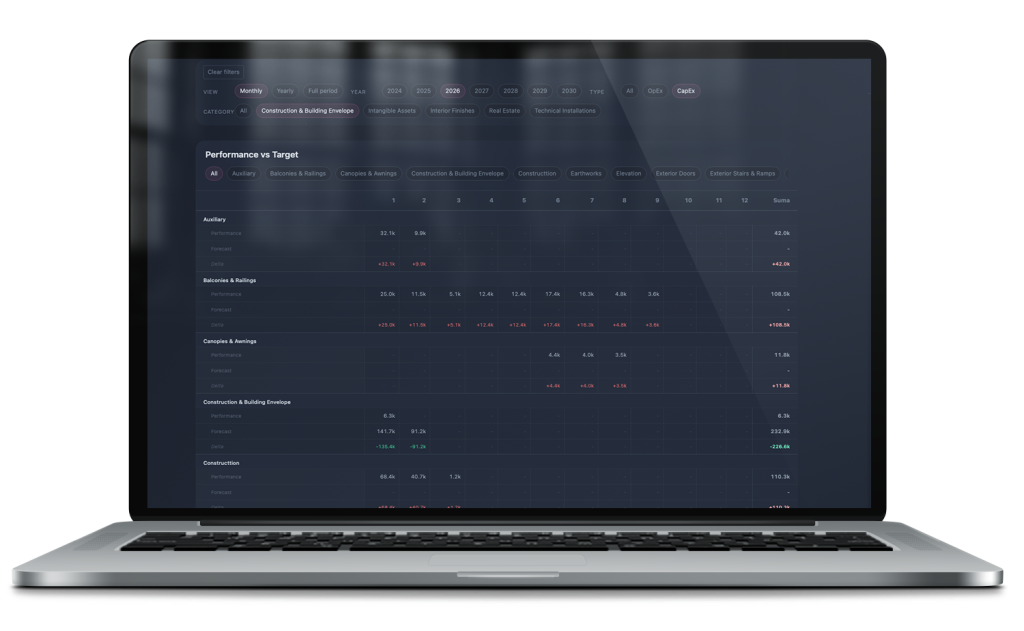
- Performance vs Target — deviation of actuals from plan for each OpEx and CapEx category
Every view updates with each confirmed invoice. There is no on-demand reporting here. There is a picture of the company that simply exists.
Integration with Clio
Echo and Clio solve two different problems and together create a complete picture of the organization.
Echo captures knowledge at the moment an invoice crosses the company’s threshold — a detailed, operational, up-to-date cost layer.
Clio takes this knowledge and distributes it further — management reports, departmental dashboards, budget vs actual comparisons, KPI alerts, documents on SharePoint. There are no exports or copy-paste between them. Data flows automatically through a shared MongoDB database.
Real-time Alerts
Clio continuously monitors the data and signals deviations before they become a problem:
- Overdue invoice
- Budget overrun in a cost category
- Missing data or incomplete assignment
- Cost anomaly deviating from historical pattern
- Forecasted liquidity threshold
- Performance vs plan Delta exceeding the defined limit
- Duplicate invoice
Alerts go directly where the person is: Discord, WhatsApp, Slack, Microsoft Teams, email.
Output Formats
Echo generates documents in formats tailored to the recipient and purpose:
- Excel — detailed cost reports for controlling in a consistent format
- PDF — reports for archiving, distribution, and audit
- PowerPoint — management reports with company branding, ready for presentation
- SharePoint — automatic distribution to the appropriate folders
- JSON / AI Prompt — structured data export ready to be passed to an AI model with precise numerical context: invoices, categories, periods, deviations
Echo as a Foundation for AI
Implementing an AI agent, copilot, or RAG system always starts with the same question: what data should it work on? A company using Echo has this problem solved from day one.
Every invoice confirmed according to the procedure is structured, consistent, API-accessible information about the company’s costs. Instead of scattered files that no one can connect — a ready foundation for language models that can answer specific management questions with numbers, not generalities.
Industry-Specific Variants with Integration to Financial Models
Echo for Agriculture (AgriTech)
Echo integrates with Demeter — the agricultural business simulator. Actual costs of feed, veterinary services, plant protection products, and machinery fleet are automatically compared with norms calculated by the model. The cost of a liter of milk calculated from invoices — not from assumptions.
Echo for Real Estate
Echo integrates with Artemis — the real estate investment management system throughout its entire life cycle. Contractor invoices assigned to bottom-up cost estimate categories. DSCR monitored with every invoice.
Budget execution Delta visible immediately. The Artemis model does not end up in a drawer — because Echo feeds it the reality it needs.
Fixed Assets Register
Echo, together with data from the financial model, tracks every asset individually:
book value, depreciation, fuel costs, energy demand, service, and spare parts. For every machine or property component, for every year, broken down by month.
The view is available in three modes: Forecast, Performance, and Delta. This is a fixed assets register that is not a dead table — it is a living summary connected with actual invoice execution and the financial model that defines what it should cost.
OpEx and CapEx: Performance vs Target
For every cost category — monthly, yearly, or for the entire period — Echo compares actual performance with the financial model and shows the Delta. It works for both operating costs and capital expenditures, with filtering by type, year, and category.
A negative Delta shows where the plan was not met. A positive Delta shows where reality exceeded it. Visible immediately — without building a separate report or waiting for books to close.
Implementation Effect
- Cost data available on the day the invoice arrives — not after month-end closing
- Controlling without involving accounting in delivering management data
- Standardized invoice description procedure automatically enforced by the system
- Performance vs Target for every cost category in real time
- Automatic payment orders and cash flow forecasting
- Fixed assets register connected with actual performance and the financial model
- Ready data foundation for AI agents and RAG systems from day one
- Zero retyping, zero exports, zero waiting
FAQ
Does Echo replace the accounting system?
No. Echo operates in the management layer that precedes accounting. The financial accounting system receives an already described and assigned invoice — ready for posting. Echo and the accounting system solve two different problems and work complementarily.
Do you have to learn a new system?
The user works in Excel — a tool they already know. Echo suggests categorization, the user confirms. There is no new interface to learn or a completely new process to implement from scratch.
How long does implementation take?
Implementation begins with designing the invoice description procedure — tailored to the company’s cost structure and information needs. Implementation time depends on the complexity of the organization and the number of integrations with other systems.
Does Echo work for a company without a financial model?
Yes. Echo provides full management accounting and real-time controlling regardless of other models. Integration with e.g. Demeter adds a layer of comparison with the financial model — but it is not required for the system to function.
Are Echo data available via API?
Yes. The data is stored in Clio, which among other things is a MongoDB database that exposes data via API — enabling integration with external systems, AI agents, and any analytical tools.