


Hebe – Intelligent Operational Recording, Quality Control, and Herd Simulation System for Dairy Farms
The Hebe system is a crucial execution and operational link in the management structure of a modern dairy farm. The tool was designed as a stand-alone application embedded in the Microsoft Excel environment and automated using VBA scripts. This architecture ensures maximum ergonomics and speed of data entry directly on the farm, combining the simplicity of a spreadsheet with powerful computing capabilities.
However, Hebe is not just a digital register – it is an intelligent link between farm physics and advanced business analytics. Through the Clio data bus (MongoDB database / Python API), the application exchanges information with the Demeter system and automatically downloads official cattle performance evaluation data (Fedos/OWUB system).
All operational events, laboratory results, and feeding structures are aggregated and transmitted higher to the Iris interactive visual layer. This allows management and nutrition advisors to conduct extensive reporting and multi-dimensional operational margin control in real time.
2026 Implementation
HEBE – DATA ORCHESTRATION AND ECOSYSTEM SYNERGY
The system operates in full synergy with Origami Effect’s central analytical modules, allowing herd biology to be automatically mapped to financial results.
Automated Integration and Data Transfer (Clio & Demeter)
Thanks to Clio’s centralized architecture, the Hebe operational application continuously collaborates with the advanced Demeter technical-economic model:
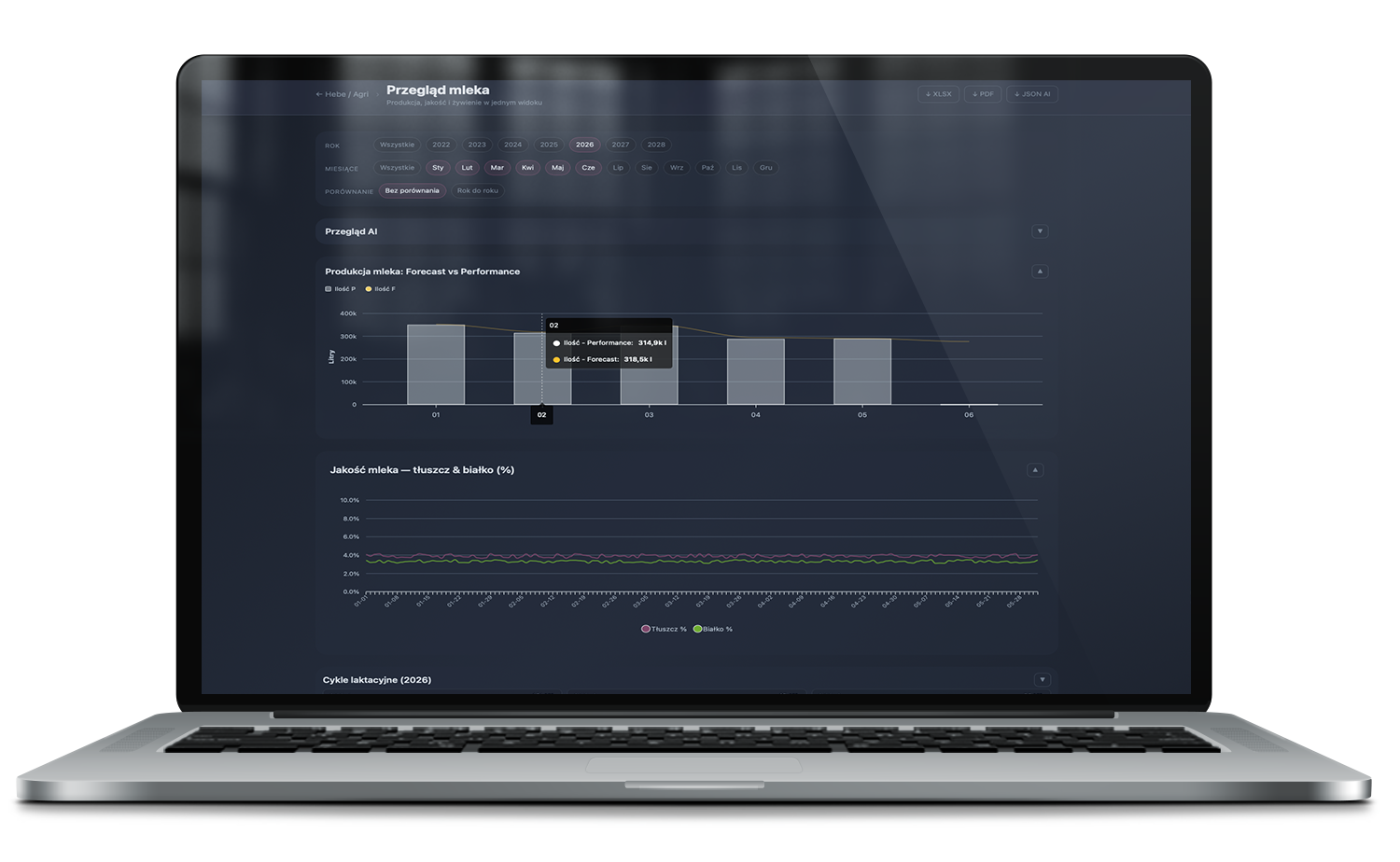
- Production Prediction (Forecast vs Performance): The system imports herd milk yield forecasts for the following months generated by the Demeter engine, cross-referencing them with the actual daily milk yield.
- Bidirectional Nutrition Management: Hebe downloads target formulas and dry matter (DM) requirements from the nutrition technician, while reporting real resource consumption from the feed warehouses in the other direction.
- Automated Import from OWUB (Fedos): The system eliminates manual data entry through a built-in module that downloads and parses official Federation reports, updating cow statuses in real time.
Multi-dimensional Management Reporting in Iris
All data collected at the milking parlor and barn level is distributed to Iris panels, creating a centralized management cockpit:
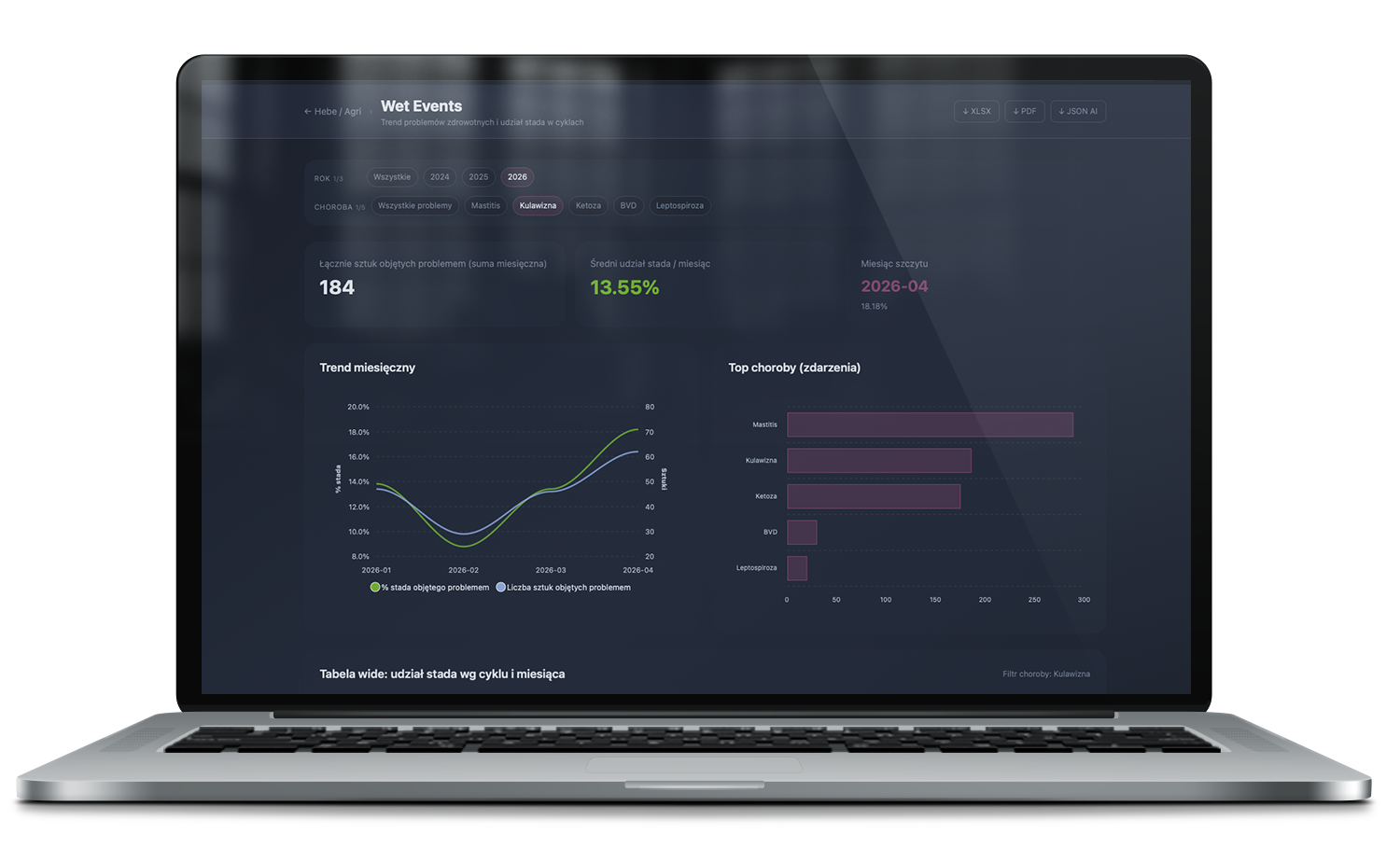
- Herd Health Trends: Precise charts and “wide tables” showing the correlation between lactation cycles and the occurrence of diseases in the herd.
- Milk Costs and Margin: A dynamic comparison of revenues from raw material and livestock sales against the complete cost structure (feed, veterinary care, energy, services).
- Diet Composition Over Time: Visualization of the ration structure (TMR/PMR) and monitoring of the efficiency of feed conversion per liter of milk produced.
HEBE – COW MODULE & HERD STRUCTURE
Precise, real-time reflection of farm physics and biology.
This module forms the foundation of the herd simulator, tracking the full demographic and biological structure of the animals on the farm.
Management of Technological Groups
The system allows for detailed recording of the number of head broken down into specific production and age categories: milking cows (divided into sections), dry cows, heifers (in intervals of 1-2 M, 2-8 M, 9-11 M, 12-26 M), and bulls.
Recording Turnover and Month-to-Month Changes
Hebe records every addition, loss, calving, and movement of animals between technological groups. This data allows Iris to generate dynamic herd size trend charts and precise analysis of count changes over time, which is critical for planning barn space and future production.
HEBE – MILK MODULE & QUALITY CONTROL
Automated parsing of laboratory analyses and monitoring of milking parameters.
This module relieves managers from the burden of manually copying data from dairies and evaluation laboratories.
Laboratory Sample Parser
A VBA script built into the Excel sheet automatically processes raw output files from laboratories testing milk composition. The tool cleans the data, standardizes it, and appends it to the farm’s milking history.
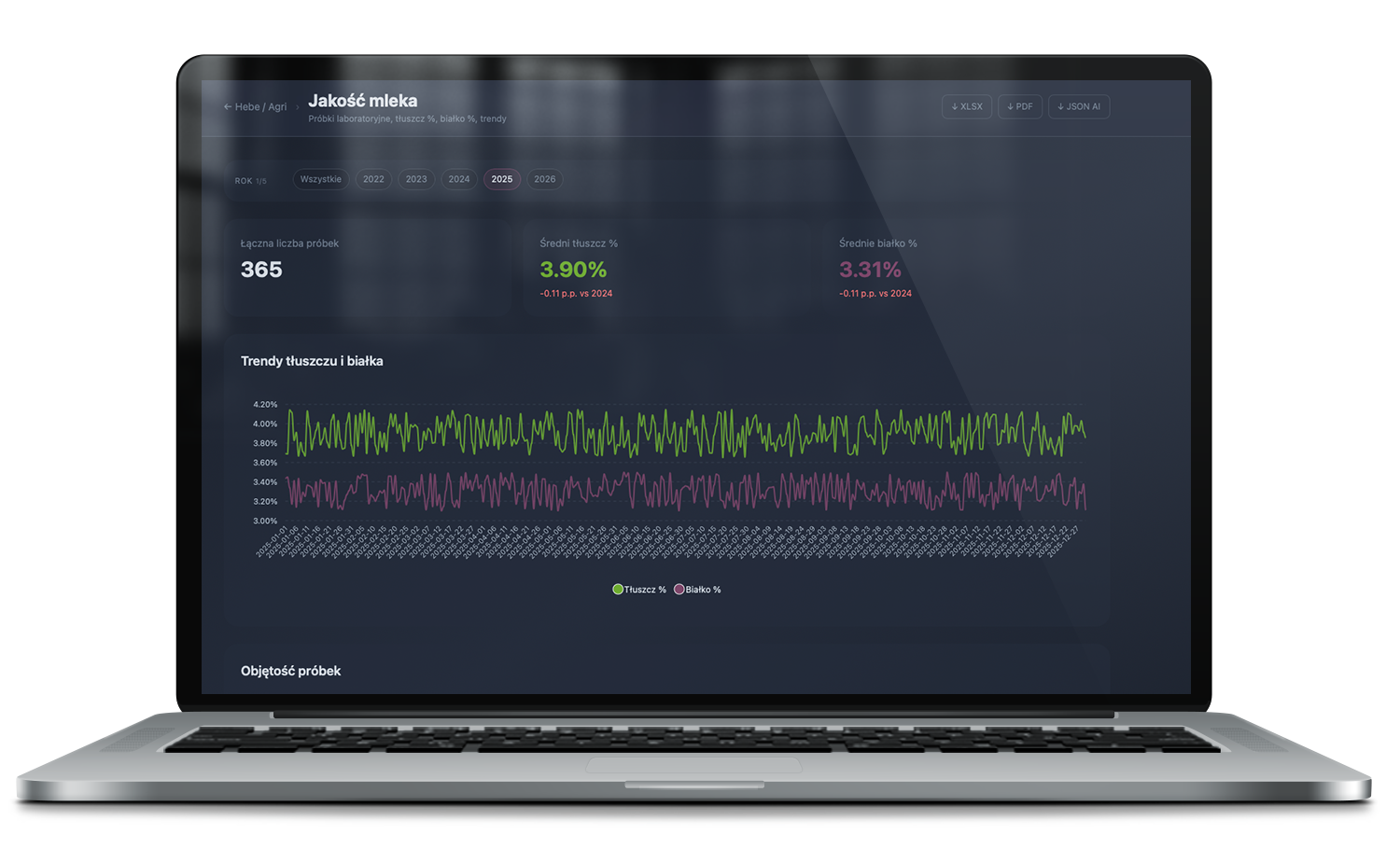
Monitoring Fat, Protein, and Temperature
The system continuously analyzes key technological parameters of the delivered raw material: percentage of fat and protein content (along with percentage point deviation calculations year-over-year), average milk temperature, and total daily delivery tonnage. This data is displayed on a timeline in Iris, enabling quick detection of nutritional errors or problems with the cooling installation.
Financial Settlement and Milk Margin
The module cross-references physically delivered liters of raw material with purchasing price lists and invoices. This allows for the calculation of real revenue from milk and cattle sales, serving as a starting point for calculating the operational margin and profitability of each liter in relation to incurred costs.
HEBE – VETERINARY MODULE & ALERTS
Recording of Health Incidents (Wet Events) and Automated Warning.
Meticulous recording of medical actions and zootechnical treatments combined with advanced herd epidemiological analytics.
Recording Veterinary Events
The application interface allows for quick logging of every health incident. Each event is categorized according to key medical conditions: Mastitis, Lameness, Ketosis, BVD, and Leptospirosis. Records also cover insemination treatments, hoof trimming, and routine protective vaccinations.
Intelligent Veterinary Alerts
Based on the dynamics of operational entries, the system automatically generates alerts about potential health problems in specific groups or lactation cycles. This allows for the immediate isolation of sick animals and implementation of corrective procedures before the issue affects global milking volume.
Disease Trend Analysis in Iris
Synchronized veterinary data creates an advanced analytical matrix within the Iris module. Management and veterinarians can investigate the seasonality of diseases, their percentage share in the herd, and check within a tabular format (“Wide table”) which lactation cycles are most susceptible to specific conditions.
HEBE – NUTRITION & FEED CONSUMPTION MODULE
Precise recording of feeding and complete control over Dry Matter (DM).
This module connects the daily feeding practice of the barn with the advanced strategy of the nutrition advisor.
Consumption Log and Ration Structure (TMR/PMR)
The program maintains a daily record of physical consumption of raw materials and feed components (corn silage, ready-made feeds, beet pulp, grains, molasses, chalk, hay, straw, milk replacer). The system tracks consumption on a monthly and annual basis relative to each technological group of animals.
Integrated Nutrition Technician Panel
Thanks to integration via Clio, the nutrition advisor (internal or external) has direct access to the data. They can define nutritional formulas, control recipe costs, and forecast annual demand for individual ingredients, adjusting the feed structure to current lactation curves.
Inventory Forecasting in Demeter
Actual feeding data recorded in Hebe is instantly transmitted to the **Demeter** system. There, the mathematical engine simulates inventory depletion (e.g., silage silos) and generates a warehouse demand forecast for the coming months, allowing for optimal procurement planning and advance contracting of feed raw materials.
Hebe – Payload Generator for AI Models (JSON AI)
Ready for integration with artificial intelligence models without complex IT implementations.
A unique feature of the system is its ability to automatically consolidate scattered farm data into a single, standardized text file.
Automated Generation of JSON Structure: The system allows you to generate a dedicated file in JSON format (hebe_ai_payload), which collects the complete operational status of the farm for a selected period in one place. The file contains structured data arrays covering herd size, physical-chemical milk parameters, feed consumption, and veterinary incidents.
Optimization for Large Language Models (LLMs): The generated payload serves as a ready-made input for artificial intelligence models. Thanks to its clean data structure (key-value), LLM algorithms can instantly process the information, detect hidden production anomalies, link temperature spikes with drops in milk quality, and generate a ready-to-use, descriptive management report without the need for a data analyst.