

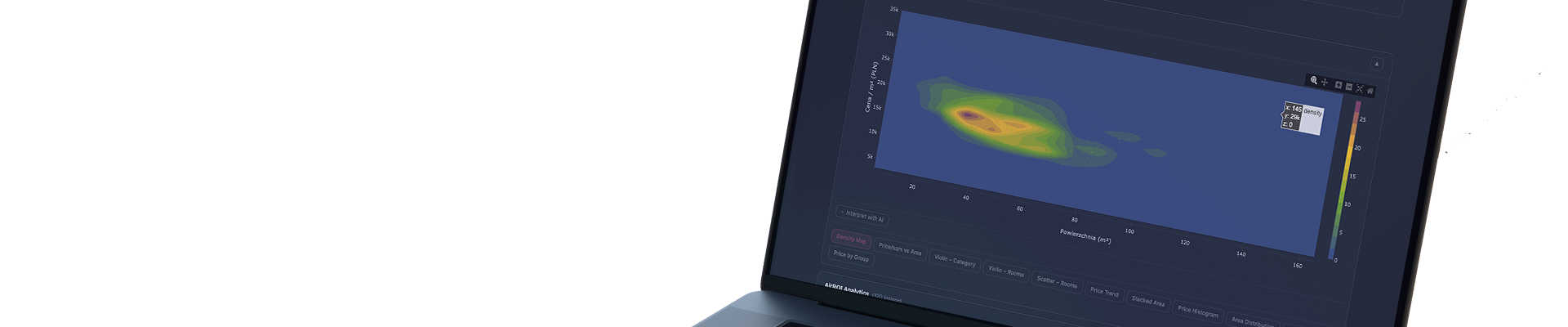
Iris for the real estate market was created from a very specific observation. Investors, funds, and family offices make decisions involving millions of PLN based on PDFs dated a week ago, Excel tables that someone updated before the meeting, and market averages that hide more than they reveal.
The data exists. There are thousands of data points — listings, transaction prices, square meters, occupancy rates, rental income. The problem is not the lack of data. The problem is the absence of a layer that can turn it into a current, interactive, decision-ready picture — without involving an analyst, without waiting for a report, and without opening a file.
Iris is that layer. Powered by one of Themis modules — the real estate market analytical model — it visualizes a living, real-time image of the market.
One screen. 1,951 listings. Historical snapshots. Drill-down to a specific segment. No intermediaries.
The problem solved by Iris · Themis
The real estate market produces a huge amount of data: listing portals, transaction data from land and mortgage registers, Airbnb data, asking price registers. Each source separately is only a fragment of the picture.
The problem is not data availability — it is their dispersion, inconsistency, and the lack of an interpretive layer that can answer specific investment questions: where to buy, in what size, in which district, and at what price — to achieve the expected return.
What reality looks like without Iris · Themis
Investment decisions are made based on general GUS statistics or averages from portals — numbers that are delayed, aggregated, and useless at the micro-investment level.
Analysis of a specific district or size segment requires hours of manual work in a spreadsheet.
Comparing today’s market with the one from a quarter ago requires two separate reports and manual compilation.
Data on short-term rental potential (Airbnb, Booking) lives in a different place than purchase price data — no one combines them into a single view.
A fund, family office, or private investor operates on intuition supported by selected data — not on a complete model.

What Iris · Themis changes
Iris visualizes the Themis model as an interactive dashboard available in the browser — on a phone, tablet, or boardroom screen. Data updates automatically with every new market snapshot. No exports. No refreshing files. No asking “is this the latest version”.
The investor clicks. Drills down. Answers their own questions.
System architecture — how Themis and Iris process data
Layer one: Themis — real estate market analytical model
Themis Real Estate is the central data processing engine. It aggregates property listings from the market, processes, cleans, and loads them into a consistent database on a defined schedule. Each listing is assigned: district, size, number of rooms, total price, price per m², price category, and geographic coordinates.
Themis records the state of the market at historical points — creating snapshots that allow comparison of today’s market with the one from a month, quarter, or year ago.
Layer two: AirROI — short-term rental model
A separate branch of Themis aggregates data from short-term rental listings (Airbnb and similar). For each listing it calculates: ADR (average daily rate), occupancy (%), estimated annual revenue, property type (entire home vs. private room), and geographic location.
This allows direct comparison of purchase cost with real short-term rental revenue potential — based on observed market data, not portal declarations.
Layer three: Iris — React visualization
Iris is an interactive visual layer built in React. It connects to Themis API and renders data as interactive charts, maps, and tables. Every view is responsive — it works identically on a phone and on a 4K monitor in a conference room.
The user doesn’t see the database. They see a market picture ready for interpretation.
API-First — Iris talks to any tool
Every value calculated by Themis is available via API. Dashboards, Excel financial models, internal reporting systems, and investor presentations — all can be powered from one consistent data source.
What Iris · Themis calculates and visualizes
Price/sqm vs Area — where the opportunity is, where you’re overpaying
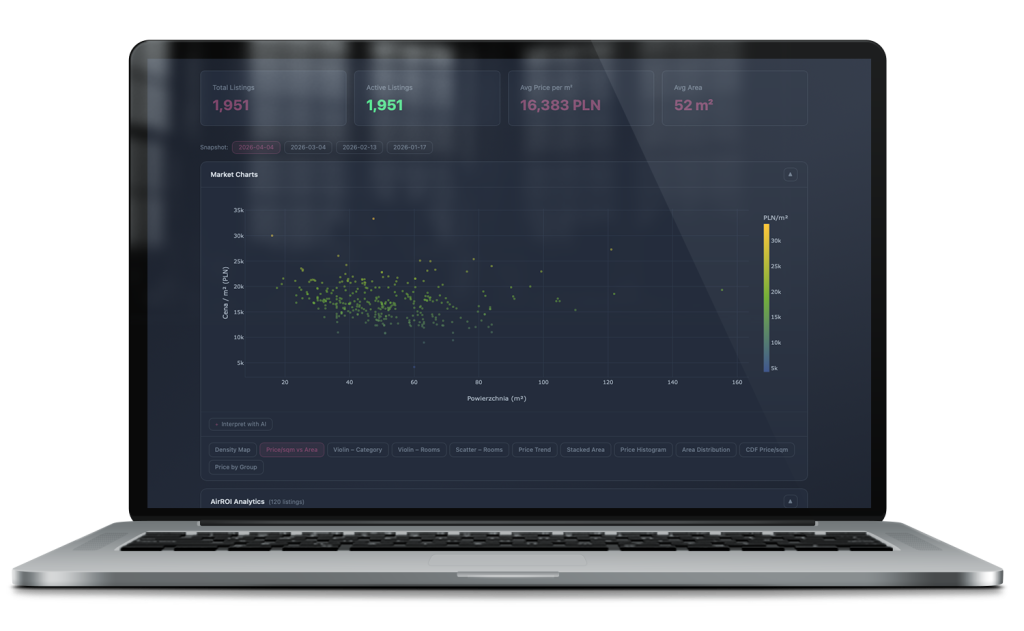
Scatter plot of every listing on the market with three-dimensional data encoding: X-axis = size, Y-axis = price per m², color = price level (viridis scale). Immediately visible negative correlation between size and price per m² — small apartments are expensive per square meter, larger ones cheaper, but the absolute price limits the pool of buyers at exit.
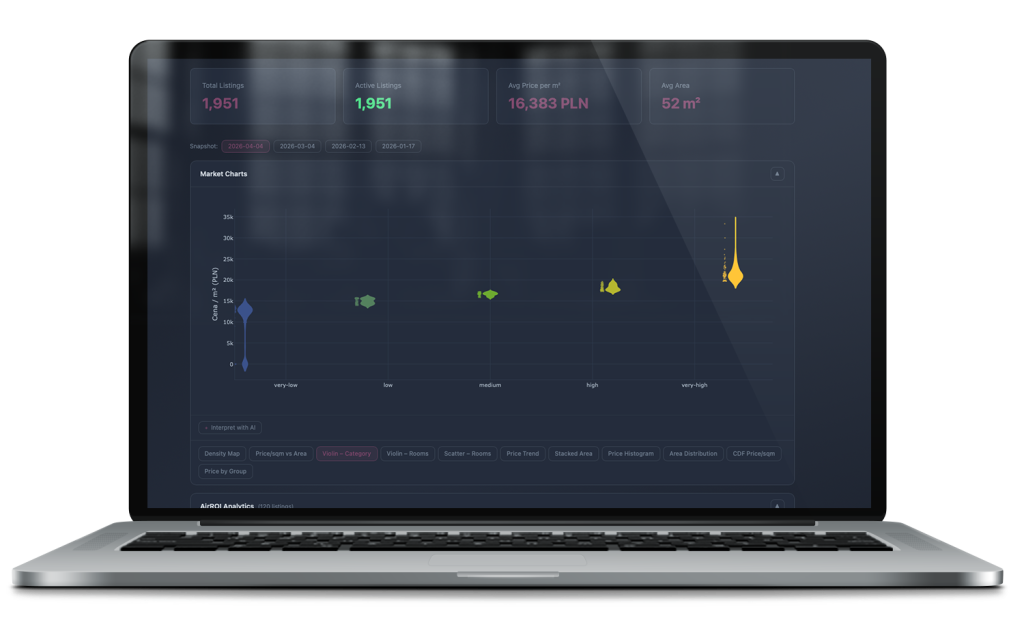
Violin Chart — price distribution by number of rooms (KDE)
Instead of an average bar — a full statistical distribution. Kernel Density Estimation (KDE) for each room segment shows not only the median but how wide the price spread is, where the outliers are, and where the mass of offers is concentrated. The IQR box (Q1–Q3) and median line are visible immediately.
This tool distinguishes homogeneous markets from those with high variability — key when assessing purchase risk in a specific segment.
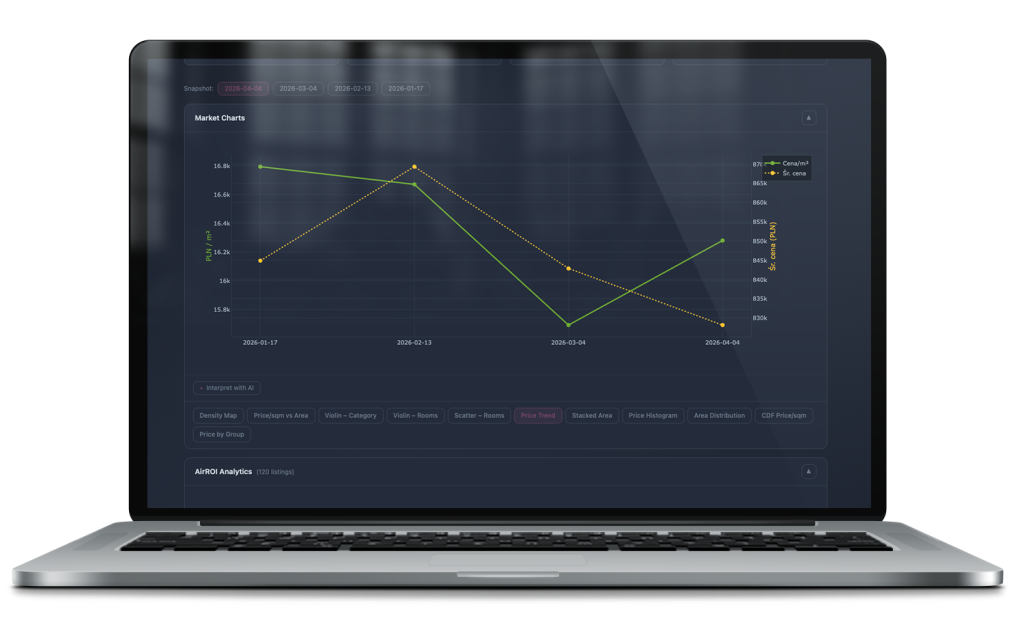
Price Trend — price dynamics over time
Linear price/m² trend for six districts simultaneously, across four time points. You can immediately see which districts are growing faster, where growth is accelerating, and where the market is stable. This is not a forecast — it is the observation of actual price changes between Themis snapshots.
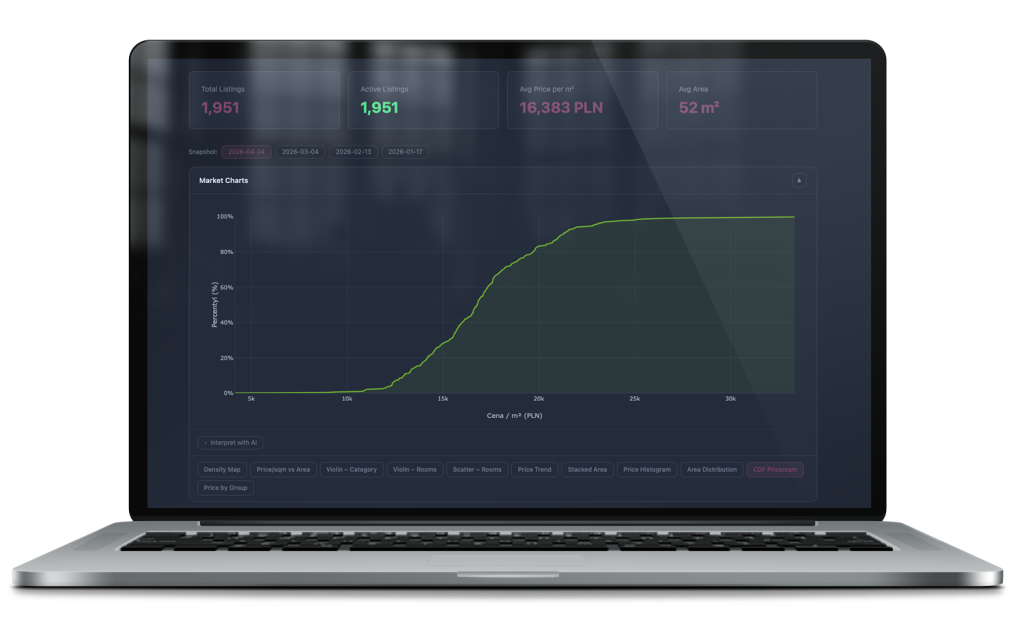
CDF Price/sqm — market percentiles
The empirical cumulative distribution function (CDF) answers one of the most important investment questions: what percentage of the market is below a given price? Reference lines P25, P50, P75 are visible immediately. Buying below P50 means that at exit, more than half of the market buyers have the budget for this property.
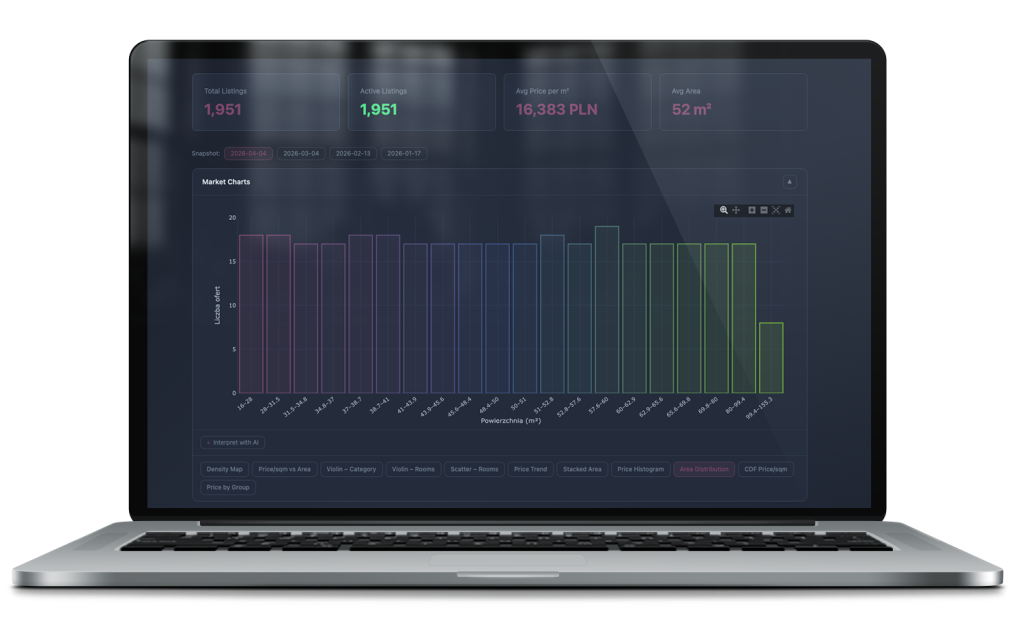
Area Distribution — market depth by size
Size histogram shows where supply is concentrated. The 35–60 m² segment represents over 60% of the market — maximum liquidity at exit. The right tail signals the rarity of large units and their lower transactional liquidity.
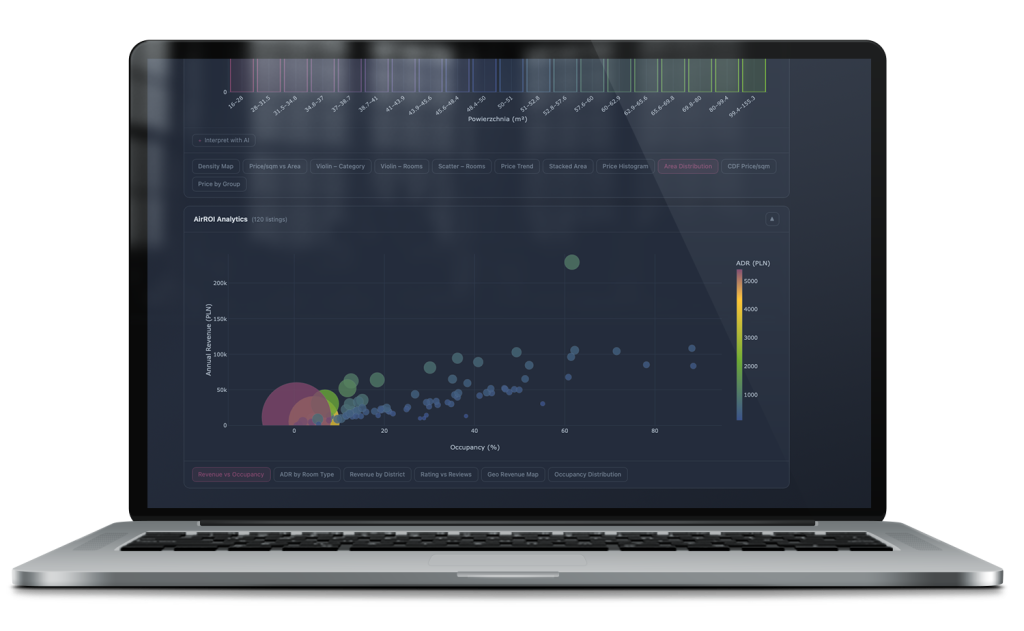
Revenue vs Occupancy — AirROI bubble chart
Three-dimensional bubble chart: X-axis = occupancy (%), Y-axis = annual revenue (PLN), bubble size and color = ADR (average daily rate). Three clusters are immediately visible: high occupancy + high ADR (top performers), middle (optimization potential), and those that don’t earn. High ADR without occupancy does not generate return — this chart proves it empirically.
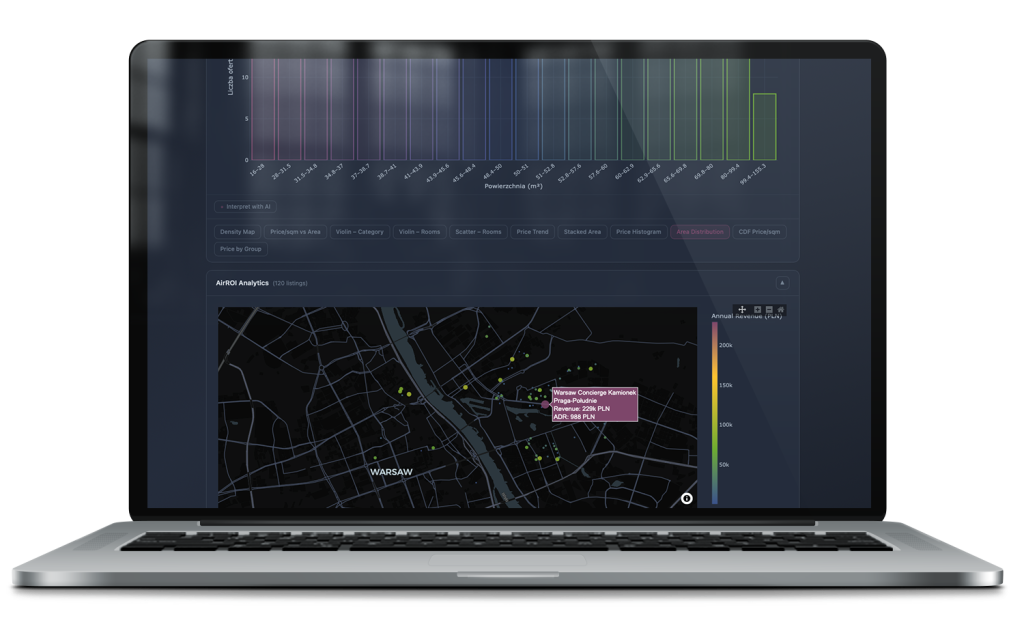
Geo Revenue Map — geographic revenue map
Every listing plotted on the Warsaw map with color encoding annual revenue (color scale). Immediately visible where the highest-revenue listings are geographically concentrated — and where an address looks good on paper but the STR market doesn’t reward it.
Historical snapshots — the market over time
Themis records the state of the market at specific moments. Iris allows switching between snapshots with one click — and instantly comparing today’s market structure with the one from a quarter ago.
You can see which districts have accelerated, where new listings appeared in previously empty segments, and how price percentiles have changed. This is a tool for the investor who wants to see the trend before the competition does.
AI Layer — Iris explains what you see
A chart without context is just a shape on the screen.
Iris has a built-in AI layer that does not replace the analyst — it complements them. For every view there is an “Interpret with AI” button. The system analyzes the currently displayed data and formulates a natural language interpretation: what this distribution means, what anomalies are visible, and what to pay attention to before making an investment decision.
The AI in Iris does not answer general market questions. It responds based on the data it currently sees — specific listings, a specific snapshot, a specific district.
Implementation effects — what changes in practice
- Investment decisions in minutes instead of weeks. Data that previously required a week of analyst work is available immediately, in one view, ready for interpretation.
- No more decisions based on averages. Iris shows the full price distribution — not just where the average lies, but how wide the spread is and where the outliers are. This is a fundamental difference in risk assessment.
- Real-time verification of investment theses. “Praga is undervalued and will grow” — this is no longer just a thesis. It’s a hypothesis. Iris allows it to be verified with hard data: growth pace vs. other districts, market depth, STR potential.
- Short-term rental ROI without guessing. AirROI data combines location with real rental income. The investor sees not “potential” — but actual results of listings in the same location.
- One view instead of three reports. Purchase market data, STR data, and historical trends in a single interface. No combining files, no asking an analyst for a compilation.
FAQ
Where does the data in Themis come from?
Themis aggregates data from publicly available sources and data provided by Origami Effect clients. The data is processed, cleaned, and loaded into a central MySQL database in automatic cycles. Every snapshot is archived — enabling trend analysis over time.
Does Iris require replacing the existing ERP or system?
No. Iris connects to the data you already have. The ERP remains the recording system. Iris becomes the visual layer that turns this data into an accessible picture without logging into the ERP.
Does Iris work on a phone?
Yes. Iris is built in React with a responsive layout. It works identically on a phone, tablet, and boardroom monitor. The same view, the same interactivity, without a dedicated mobile app.
Does Iris replace the analyst?
No. Iris removes the bottleneck between data and decision — but does not replace expert judgment. The analyst stops spending 80% of their time preparing visualizations and 20% interpreting them. Iris reverses these proportions.
Iris is everywhere there is data
Themis is one of the systems Iris supports. The same philosophy extends to anything that produces data.
Quantis — operational analytics for import companies, ML demand forecasting and inventory management.
Artemis — interactive DCF with scenarios for investment projects.
Demeter — farm controlling with accuracy no other system on the market offers.
Every system that produces data can have its own view in Iris. Every owner, board, CFO, and investment committee can see what matters — without involving an analyst, without waiting for a report, without opening a file.