


Capital Transaction Financial Model – Support for Companies in Raising Investor Capital
In many companies, there comes a moment when further development requires raising capital from external sources. This may be a financial investor, a VC fund, or an industry partner who brings not only funds but also know-how, business relationships, or technology.
To conduct a professional investment process, it is essential to prepare:
- A financial model – showing investment efficiency, valuation, profit projections, cash flow, and return on capital (IRR).
- A business plan and financial forecasts – defining how the capital will be used and the expected outcomes.
- An investment proposal – containing the proposed share price, transaction structure, and possible investor exit scenarios.
As Interim CFO, I prepare complete capital transaction models that:
- Reflect all possible investor entry variants (new share issue, share buyback, capital increase, contribution in kind),
- Take into account changes in ownership structure (cap table) at every stage of the investment,
- Show the impact of earn-outs, conditional issuances, and new valuations on share value,
- Forecast tax consequences, cash flows, and mechanisms to protect the interests of both parties.
The sample model enables:
- analysis of changes in ownership structure (cap table) over time,
- comparison of shareholders’ share values before and after the investment – at a given valuation,
- precise calculation of dilution and its impact on share value,
- simulation of the effects of conditional issuances, earn-outs, contributions in kind, and performance bonuses,
- preparation of consistent data for investment term negotiations and investor presentations.
The model is not used for company valuation, but is an invaluable tool for discussions on how valuation affects shares and the interests of all parties.
The following model concerns a limited liability company with at least two shareholders and assumes various investor scenarios:
- Scenario 1 – buyback of shares from one shareholder
- Scenario 2 – new share issue and capital increase
- Scenario 3 – earn-out mechanism and bonus for achieving KPIs
- Scenario 4 – analysis of share value at every stage of the transaction
The investor enters the company by acquiring part of the existing shareholders’ shares, which means a change in ownership proportions, but without affecting the share capital or the company’s cash position.
The charts show:
- The new shareholder (e.g. Shareholder A) receives 20% of the shares.
- The remaining shareholders (B and C) have reduced shares (e.g. from 29% to 23%, from 51% to 41%).
- The company’s capital does not change, but the ownership structure does – important when analyzing the impact on voting and ownership decisions.
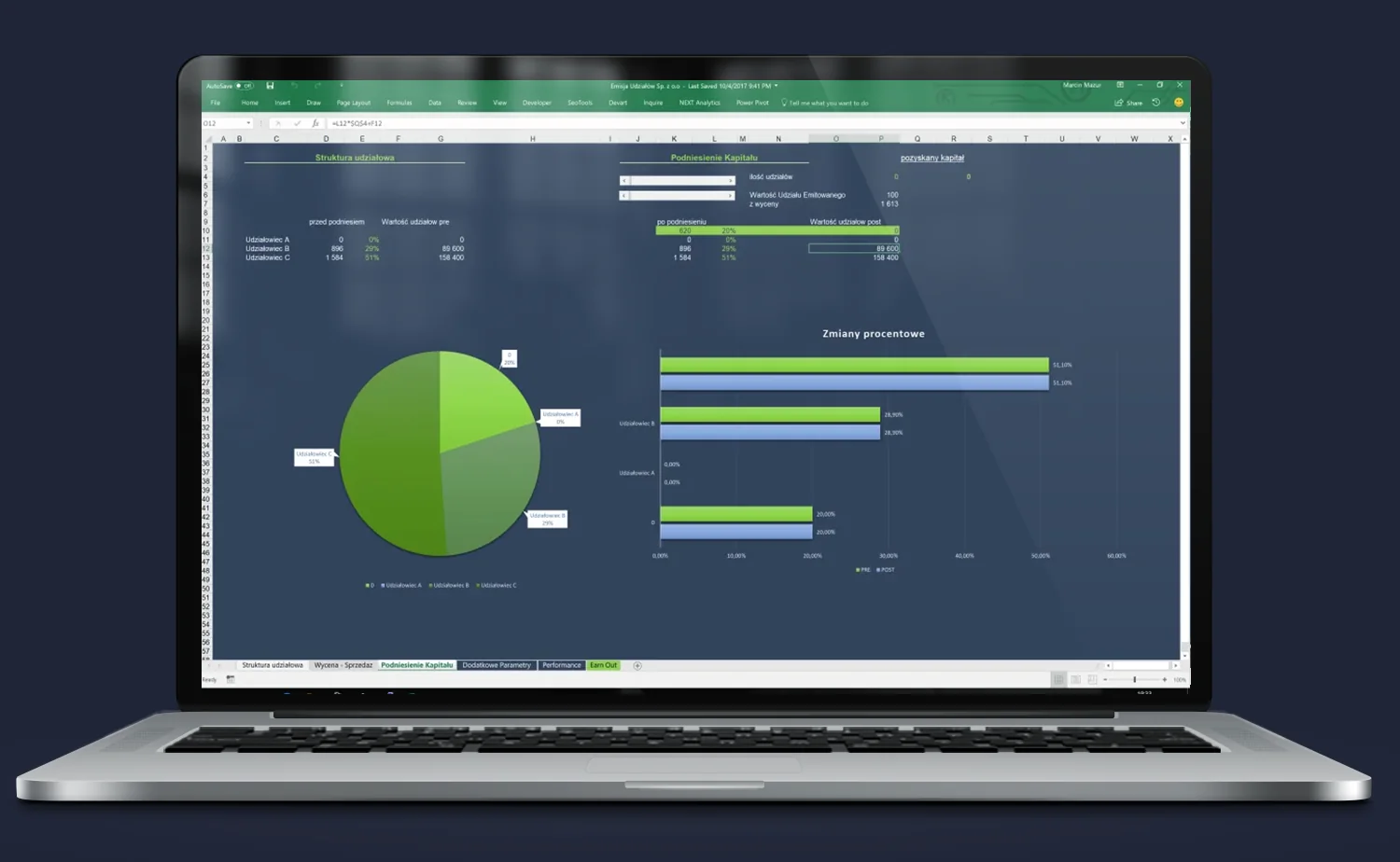
Capital increase by the investor
The following screen shows the situation after the investor subscribes for shares as part of a new issue, i.e. capital increase, contributing cash to the company.
- New share issue (e.g. 777 shares) increases the total number of shares.
- The investor subscribes for these shares at the agreed valuation – new capital is raised (e.g. 1,181,040 PLN).
- The remaining shareholders are diluted proportionally to the issue (their percentage shares decrease).
- The company gains new financial resources that can be used, for example, for development, expansion, R&D or hiring.

At this stage the model allows:
- Analyze the dilution effect, but also the effect of increasing share value.
- Calculate the raised capital that affects the company’s further operational capabilities.
- Show the investor and shareholders how their position will change – and under what conditions it is beneficial.
New valuation before the issue – starting point for Earn Out
This screen shows the moment when the company reaches a valuation of 30.8 million PLN, but before granting the investor additional shares under the Earn-Out.
At this stage:
- The ownership structure remains unchanged – both the investor and existing shareholders retain their shares without changes.
- The value of the shareholders’ shares is updated according to the new valuation.
- The tool enables easy comparison of share values before and after achieving the target.
This is the moment when the joint success is measured – before the investor receives their reward in the form of new shares.

Completed issue – investor rewarded for success
The second screen shows the final stage of the process – after the new share issue for the investor, which is the reward for achieving the agreed goal (Earn-Out).
What has changed:
- The investor receives additional shares without the need for another contribution, as part of the agreed arrangement.
- Existing shareholders are proportionally diluted, but the value of their shares continues to grow thanks to the 30.8 million PLN valuation.
- The changed ownership structure is clearly visible, with a precise division of shares and value after the issue.
This is the stage where the real sharing of the reward for the achieved result is visible – transparent, fair, and beneficial for all parties.

Do you need someone who instantly understands the problem — and knows what to do with it?
Most companies have data. What’s missing is the idea of what to do with it — and someone who will actually execute it. Origami Effect provides both.