

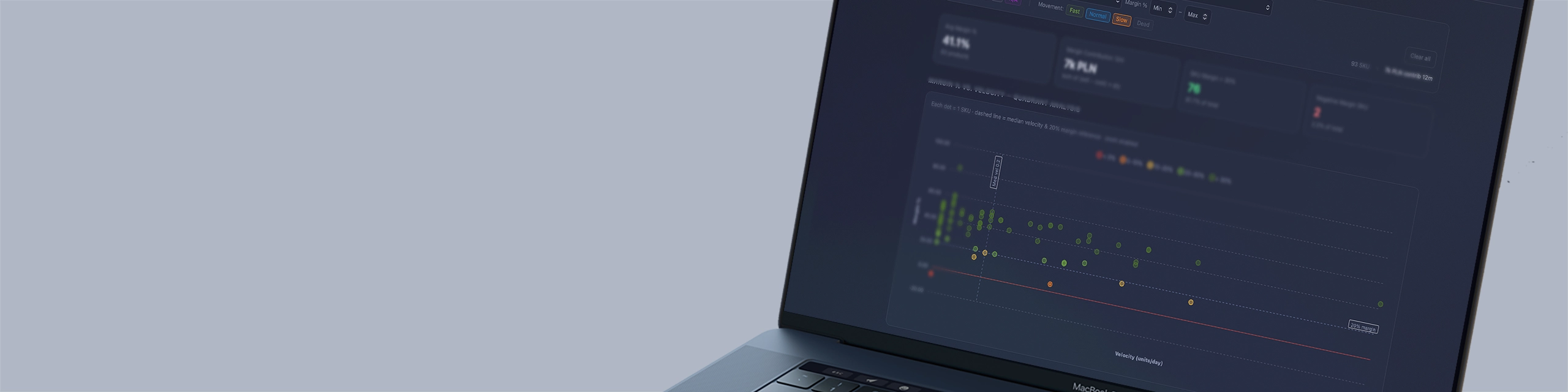
Quantis — Central Analytical and Predictive System for Import Companies
Quantis was born out of a very specific frustration. Out of moments when real-money decisions had to be made based on data that was incomplete, inconsistent, or simply not available in time. Not due to a lack of data — but due to the lack of an architecture capable of meaningfully connecting and processing it.
The system now functions as the central analytical engine for an import company. It connects data from the ERP, automates demand forecasting, generates operational alerts, and supplies every department of the company with the same consistent numbers.
The Problem Quantis Solves
Import companies build years of transactional history in their ERP system. Thousands of products, hundreds of customers, millions of documents. The data exists. The problem is that it is trapped.
A standard ERP was designed for record-keeping — not for analysis. Every attempt to extract real insight ends the same way: exporting to Excel, hours of VLOOKUPs, and decisions based on week-old data.
What reality looks like without Quantis
Purchasing decisions are made based on gut feeling or simple sales averages.
Reports are calculated manually — and by the time they reach the right person, they are already outdated.
Stockouts are discovered when a client calls asking where their order is.
Promotions and discounts are planned without knowing whether they actually drive sales — or just destroy margin.
Every department has its own spreadsheet. No one knows which numbers are true.
What Quantis Changes
Quantis does not replace the ERP. It connects to its data and turns it into a living, predictive analytical platform — without months-long implementations or infrastructure replacement.
From dead data to data that earns money.
System Architecture — How Quantis Processes Data
Hybrid Data Sources
Quantis is fed from two layers that together create a complete operational picture of the company.
Layer One: ERP (Direct SQL Access)
Hard transactional data pulled directly from the database: sales, stock levels, product records, customers, purchase and sales documents. Data updates automatically in a nightly cycle — no exports, no manual copying.
Layer Two: Smart Excel Layers
Everything missing from the ERP — defined in Excel spreadsheets by the user. Custom product attributes, alert thresholds, seasonality, classification rules, custom categories, logistical parameters. Quantis pulls this data and integrates it with the database in every analytical cycle.
One Central Data Model
The result of combining both layers is one consistent data model. Sales, warehouse, logistics, and finance all operate on the same numbers. Every department sees the same reality — not their own version of the truth from their own spreadsheet.
API-First — Quantis Talks to Every Tool
Every value calculated by Quantis is available via API. Dashboards, Excel applications, reporting systems, team calendars — all fed from a single source. Data processed by Quantis does not end its journey in the database. It powers the tools the company already uses.
What Quantis Calculates — Logic That ERP Lacks
Demand Forecasting at SKU Level
Quantis forecasts sales for every product and every customer individually. Not based on a global average — but on history, trend, seasonality, and the behavior of similar customers.
Two Machine Learning models work in parallel:
Facebook Prophet — detects seasonality and trends. Handles anomalies and data gaps. Best for products with a clear annual rhythm.
XGBoost — advanced decision trees. Automatically analyzes multiple product features at once. More effective for dynamic categories without regular seasonality.
The forecast is generated on a monthly basis — 12 or 24 months ahead. It updates automatically without user involvement.
Dynamic ABC Classification and Movement Class
A standard ERP classifies products once per quarter, manually. Quantis does it daily — and bases it on market behavior, not just turnover. A product that suddenly loses momentum is reclassified before it becomes a warehouse problem.
Velocity in Time Windows
Quantis calculates sales velocity in 30, 90, 180, and 360-day windows — with dynamics and seasonality. This shows not only how much a product sells, but whether it is selling faster or slower.
Econometrics and Price Elasticity
The system uses statistical regression to answer the question: how will a price change of X percent affect sales volume? This is mathematics that no standard ERP module has.
Promotion and Cannibalization Analysis
Quantis automatically calculates the real Lift% of every promotional action. It identifies products that respond to discounts — and those that sell the same without them. It detects promo fatigue before the promotional budget starts burning. It checks whether a promotion on one product destroyed sales of another higher-margin SKU.
ML Segmentation (KMeans)
ERP groups products by brand or category. Quantis groups them by market behavior. It sees sales similarities that are invisible in the category tree — and builds recommendations based on that.
Alert System — Quantis Reacts Before Problems Appear
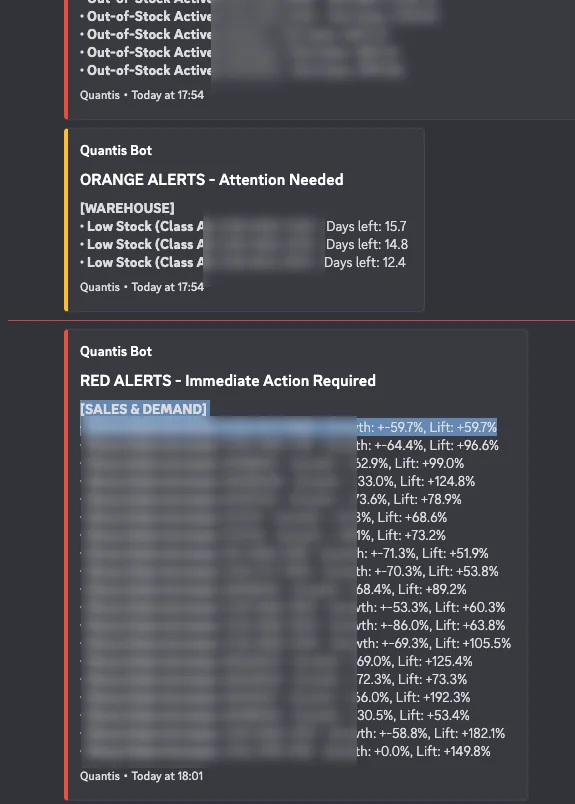
Quantis doesn’t just process data. It monitors it according to defined business rules and triggers notifications before a problem becomes visible to the naked eye.
Four Layers of Monitoring
Warehouse and Inventory — Critical stock levels, stockouts, low stock of A and B class products, risk of depletion before the next delivery.
Sales and Demand — Sudden spikes and drops in sales, products unresponsive to promotions, early signals of seasonal peaks.
Capital and Cash Flow — Margin burn, product cannibalization, slow-moving inventory, capital tied up in products that aren’t selling.
Business Risk — Over-dependence on a single customer, discount-heavy portfolio, fragile growth without solid foundations.
Intelligent Distribution — No Spam
Every alert receives a priority flag: RED, ORANGE, or YELLOW. The system automatically recognizes what is new, what has changed, and what is no longer relevant. Each alert has a unique signature — no duplicates, no information noise.
Alerts go where the people are — not where they have to log into the system.
Quantis integrates with Slack, Microsoft Teams, Discord — and any other communication channel the company already uses.
Quantis Ecosystem Modules
Quantis is the foundation — the central database and computational layer. Built on it are specialized modules, each designed for a specific role in the company.
Quantis Logistics — Order and Inventory Management
An Excel VBA application built on Quantis data. Order planning, inventory management, replenishment forecasting. Generates ready-to-send orders with email, PDF, and XLS for the supplier — in minutes instead of hours.
→ Learn more about Quantis Logistics
Quantis Next Best Actions — Recommendations for Salespeople
A recommendation engine that generates a personalized action queue for each salesperson every day. What to offer, to which client, in what order, and why. Based on churn risk, cross-sell opportunities, and product fit.
→ Learn more about Next Best Actions
Iris — Interactive React Dashboards
Analytical dashboards powered by the Iris API prepared by Origami Effect. Role-specific views: owner, salesperson, logistics, controlling. Real-time data without logging into the ERP.
Clio — Automated Reporting
Archiving and reporting system. Automatic generation of PowerPoint, PDF, and Excel reports — based on data from Quantis and other systems, without manual work.
Metis — Financial and Operational Model
The decision-making center for an import company. Simulations, scenarios, and financial planning based on hard operational data from Quantis.
Implementation Effects — What Changes in Practice
Quantis is not theory. It is a tool whose effects are visible in concrete operational decisions.
Less capital frozen in inventory. SKU-level demand forecasting replaces ordering based on intuition. The company buys what it needs — not what it feared would run out.
Detecting sales drops before they become a problem. The system signals deviation from the norm before the client calls asking where the goods are.
No more burning through the promotional budget. It is known which products respond to discounts and which sell the same without them.
Automation instead of hiring. Processes that currently take dozens of hours per week happen automatically in the background.
Purchasing decisions a day earlier. Not when the shelf is empty — but when the system says there will be a problem in eight days.
Technology — What Powers Quantis
| Layer | Technology |
|---|---|
| Programming Language | Python |
| Database | MySQL |
| ML Forecasting | XGBoost, Facebook Prophet |
| User Interface | Excel VBA, React (Iris) |
| ERP Integration | Comarch ERP Optima (Direct SQL) |
| Notifications | Slack, Microsoft Teams, Discord |
| API | REST, JSON |
| Update Cycle | Automatic, nightly |
Who Stands Behind Quantis
Quantis is a tool designed by someone who understands business from the inside — with experience in investment project execution on the fund side. Every module answers the questions asked when real money is at stake — not what can be shown in a nice chart.
Implementing Quantis means working directly with the system’s creator. Not with a consultant who has read the documentation. With someone who understands both the technology and the business behind it — and knows that a good system is not the one with the most features, but the one that solves the right problems for the right people.
FAQ — Quantis
Does Quantis replace the ERP system?
No. Quantis works in parallel with the existing ERP — connecting to its data via direct SQL access. It does not require infrastructure replacement or data migration. The ERP remains the system of record. Quantis becomes the system of analysis and decision-making.
Why is Quantis a hybrid solution (Python + Excel)?
Because advanced analytics requires serious computing power, while business management needs flexibility. Locking predictive models in closed software cuts the user off from influencing the algorithms.
In Quantis, these two worlds are combined. Heavy mathematics, ML forecasting, and automatic processing of millions of rows from the ERP happen in the background in Python — operations too demanding for regular spreadsheets. Excel, on the other hand, serves as the operational interface and tool for entering custom business rules.
This allows logistical and analytical parameters to be defined in a familiar environment, while the Python engine immediately integrates this data with the database and turns it into ready forecasts and analyses.
What data is needed to run Quantis?
Quantis uses transactional data available in any standard ERP: sales history, stock levels, product and customer records, purchase documents. The longer the history, the more accurate the ML forecasts.
Does Quantis work only with Comarch ERP Optima?
Quantis was created for a leading import company. The current version is integrated with Comarch ERP Optima via direct SQL access. The system architecture allows integration with other ERP systems — the scope of adaptation work depends on the structure of the specific database.
Does Quantis require specialized IT support?
No. The system is designed so that business users — salespeople, logisticians, owners — can use it without technical knowledge.
Configuration and parameters are defined in Excel spreadsheets. The technical layer is handled by Origami Effect.
How long does Quantis implementation take?
Implementation is much shorter than replacing an ERP. Quantis does not require changing operational processes — it extends them with an analytical layer. Implementation time depends on the scope of modules and the quality of historical data in the client’s ERP.
What does cooperation with Origami Effect look like after system implementation?
The project does not end when the code is launched. Every solution at Origami Effect is created with the assumption that we build only tools we ourselves would like to use every day — without compromises and without mass templates. Every system is treated with craftsman-like attention to detail, like our own venture that must work exceptionally well and genuinely build company value.
Experience gained from working on the investment fund side has shaped the principle that a strong business needs constant access to the best, clean data. That is why after implementation, Origami Effect remains a long-term technical partner. The system is continuously monitored, optimized, and developed together with the company. Quantis is not a project that gets closed and put on a shelf — it is a living tool that grows and adapts to the changing physics of the market.
How does Quantis send alerts?
Alerts are delivered to the communication tools the company already uses: Slack, Microsoft Teams, Discord. Each alert is assigned a priority (RED, ORANGE, YELLOW) and sent to the appropriate department. The system does not create duplicates — every signal is unique and up-to-date.
Can Quantis forecast sales of new products?
ML forecasting works best for products with established transactional history. For completely new items in the portfolio that do not yet have their own historical data, standard mathematical models need a reference point.
In such cases, Quantis can rely on similarity analysis to products in the same category and patterns of behavior of similar customer groups.
To dive deeper into this process and estimate the potential of new products as accurately as possible before launching them, feel free to ask Origami Effect about dedicated Themis solutions — a module created specifically for advanced market and product analysis, focused on mapping connections and consumer behaviors within the same product groups.
Do you need someone who instantly understands the problem — and knows exactly what to do with it?
Most companies have data. What’s missing is the idea of what to do with it — and someone who will actually execute it. Origami Effect delivers both.