


FarmWise – Intelligent Financial Management of a Farm
FarmWise is an advanced MFO (Financial-Operational Model) class system, designed for farm owners who want to make all decisions based on data, not assumptions. It is the 190th implementation in the field of financial modeling by Origami Effect and was created in 2024.
This is a solution for the most demanding users. It covers every part of the farm: from fields and herds, through fertilizers, fuel and leases, to subsidies, cash flow and asset valuation.
FarmWise is not just a budgeting or financial analysis tool – it is the decision-making center of the farm, allowing you to run the business like a modern enterprise.
Investment decisions based on hard data
- impact of new equipment on unit cost – e.g. how much a ton of grain or a liter of milk costs you now,
- fuel consumption costs, spare parts, service and maintenance,
- financing scenarios: cash, operating lease, financial lease, credit,
- impact on cash flow, profitability and cost structure – globally and for a specific segment: feed, milk, crops.
Modernizing the milking parlor? FarmWise will show you how much you will really gain
- energy consumption, service, spare parts,
- electricity demand and its impact on monthly costs,
- impact on the cost of a liter of milk – before and after replacement,
- different forms of financing and their impact on cash flow.
And if you are planning photovoltaics – the RES (Renewable Energy Sources) module will tell you:
- how much energy you will produce and how much you will consume in the milking parlor and cooling room,
- how much electricity bills will drop,
- when the investment will pay off,
- how the cost structure of dairy production will change.
Analysis of any scenario in a few minutes
Statistical modules – cow health and loss forecasts
- treatment vs vaccination,
- cost of milk loss vs cost of prevention,
- and choose the option that minimizes losses and optimizes the cost of a liter of milk.
Crops, subsidies and machinery fleet in one plan
- availability and efficiency of machines,
- subsidy structure and type of crops,
- impact of decisions on gross margin, EBIT and cash flow.
Controlling at a level unmatched in the industry
- predicts results before problems arise,
- controls budget and operating costs with engineering precision,
- tests “what if” variants based on real data,
- values the farm reliably – ready for talks with an investor or bank.
The foundation of strategy and operational control over the farm
- cost and margin controlling broken down by departments, crops and animals,
- profitability analysis of every investment — with a dynamic CAPEX/OPEX model and depreciation,
- liquidity planning — taking into account inflows from subsidies, loans, leases and sales,
- forecasting debt and financing structure over time,
- management and operational reporting — ready for meetings with an investor or bank,
- full asset valuation — both accounting and market (adjusted book value),
- assessment of resource efficiency — land, people, machinery and buildings,
- crop and feed production planning based on actual herd demand,
- inventory control — feed, fertilizers, straw and plant protection products,
- scenario analysis: changes in grain prices, fertilizer costs, subsidies or digestate availability,
- integration of data from OMS and SmartField systems — without the need to log in elsewhere.
Straw, fuel, working hours – everything under control
Straw:
- predicts demand for bedding and feeding based on the herd,
- calculates production from each field and yield,
- compares needs with production – you know whether to buy, sell or increase acreage.
Fuel and machinery:
- the model knows fuel consumption standards, working hours and labor costs,
- compares planned data with actual data – and immediately detects deviations (e.g. too long plowing or excessive diesel consumption),
- this is operational controlling – in real time.
A financial model with no equivalent
Global Data module in the Agro section
collects key data on crops, yields, fuel and fertilizer requirements, and external agricultural services. It provides the basis for financial and operational analysis for individual crops and the entire farm, enabling cost optimization and forecasting future results based on real data.
Detailed information on yields for different crops, broken down by:
- Minimum and maximum yields to be achieved
- Crop type (winter/spring).
- Seasonal harvest data.
Example: Wheat – min. yield 5 t/ha, max. yield 11 t/ha, winter type, harvest season – July.
Losses due to poor storage:
- Estimation of losses in feed and other materials resulting from improper storage, which affects the actual cost of production.
- Example: Losses in year 1 to 5 amount to 5% for triticale, 0% for corn silage.
Costs of external services for straw production:
- Data on external services related to straw production, fuel requirements for transport, harvesting and other operations.
- Example: Cost of straw harvesting service per bale, fuel requirement per hectare for
Straw production and its demand in crops:
- Data on straw production and demand, including straw-to-yield conversion ratios.
- Information on price, length and demand for netting for bale wrapping, allowing for planning of straw packaging costs.
- Examples: Straw-to-yield ratio for wheat – 0.35, for corn silage – 0.35. Netting price for wheat wrapping is 335 PLN in year 1, demand 16.6 m.
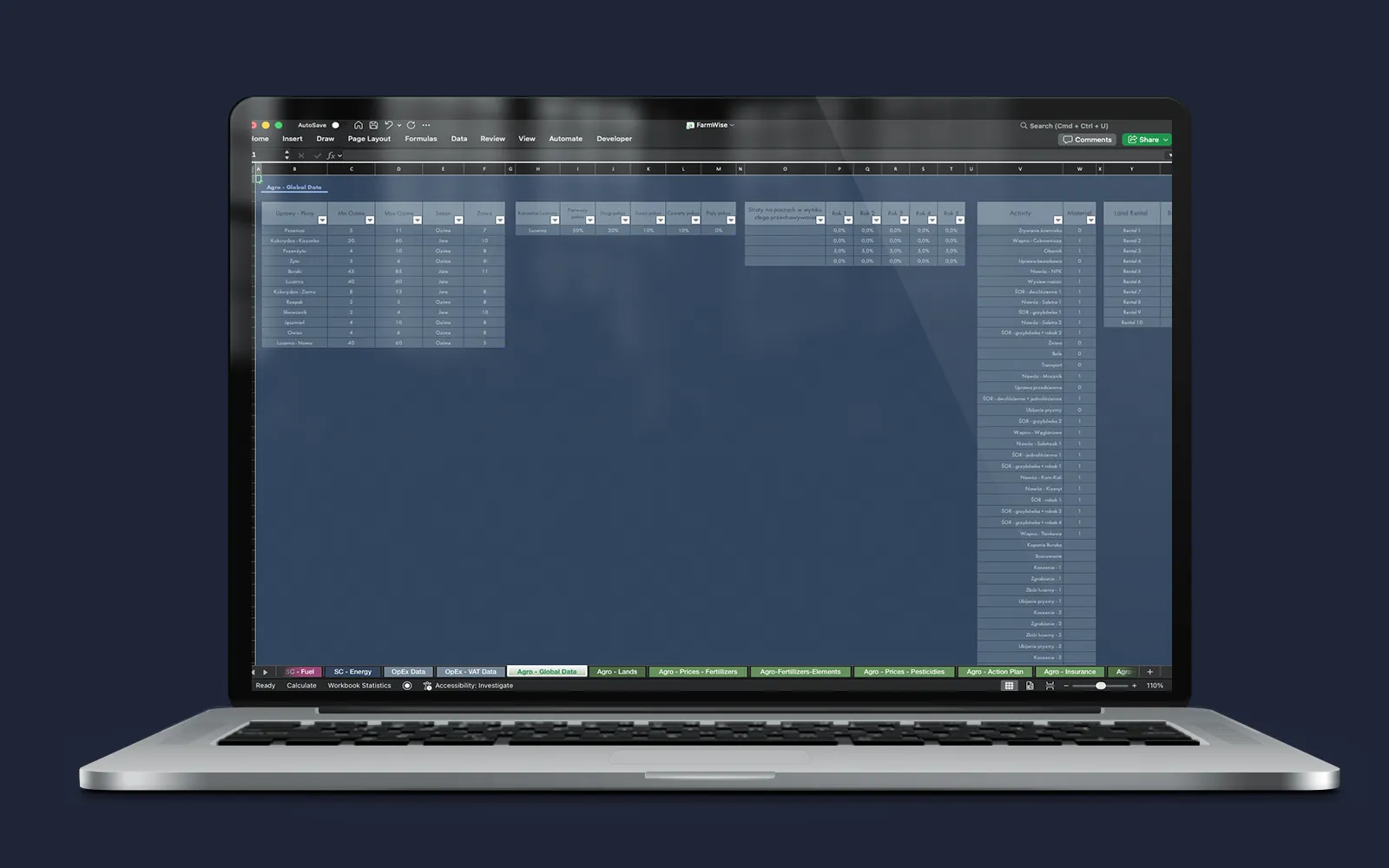
Agro: Initial Data
The Initial Data module in the Agro section is another element that allows the model to be adapted to the individual conditions of the farm.
This module provides the foundation for building a comprehensive financial model of the farm and adapting plant and animal production strategies to real resources and operational conditions.
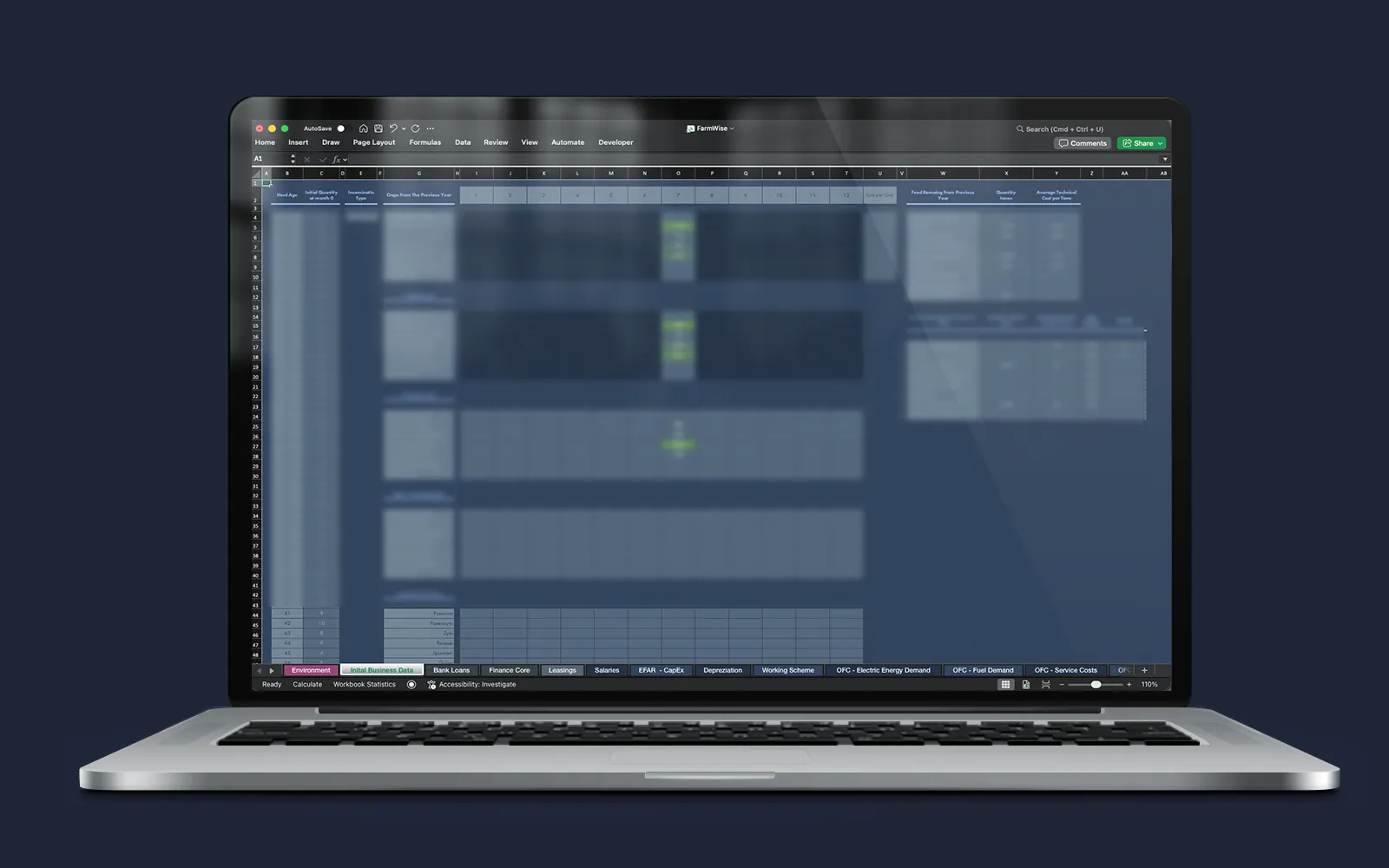
Agro: Initial Data – Sample data areas:
- Herd age: Data on the age structure of animals, allowing precise estimation of feed needs, milk production and other breeding parameters.
- Initial quantities: Information on the number of individual animal groups at the beginning of the month, which forms the basis for further production analyses.
- Type of insemination: Choice between sexed and non-sexed insemination, which affects the herd structure in the long term.
- Previous year’s harvests: Data on yields from individual crops, including details on available tons of grain and other plants preserved from the previous season.
- Costs and prices: Determination of technical costs and prices for individual crops, enabling ongoing profitability calculations.
- Remaining feed and straw resources: Information on remaining feed and straw resources, including tonnage, technical cost per ton, as well as weight and parameters related to bale packaging.
Agro: Initial Data – Module functionalities:
Preparation of the initial state:
- Entering data on herd age and numbers, structure of feed, straw and crops at the start of the analysis.
- Allows precise adaptation of the model to the specifics of the farm.
Inventory analysis:
- Monitoring of leftovers from the previous year, including precise information on quantities and costs.
Expense management:
- Setting unit costs and prices, which form the basis for further financial calculations.
Investment scenarios:
- Data entered in this module can serve as the basis for optimization scenarios, e.g. management of feed and straw resources.
Optimization of crop planning and animal production:
- Facilitates performance analysis and determination of potential costs depending on different crop and breeding strategies.
Agro: Land Costs
Agro-Land Costs is a module that monitors costs related to the use of agricultural land. It allows assigning specific land to lease agreements or agricultural loans (bank loans or leases).
Thanks to this, it is possible to accurately track expenses related to individual plots and easily forecast costs related to land use in the future.
This module is particularly useful for analyzing the cost structure in the farm and optimizing expenses based on the profitability of individual crops on a given area.
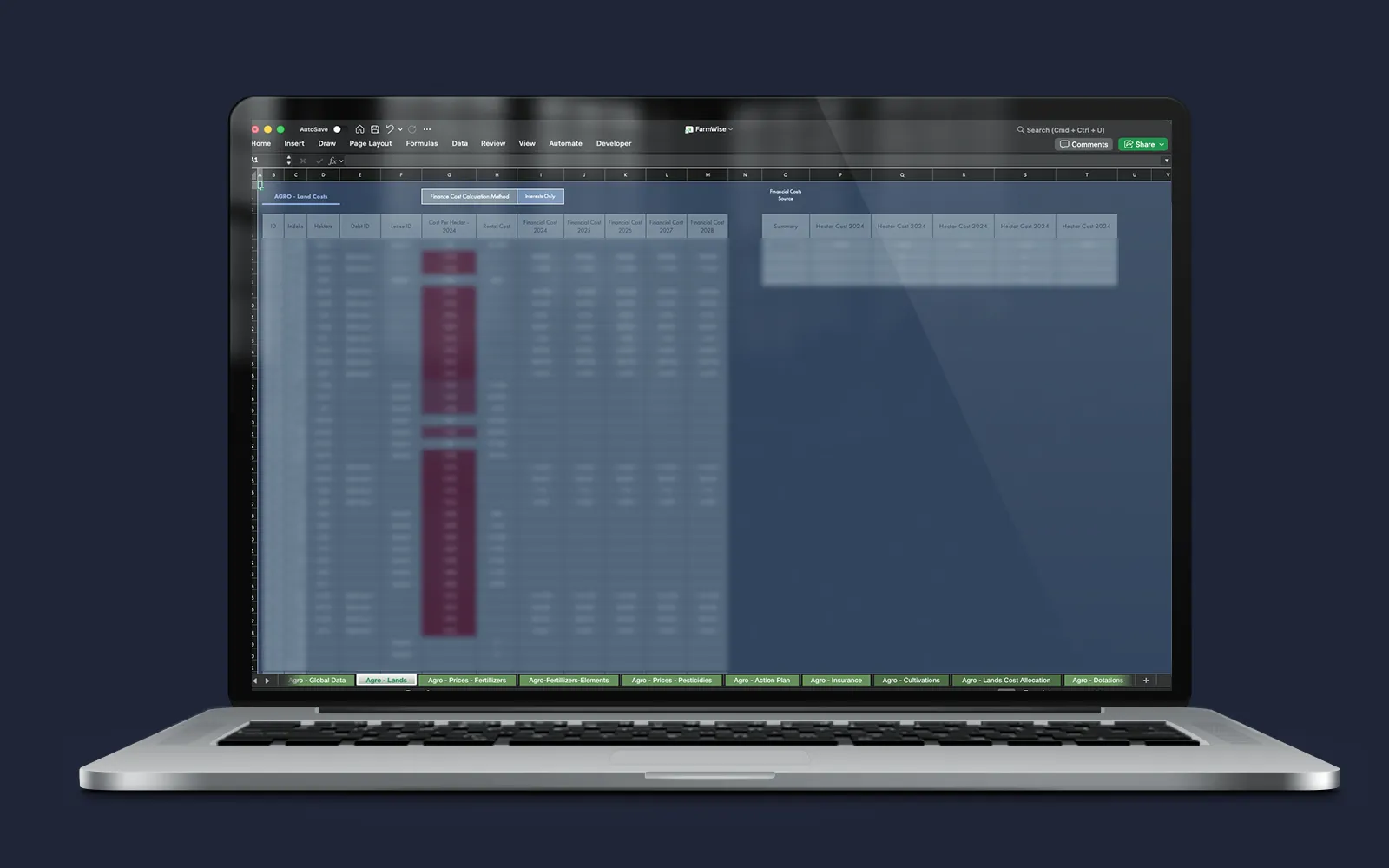
The module is designed with a flexible approach to managing different forms of financing in mind. Each plot can be linked to a specific form of financing, e.g. a bank loan or lease. This allows for a full review of costs that will be incurred in the coming years in connection with land use.
Thanks to this module, the user gains the ability to review total and unit costs for each plot, including rental and financing costs. This module gives the agricultural enterprise a tool for making more informed financial decisions related to land, taking into account current costs and forecasts for the coming years.
Agro: Prices – Fertilizers
The Agro – Prices Fertilizer module is a tool designed for comprehensive management of fertilizer and sowing material costs on the farm. Thanks to a detailed cost table broken down by quarters and years, the user can track, analyze and optimize expenses related to fertilization and sowing on individual fields.
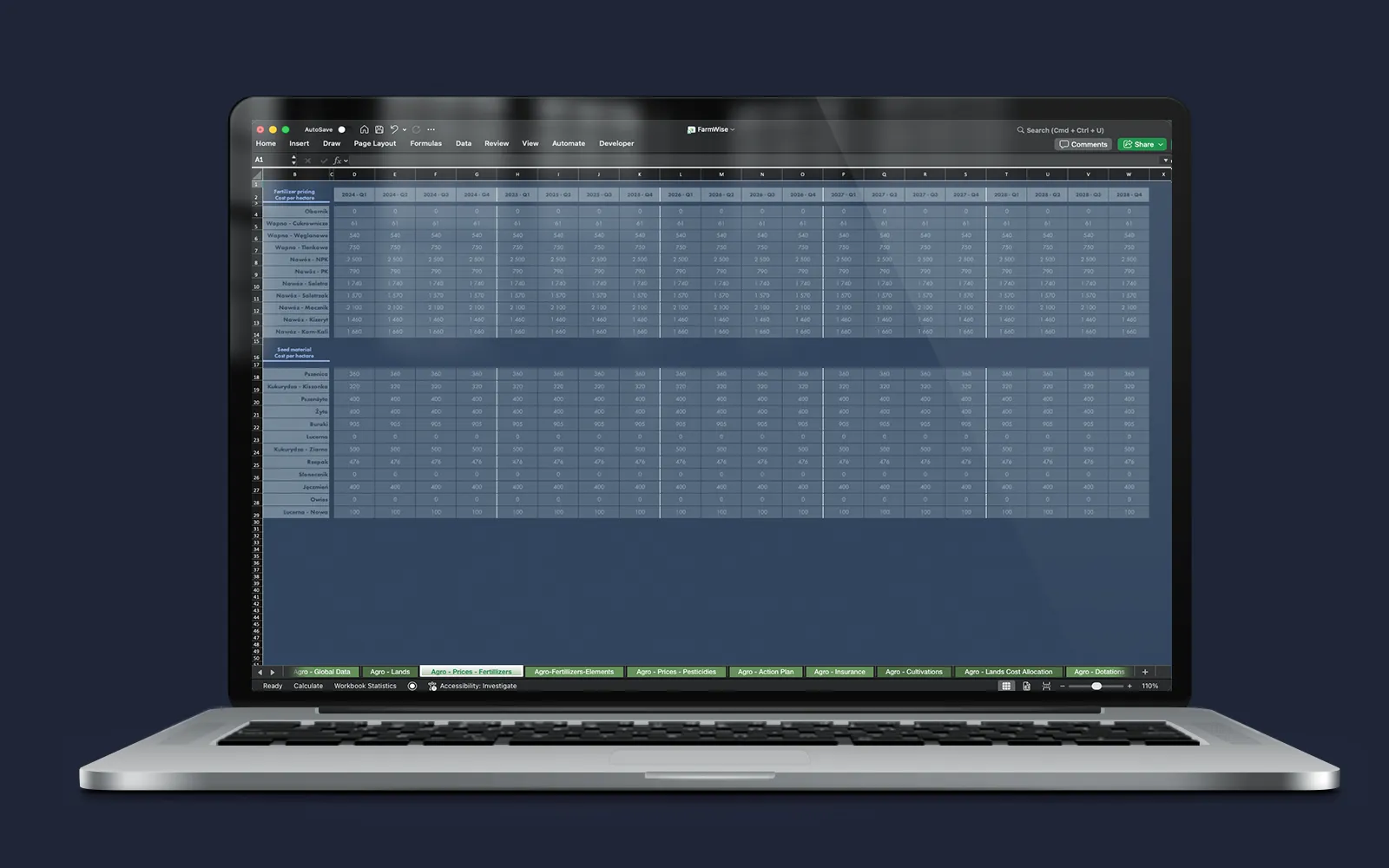
The module is equipped with a dynamic cost determination function based on various types of fertilizers, such as NPK, saltpeter, urea and others, and sowing materials for individual crops. The user has access to costs per hectare for each fertilizer and sowing material, which allows for precise budget planning in relation to actual crop needs.
Thanks to the module, an agricultural enterprise can easily forecast fertilization expenses several years in advance, taking into account changing prices and requirements for individual fertilizers. This module is a key element supporting the optimization of plant production costs and enables a quick response to changes in market prices of fertilizers.
Agro: Prices – Pesticides
The “Agro – Pesticides Prices” module is used to monitor and analyze the costs of plant protection products (PPP) for various crops, such as wheat, corn, rapeseed, barley, beets, and others. The data concerns quarterly prices over several years, which enables detailed tracking and forecasting of expenses related to plant protection against weeds, fungi and pests.
This module is flexible and allows adaptation of the plant protection strategy in response to price changes and the specific needs of each crop.
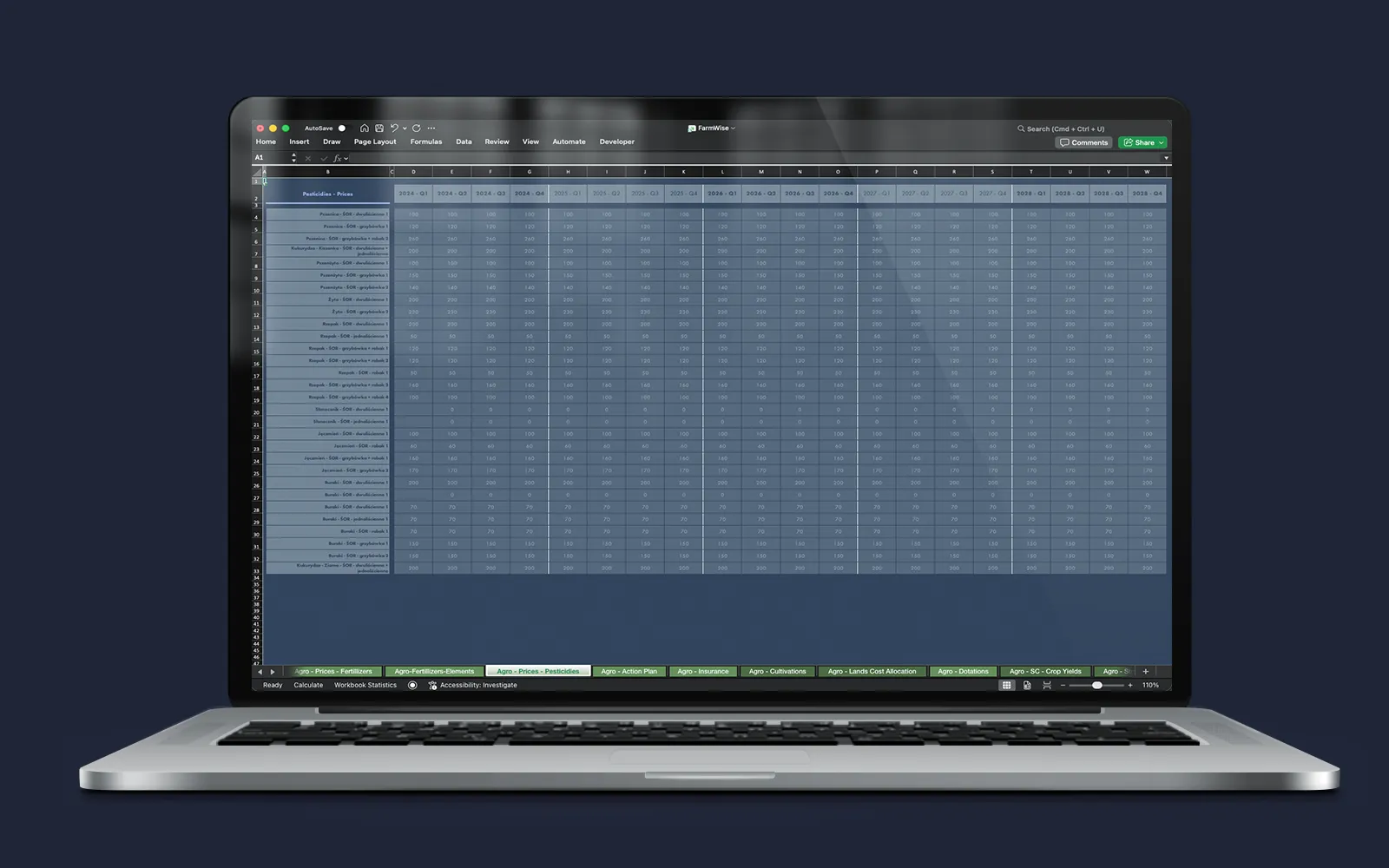
AGRO: PRICES – PESTICIDES – FUNCTIONALITIES
Tracking PPP costs on a quarterly basis: The module allows analysis of plant protection product costs for various crops, enabling control of expenses in individual quarters.
Review of prices for different types of protection:
- Dicotyledonous (e.g. herbicides against dicotyledonous weeds).
- Fungal (fungicides combating fungi).
- Insect (insecticides or protective mixtures against pests).
Budget forecasting:
The module contains data for subsequent years, which facilitates the creation of a plant protection budget and expense planning.
Flexibility in scenario analysis:
In combination with other model modules, scenario analyses can be carried out, e.g. in the event of an increase in the prices of plant protection products on the market or a change in the plant protection strategy.
Agro: Action Plan
The “Agro – Action Plan” module supports detailed planning and management of crop processes on the farm.
Thanks to it, the user can precisely determine the schedule and demand for materials and external services for various crops, such as wheat, corn, triticale, rye, rapeseed, sunflower, barley, alfalfa and beets.
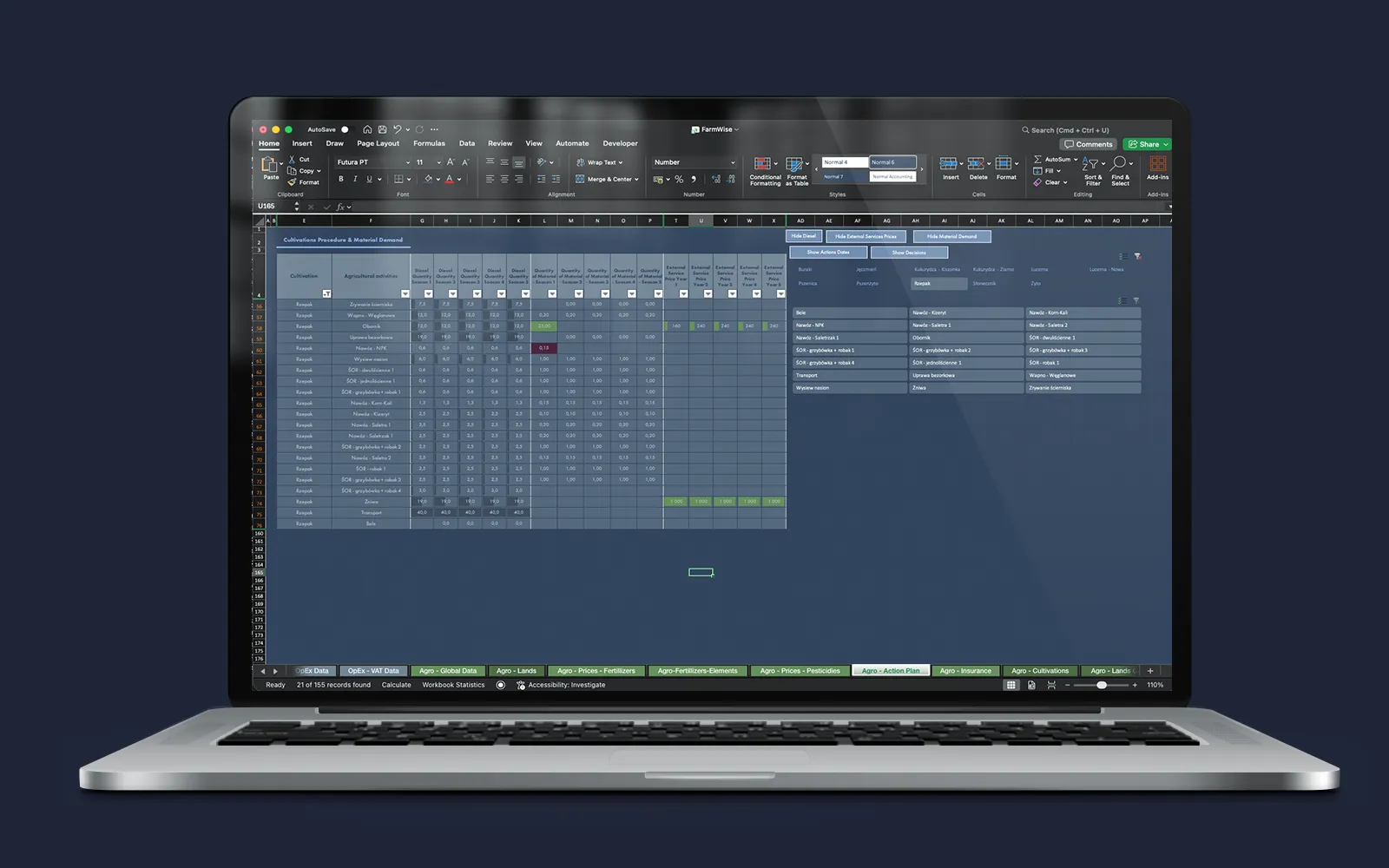
The “Agro – Action Plan Cultivations Procedure & Material Demand” module is a key tool supporting integrated planning and monitoring of crop processes, which translates into more efficient management of agricultural production.
Providing full transparency in the scope of resource planning for individual crops.
Optimization of production costs thanks to precise determination of demand for materials and services.
Enabling analysis of seasonal demand for fuel and materials.
Support for sustainable resource management through detailed analysis of the impact of agricultural activities on production costs and farm profits.
Analysis of the Impact of New Technologies and Machines.
The user can simulate the introduction of new machines with different parameters, such as fuel consumption or efficiency, which allows assessment of how these changes will affect operating costs and production efficiency.
For example, the module allows estimation of how more efficient machines can reduce fuel consumption, which has a direct impact on production costs.
Defining Specific Tasks and Material Consumption.
The module allows the user to define in detail tasks related to cultivation, such as fertilization, plowing, sowing and others, and to determine the amount of materials needed to carry them out.
This makes it possible to precisely plan costs and control the demand for individual materials, which supports optimal use of resources.
Substitution of Artificial Fertilizers with Digestate
The module allows modeling the impact of replacing artificial fertilizers with digestate from a biogas plant. Thanks to this function, the user can analyze how reducing the use of synthetic fertilizers in favor of digestate will affect costs and crop yields.
This type of substitution can be financially beneficial and support a sustainable development strategy, reducing costs and potentially improving soil quality.
AGRO: ACTION PLAN – FUNCTIONS
Planning agrotechnical activities:
The module allows defining actions, such as stubble breaking, liming, fertilization, sowing, application of plant protection products and harvesting for each crop.
Determining demand for fuel and materials:
For each action, fuel and material consumption (fertilizers, seeds, plant protection products) is assigned in different seasons, which enables strict monitoring and analysis of demand and costs.
Costs of external services:
The module allows inclusion of external service costs, such as harrowing or silage pile compaction, enabling more accurate expense forecasting and budget planning.
Dynamic management of costs in individual years:
Each cost and material parameter can be set for a five-year period, which allows forecasting and optimization of expenses.
Monitoring the impact on costs and profitability:
The module enables analysis of the impact of various crop strategies on overall production costs and profitability, taking into account variable factors such as the amount of fuel and materials, external service costs and raw material prices.
Optimization of seasonal planning:
Planning demand for fuel and materials for individual actions in specific seasons allows precise adaptation of the production process to seasonality and resource availability.
Flexible management of different crops:
Thanks to the ability to adapt actions and material demand for different crops, the module is versatile and flexible, allowing full adaptation to the specifics and scale of each farm.
Agro: Land Costs Allocation
The Agro – Land Cost Allocation module was designed to enable precise assignment of financial and rental costs to individual crops, allowing for accurate control and analysis of costs related to land use over multiple seasons.
This functionality is particularly useful for farms that manage different forms of financing, such as bank loans or leases, and lease land on various terms. Thanks to the module, the user can analyze how land use costs affect the profitability of individual crops, and better understand the impact of expenses on the overall farm budget.
AGRO: LAND COSTS ALLOCATION – OBJECTIVES
Precise Cost Control.
The module enables accurate assignment of land use costs to specific crops, which supports better financial control and enables identification of costs affecting profitability.
Financing Optimization.
Thanks to the analysis of cost assignment to specific hectares, the user can make more conscious decisions regarding land financing, which can lead to savings.
Long-term Planning
The module provides cost forecasts over a five-year period, which enables better planning and strategic decision-making in the context of land resource allocation.
Easy Visualization of Expenses.
Thanks to precise assignment of financial and rental costs to crops, the user can more easily identify the impact of individual expenses on the profitability of the entire farm, which supports strategic decision-making.
AGRO: LAND COSTS ALLOCATION – FUNCTIONALITIES
Assignment of Financial Costs.
The user can assign costs resulting from bank loans to specific hectares intended for specific crops, which allows for more precise management of land financing.
Assignment of Rental Costs.
The module enables assignment of rental costs to individual crops, which allows better monitoring and control of costs related to land leasing.
Multi-year Cost Forecast.
The user can monitor cost changes over a multi-year perspective, analyzing the impact of financial and rental expenses on farm profitability over a five-year period.
Integration with the Financing System.
The module works with other elements of the financial model, such as the Finance Core module, which allows for a more comprehensive analysis of total costs and profitability.
Flexibility in Resource Assignment.
The user has the ability to flexibly allocate land to different types of financing and leasing, which supports decisions regarding optimization of operating costs.
Agro: Dotations
The Agro – Crop Planning module is the essence of effective agricultural production management in the MFO, combining detailed control with ease of use.
It allows the user to precisely manage arable land, assigning specific hectares to individual plants, while forecasting their yield and profitability.
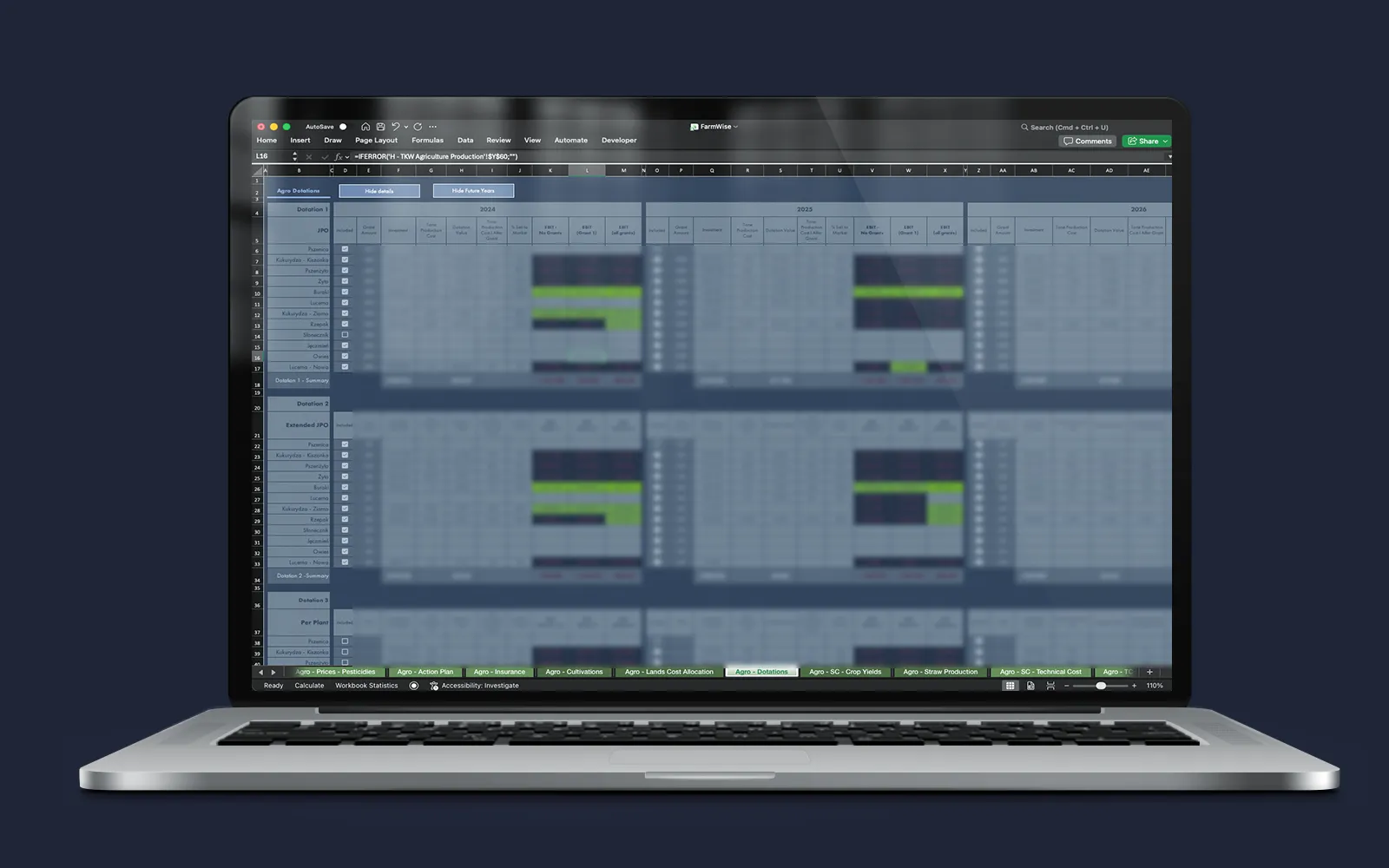
Assigning Subsidies to Crops.
The user can specify which crops qualify for individual subsidies and enter subsidy values for each year. This allows modeling of different scenarios of financial support.
Production Cost Analysis.
The module calculates production costs before and after taking subsidies into account, giving a full picture of how financial support affects unit costs and overall financial efficiency.
EBIT (Operating Profit) Simulation.
The user can run EBIT simulations for different scenarios, analyzing results with and without subsidies. The module also offers the possibility of calculating EBIT for situations where only part of the available subsidies was obtained, which facilitates realistic planning.
Calculation of Margin per Ton of Production.
By taking subsidies into account, the user can calculate the margin per ton for each crop. This makes it easier to understand which crops are the most profitable with a given level of financial support.
Agro : Dotations – Example of use.
A user who grows wheat can enter data on subsidies and investments needed to achieve specific production goals. The module will calculate the cost of production per ton, taking into account subsidy support, and indicate at what point production exceeds the profitability threshold. On this basis, the user can decide to expand or limit a given crop, optimizing the economic and financial strategy.
The Agro – Subsidies module is an advanced tool for planning and financial analysis, supporting farmers in the strategic management of crops with the support of external financing.
Agro: Insurances
The module was created to manage crop insurance, allowing the user to strictly control insurance costs and predict potential payouts in the event of crop damage.
This module takes into account the specifics of each crop, such as the amount of the insurance premium, the level of crop protection and the seasonal months of premium payments and payouts.
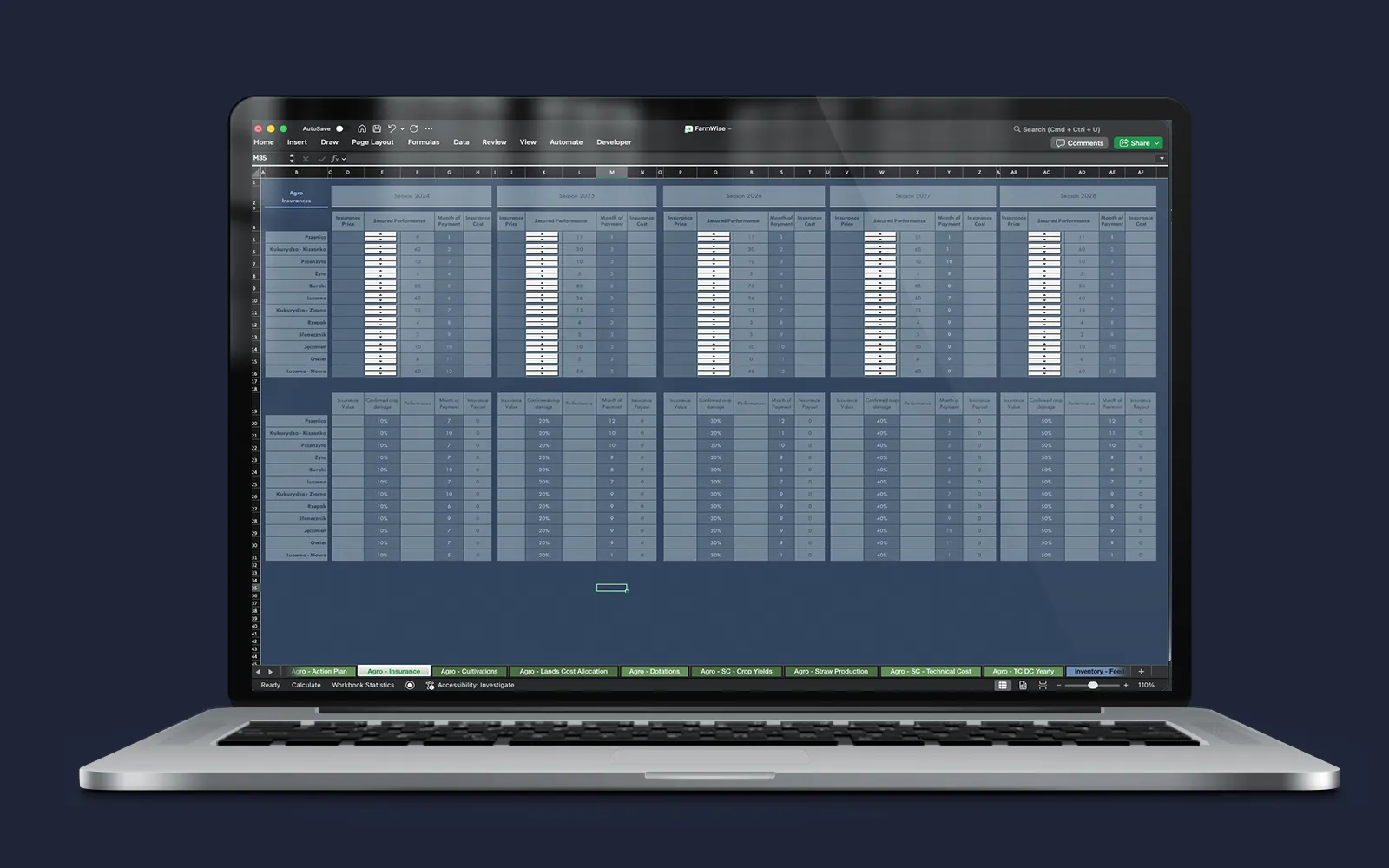
AGRO: INSURANCES – FUNCTIONALITIES
Defining Insurance Costs
The user can set insurance premiums for each crop and specify the month of payment. This allows monitoring of annual insurance costs and better management of cash flows related to insurance expenses.
Performance Protection.
The module automatically calculates potential insurance payouts based on the established level of yield protection. The user can enter a protection level, e.g. four tons, which means that if actual yields fall below this value, the model will automatically calculate the amount of potential insurance payout. This allows the user to easily monitor production protection and predict the impact of potential yield losses on farm finances.
Agro: Cultivations & Market Operations
The Agro – Crop Planning module is the essence of effective agricultural production management in the MFO, combining detailed control with ease of use.
It allows the user to precisely manage arable land, assigning specific hectares to individual plants, while forecasting their yield and profitability.
AGRO: CULTIVATIONS & MARKET OPERATIONS – FUNCTIONALITIES
Dynamic profitability calculation:
Thanks to the ability to enter current market prices for each crop, the user immediately receives information on production costs per ton and the real profit margin that can be achieved. This allows making decisions in real time, reacting to changes in prices or production costs.
Integrated cost analysis:
The module automatically takes into account all direct and indirect costs related to production, allowing for precise calculation of the total cost of producing each ton. This tool gives a full picture of profitability, and the resulting margin takes into account all financial aspects.
Precise analysis of cultivated area:
The ability to assign hectares to selected crops, with the additional option of defining the percentage of planned yield realization. Thanks to this, the user sees what resources are involved and what results can be achieved.
Sales forecasts:
The module allows determining the percentage of harvests intended for sale, which allows quick calculation of the amount of product that will go to the market and that which will be used internally. All surpluses are automatically assigned to the feed warehouse or inventory, supporting inventory control.
Intelligent inventory management:
The part of the harvest that is not intended for sale automatically supplies the feed warehouse and stocks (enterprise balance sheet), which allows for optimized management of resources within the farm without the need for manual calculations.
The module is not only an analytical tool, but also a practical guide to effective management of agricultural production. Thanks to integration with other modules of the AGRO section, the user gains full control over the cultivation process — from planning to sales, with the possibility of detailed analysis of each step and a quick response to changing market conditions.
AGRO: STRAW PRODUCTION
The Straw Production module is a comprehensive tool dedicated to managing straw production, which not only enables planning and monitoring of the entire production process, but also dynamically adapts to the needs of the farm.
Thanks to full integration with other modules in the AGRO and Herd sections, the Straw Production module provides comprehensive information on straw demand, including its use as bedding for cows and as a feed component.
AGRO: STRAW PRODUCTION – FUNCTIONALITIES
Precise Straw Production Planning:
The user can assign hectares to individual crops (such as triticale, rye, barley, etc.), and the module automatically calculates the straw-to-grain ratio and the total weight of straw that can be obtained. On this basis, the maximum number of bales that can be produced is determined, as well as the percentage of straw intended for production.
Dynamic Management of Straw Demand:
The module provides current insight into dynamic straw demand, which takes into account both current inventory levels and the farm’s needs for bedding and cow feed. These needs are automatically calculated by other modules from the Herd section, allowing the user full understanding and control over the amount of straw necessary for daily farm operations.
Tracking Production and Logistics Costs:
The module enables detailed determination of straw production and transport costs, including parameters such as transport distance and production source (e.g. internal production or external services). Based on this data, the module automatically calculates unit costs, such as cost per bale and cost per ton, allowing for precise monitoring and optimization of expenses.
Profitability and Margin Analysis:
The module allows the user to quickly check whether straw production is profitable, through dynamic calculation of the market value of straw based on average prices and margin calculation. The user can monitor production profitability in real time, taking into account both direct and indirect costs and available subsidies.
Forecasts and Future Planning:
The Straw Production module allows the user to forecast straw production for upcoming seasons (2024–2028), taking into account changing parameters, such as yield efficiency, investment costs and market prices. This allows precise planning of future straw needs and advance adjustment of the production strategy to maximize farm profitability.
Automatic Update and Data Synchronization:
The module is fully integrated with other modules in the AGRO and Herd sections, so data on straw demand is automatically updated. If parameters such as market price, inventory level, or harvest size change, the module automatically recalculates the values, providing the user with always up-to-date and precise information.
Agro: Crops technical costs
The module offers advanced analysis of technical costs for individual crops, taking into account direct and indirect production costs at every stage. This module integrates data from other AGRO section modules, allowing the user to thoroughly assess cost efficiency and the market potential of each crop.
The Technical Cost module enables precise management of costs and revenues from crops, as well as optimization of the cost structure based on real and forecasted data. Thanks to integration with other AGRO modules, the user can dynamically adjust production plans in response to changes in market prices, available subsidies or resource costs, such as fuel.
This module is an indispensable tool in planning and profitability analysis, supporting the user in making sound strategic decisions.
Calculation of Direct and Indirect Costs:
Each crop receives a detailed report on direct costs, such as diesel oil, fertilizers, plant protection products, and indirect costs, such as financial costs of plots or rental costs. These detailed data allow for precise tracking of expenses and budget optimization.
Cost per Ton of Production:
The module automatically converts the cost of producing one ton based on direct and indirect costs. This allows the user to quickly see what the real production costs are for each crop, which is key in profitability analysis.
Margin and Market Price Analysis:
Based on entered market prices, the module calculates the margin per ton and the total revenue from each crop, taking into account quantities intended for sale. The module dynamically indicates which crops are the most profitable, allowing for strategic production planning.
Integration of Subsidies and Impact on EBIT:
The module offers simulation of financial results at different levels of subsidies. Depending on the available subsidies (from 1 to 6), the module recalculates EBIT taking into account financial support, presenting their impact on the profitability of each crop. Thanks to this, the user sees how different subsidies affect the final financial result.
Additional Products:
The module takes into account additional products, such as straw or beet pulp, along with their production costs and market values. This function allows for fuller use of by-products, which can supply the warehouse or generate additional revenue.
HERD: GLOBAL DATA
The Herd – Global Data module is the foundation for managing data on the cow life cycle, enabling precise modeling of costs and benefits at every stage of development and production.
Each stage of the animal’s life – from calf, through heifer, to dairy cow – is described taking into account key parameters, such as age, weight, weight gain, lactation cycle and manure production and straw consumption.
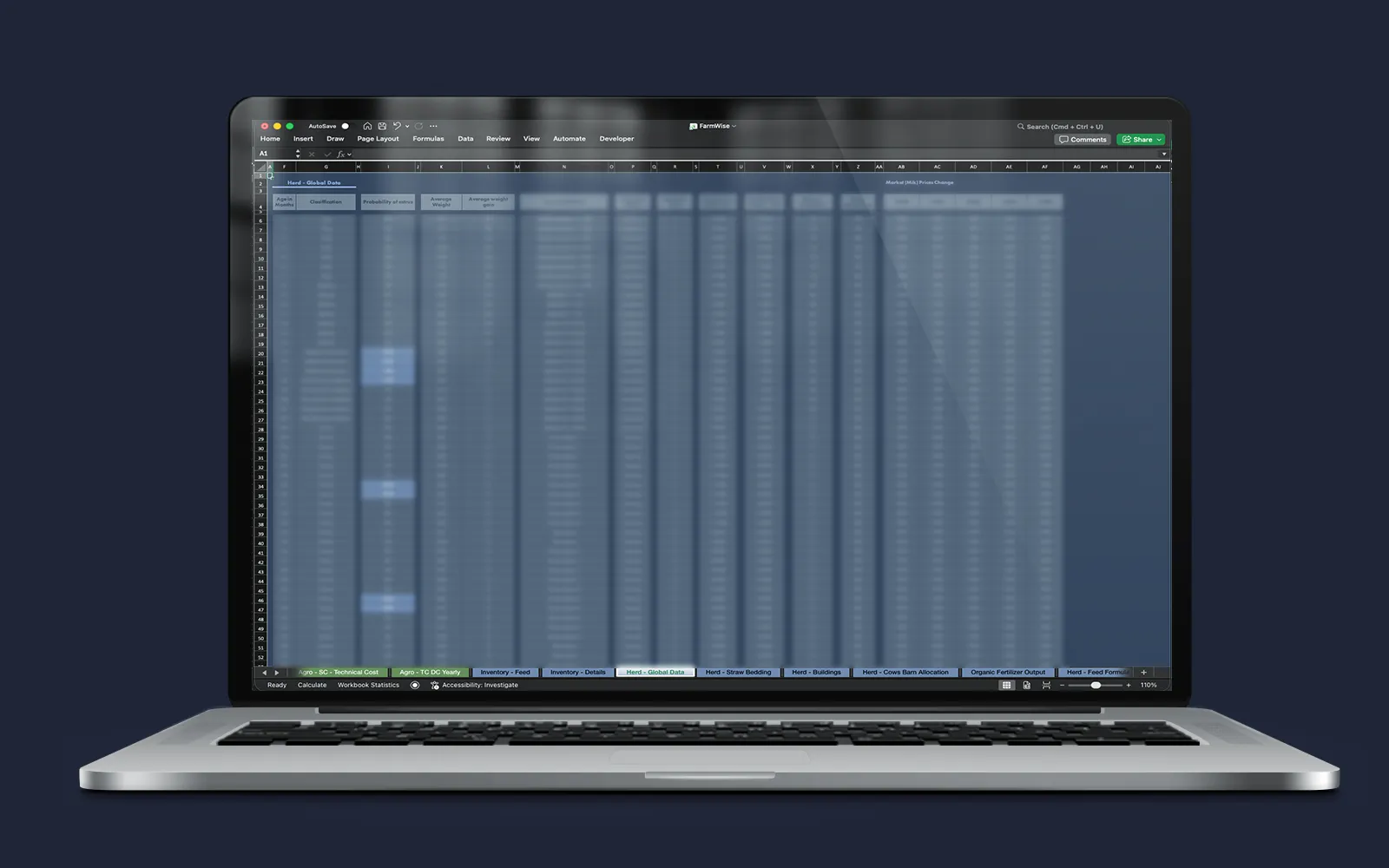
Thanks to accurate data on costs and market value of animals in individual age groups, the module enables profitability analysis and assessment of return on investment depending on financial classification (e.g. “Investment” for heifers and “Earning” for dairy cows).
Information on the lactation cycle allows better management of milk production, including forecasting the impact of individual phases on costs and revenues.
The module also takes into account parameters such as the probability of heat and manure production, which supports waste management and optimization of bedding (straw) demand – with automatic inclusion of inventory levels.
Thanks to integration with other modules of the Herd section and other model modules, Herd – Global Data becomes a comprehensive tool for financial and operational analysis of a breeding farm, providing insight into current costs and the ability to model future herd development scenarios.
HERD: STRAW BEDDING
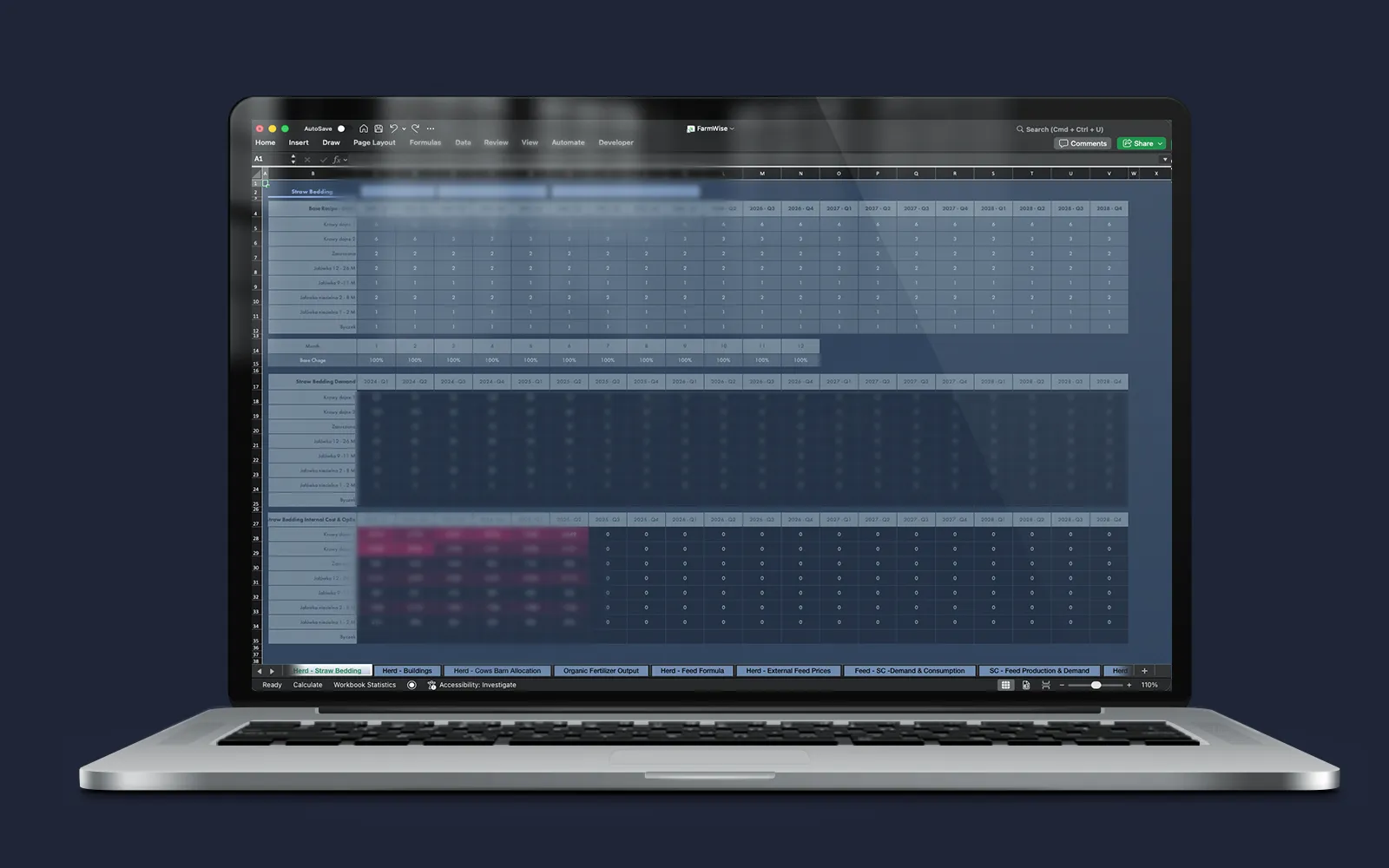
The Straw Bedding module is used for precise management of bedding demand for different cattle groups on the farm.
It is an advanced tool that enables tracking and planning of straw consumption throughout the year, adapting to seasonal changes in the needs of individual animal groups.
HERD: STRAW BEDDING – FUNCTIONALITIES
Daily Bedding Recipe:
In the module, you can specify the basic daily straw demand for each class of animals, such as “Dairy cows”, “Heifers” or “Dry”. This allows the user to precisely plan straw consumption for each group based on their numbers and specific needs.
Forecasted Consumption per Quarter:
The module shows quarterly straw demand, taking into account changes in animal numbers and status. This allows dynamic adjustment of the consumption plan and securing the appropriate amount of straw for bedding in warehouses.
Internal Costs and Operating Costs:
The module calculates straw consumption costs for individual animal groups for each quarter, giving a full picture of operating costs related to bedding. These costs are calculated based on entered straw price data, dynamically calculated costs of own straw production and the amount consumed by each animal group.
Integration with Herd Management Modules:
The Straw Bedding module is closely integrated with other modules of the Herd section, which enables automatic updating of straw demand based on data on animal numbers and age classes. Thanks to this, any changes in the herd status (e.g. increase in the number of dairy cows) are automatically reflected in the forecasted straw demand.
Monitoring Warehouse Resources:
The module enables dynamic tracking of straw stocks, which are used both for bedding and in feed. This allows ongoing control of inventory levels and adjustment of demand to current herd needs.
HERD – Buildings & Straw Beddings
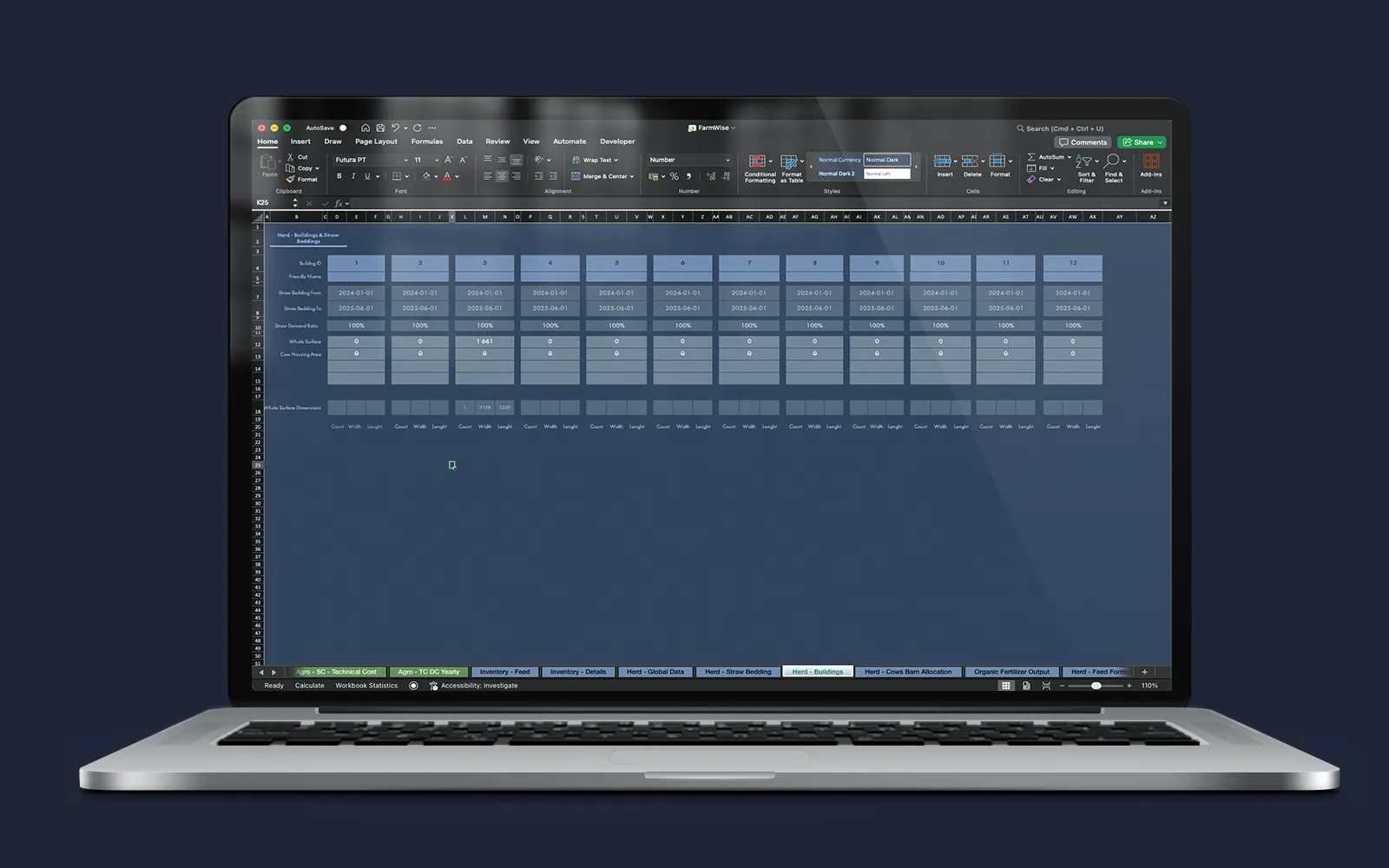
The Herd – Buildings & Straw Beddings module is a comprehensive tool for managing breeding space and straw demand in individual farm buildings.
Thanks to advanced functions and flexible settings, the module offers a full range of information needed to optimize herd and straw resource management.
HERD – BUILDINGS & STRAW BEDDINGS – FUNCTIONALITIES
Management of Bedding Periods:
It enables precise determination of dates from when and until when a given building will be supplied with straw bedding. Thanks to this function, bedding schedules can be adapted to seasonal herd needs and straw availability, which helps in more efficient resource management.
Dynamic Calculation of Bedding Demand:
The module allows assigning a percentage indicator of straw demand for each building, which enables dynamic adjustment of bedding consumption depending on current needs. For example, if building 1 requires full demand (100%), and other buildings do not need bedding (0%), the module will automatically adjust these data to the total straw demand.
Building Area Management:
The module allows detailed management of breeding space, taking into account the total area of buildings and dedicated zones for cows. Thanks to the ability to enter dimensions, such as the width and length of individual buildings, the user can precisely determine available space resources, which supports effective planning of animal placement.
Automatic Calculation of Cow Density:
One of the key advantages of the module is the function of automatic calculation of cow density in a given space. It only requires entering the dimensions of the building areas and the number of animals, thanks to which the user can quickly obtain information on the optimal herd density, which supports decisions regarding space management and animal comfort.
Integration with other modules:
The Buildings & Straw Beddings module is closely integrated with the other modules of the Herd section, which allows for ongoing data updates and their adaptation to changing breeding needs. Entered data is automatically included in straw demand forecasts, which allows dynamic adjustment of resources to current herd requirements.
Resource Planning Based on Area:
Thanks to detailed management of livestock building dimensions, the user can precisely plan bedding demand for each space. This allows adjusting the level of bedding to the functions of buildings – for example, facilities intended for dairy cows may require a different amount of bedding than buildings for heifers.
Herd: Cow Barn Allocation
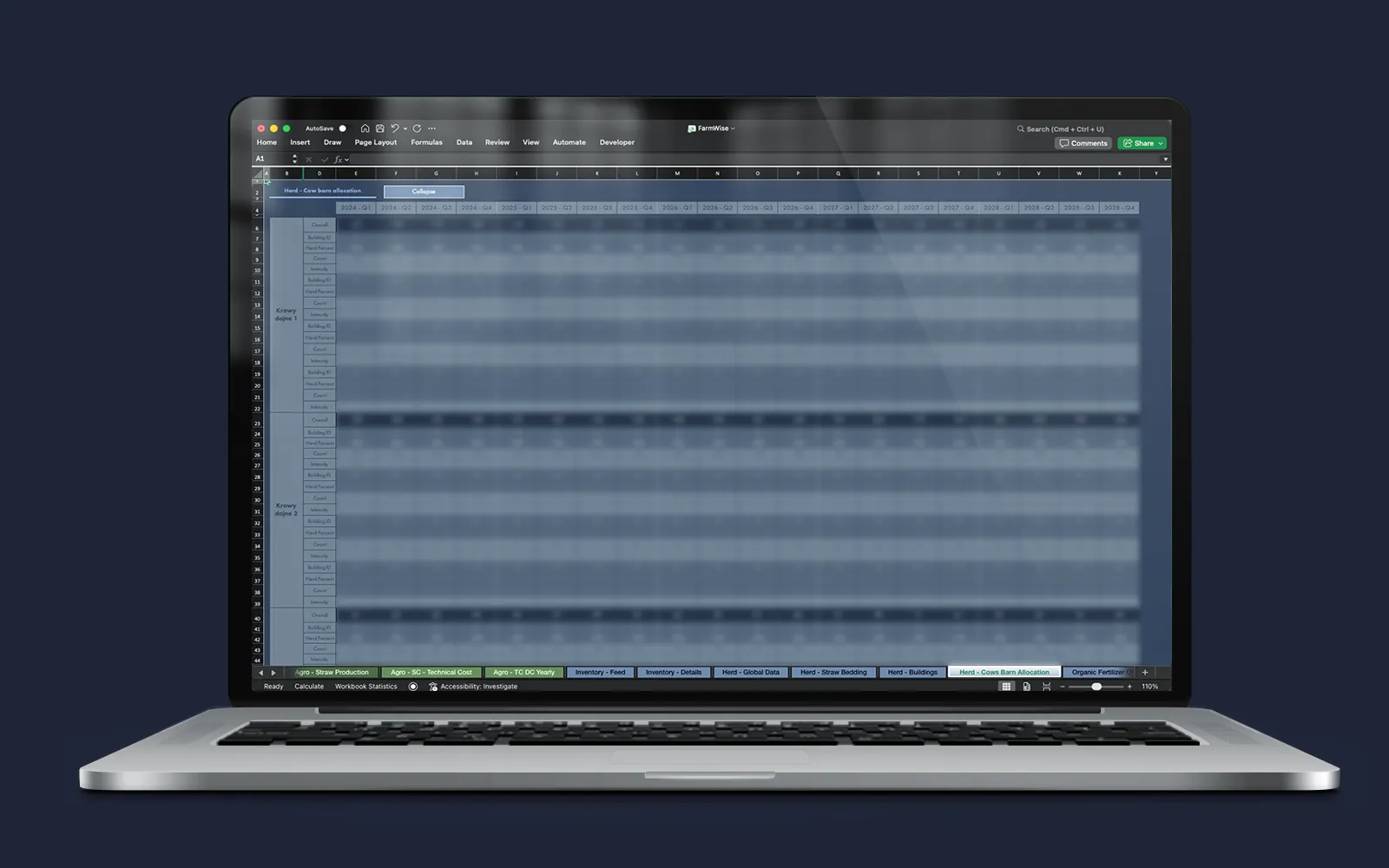
The Herd – Cow Barn Allocation module is a tool supporting the management of herd placement in livestock buildings depending on demand in individual quarters.
Thanks to this functionality, the user can precisely allocate different animal groups to appropriate spaces, which allows optimal use of infrastructure and provision of comfortable breeding conditions.
.
HERD: COW BARN ALLOCATION – FUNCTIONALITIES
Precise Allocation of Animal Groups:
The module enables assignment of animal groups, such as dairy cows, heifers, dry cows, to appropriate buildings in each quarter of the year. Each group is assigned to a specific building (building ID), and the module shows detailed information on the number of animals assigned to a given building, which allows full control over herd placement.
Dynamic Handling of Changes in Herd Population:
The module tracks changes in the number of each animal group in subsequent quarters, which allows for ongoing adjustment of allocation. The number of animals in individual groups is automatically updated, allowing the user to track population increases and decreases and adjust space to changing needs.
Intensity Indicator:
The module calculates the intensity indicator of density in the building for each animal group, providing full insight into space utilization. Thanks to this function, the user can monitor whether the number of animals assigned to the building is optimal and meets breeding standards, allowing for quick detection of overcrowding or unused space.
Flexible Management of Allocation at the Building Level:
Each building can be individually configured in the context of the number of animals, which allows dynamic adjustment of space to the needs of different animal groups. The module enables precise management of animal allocation, as well as monitoring of building occupancy in a given period, which supports optimal breeding planning.
Clear Visualization of Allocation and Intensity:
All data is presented in a clear way, allowing the user to easily monitor the number of animals assigned to each building in each quarter and track which buildings are currently in use. Thanks to this transparency, the user can quickly identify the need to adjust infrastructure or change allocation in response to changing breeding conditions.
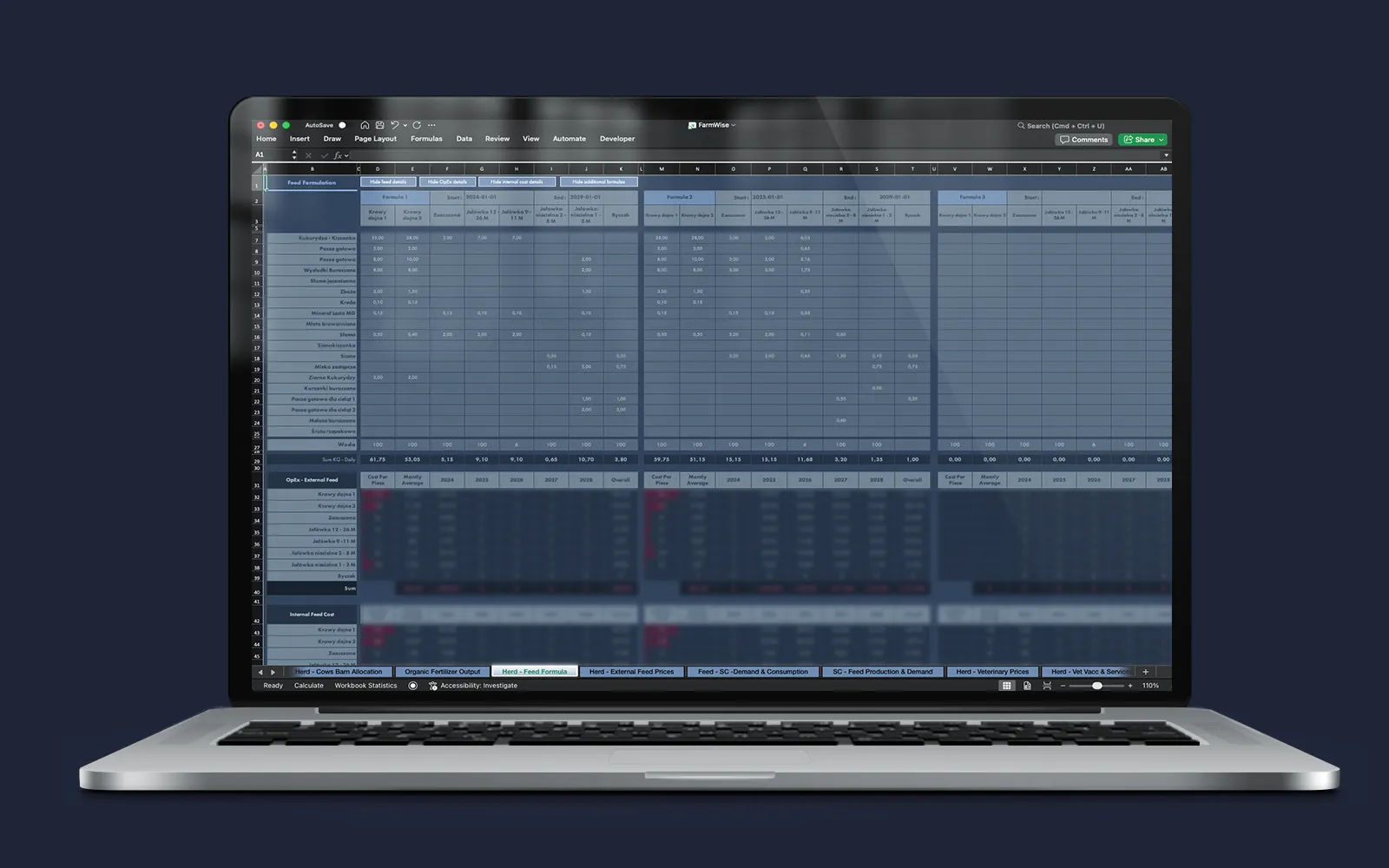
HERD – Feed Formula
The Feed Formula module enables the creation of detailed feed recipes for the herd, with the possibility of adjusting them depending on the period.
The module automatically calculates feed demand based on herd size and age structure of animals, using data from agro and feed production modules.
Thanks to this function, the user can precisely plan the feed budget and control expenses, adjusting recipes to changing economic and production conditions.
HERD – Feed Formula – FUNCTIONALITIES
Strict Cost Monitoring:
The module allows the user to recalculate costs related to feed supply from both internal resources and external sources. This allows precise control of operating expenses (OpEx) related to the purchase or on-site production of feed ingredients. This facilitates budget planning and allows optimization of animal feeding costs.
Diversity of Feed Formulas:
The module allows the creation of up to 10 different feed formulas that the user can adapt to the specific needs of each animal group (e.g. dairy cows, heifers, dry cows). Each formula can have a specified validity period, which facilitates seasonal diet adjustment without the need for manual updating of all data.
Precise Demand Analysis:
The module calculates the demand for nutritional ingredients for different animal groups, allowing precise determination of the amount of feed needed on a daily and monthly basis. This allows better planning of resources and purchases and minimizes the risk of shortages or surpluses of feed.
Multi-year Demand and Cost Calculations:
Thanks to the ability to analyze data over years, the module supports long-term financial planning. It recalculates feed demand and related costs for each year, which enables analysis of the impact of the feeding strategy on the budget in the long term.
Dynamic Tracking of Expenses and Average Costs:
The module generates average monthly feed costs for each animal group and for each formula, which allows for transparent comparison of expenses on different formulas over time. This allows making decisions based on real feeding costs, analyzing which formula best supports the financial efficiency of the farm.
Detailed Review of Feed Ingredients:
The module presents a list of individual feed ingredients, such as corn silage, alfalfa, beet pulp or corn grain. For each formula, different amounts of ingredients can be entered, which is the basis for calculating demand and costs, without automatic adjustment of these quantities.
HERD: INVENTORY TRANSACTIONS
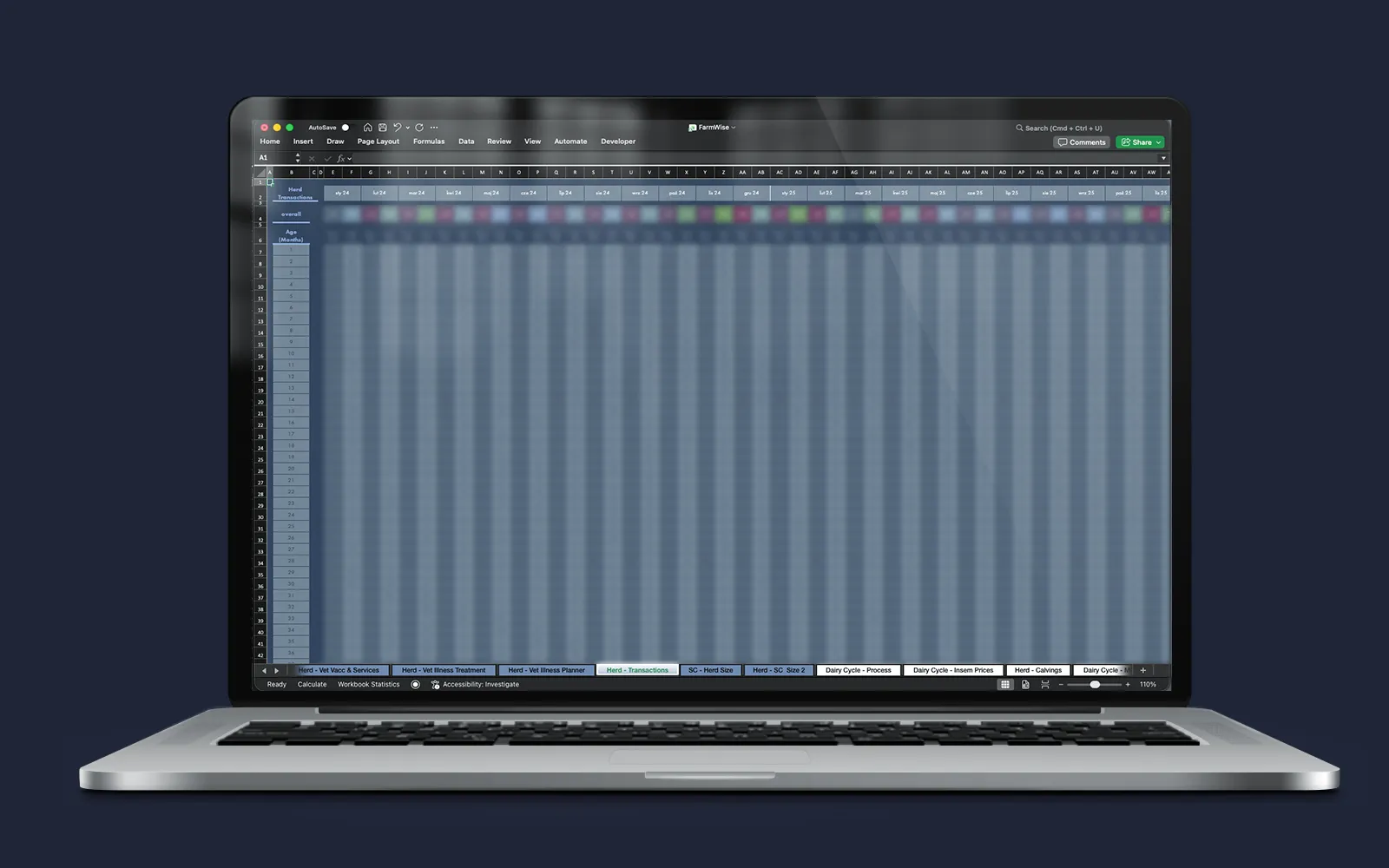
The “Inventory Transactions” module in the financial model is used to manage all transactions related to the herd, enabling tracking of the history of purchases, sales and flows in the herd over months.
Below is a detailed description of its functions and capabilities:
Module functionalities:
Registration of purchases, sales and transfers
every movement in the herd can be precisely recorded, with detailed parameters assigned to each transaction.
Tracking production cycles
the system automatically assigns cows to appropriate production stages based on their age and status, eliminating the need for manual cycle management.
Automatic determination of the moment of leaving the herd
the model identifies situations in which animals reach the age or condition requiring leaving the herd, which allows optimal resource planning and provides accurate production forecasts.
Herd status analysis
the ability to generate reports on the current composition of the herd, enabling assessment of age and production structure.
In the module, in addition to recording basic movements in the herd, the model independently tracks and recalculates changes related to the age and production cycles of dairy cows.
This means that the entered data on age and transaction dates allow the system to automatically assign animals to appropriate production cycles (such as lactation period or dry period), and also identify situations in which cows reach the moment of leaving the herd.
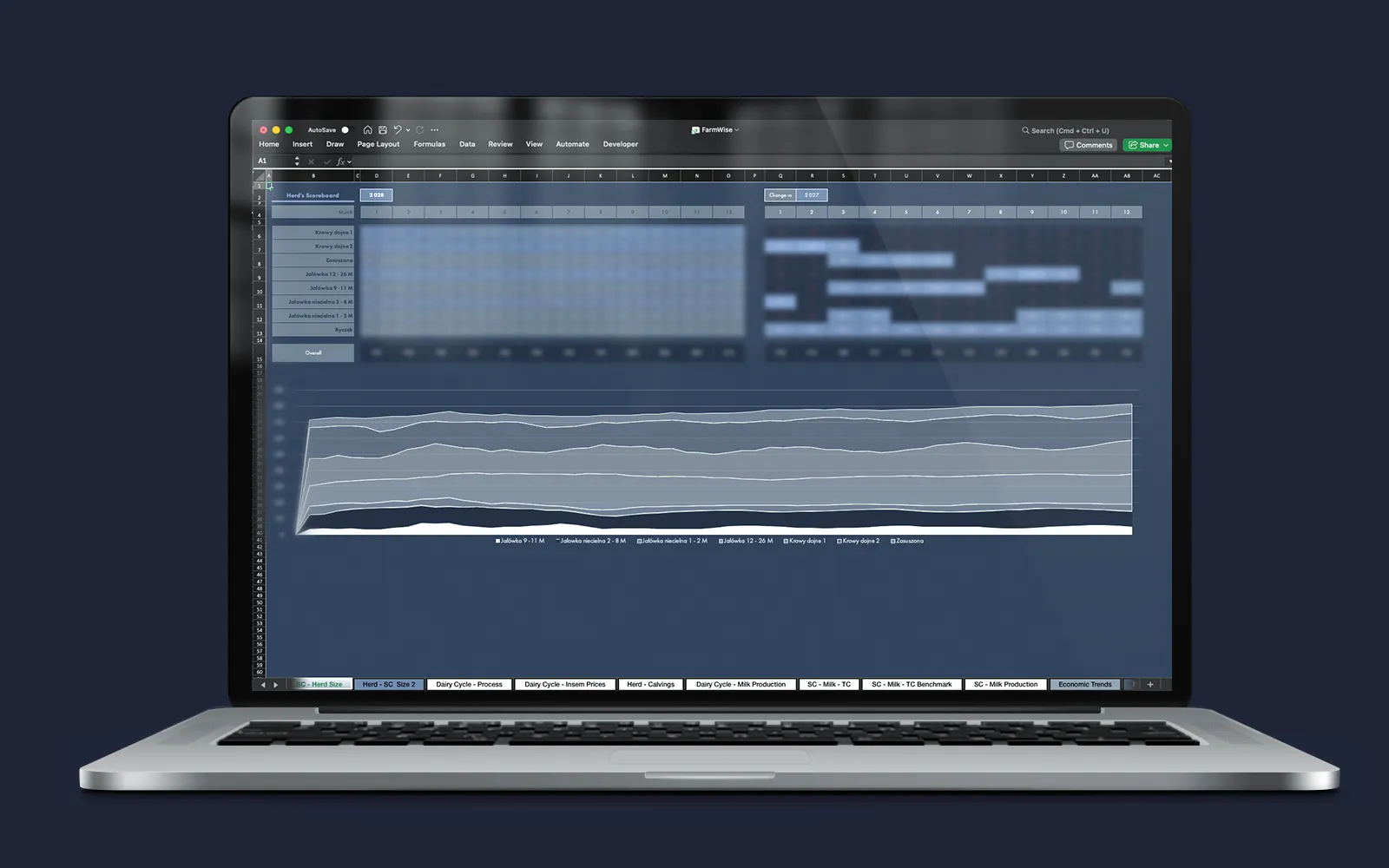
Such functionality enables more accurate planning and analysis of herd efficiency, eliminating the need for manual tracking of cycles and allowing for more precise forecasting of future production results.
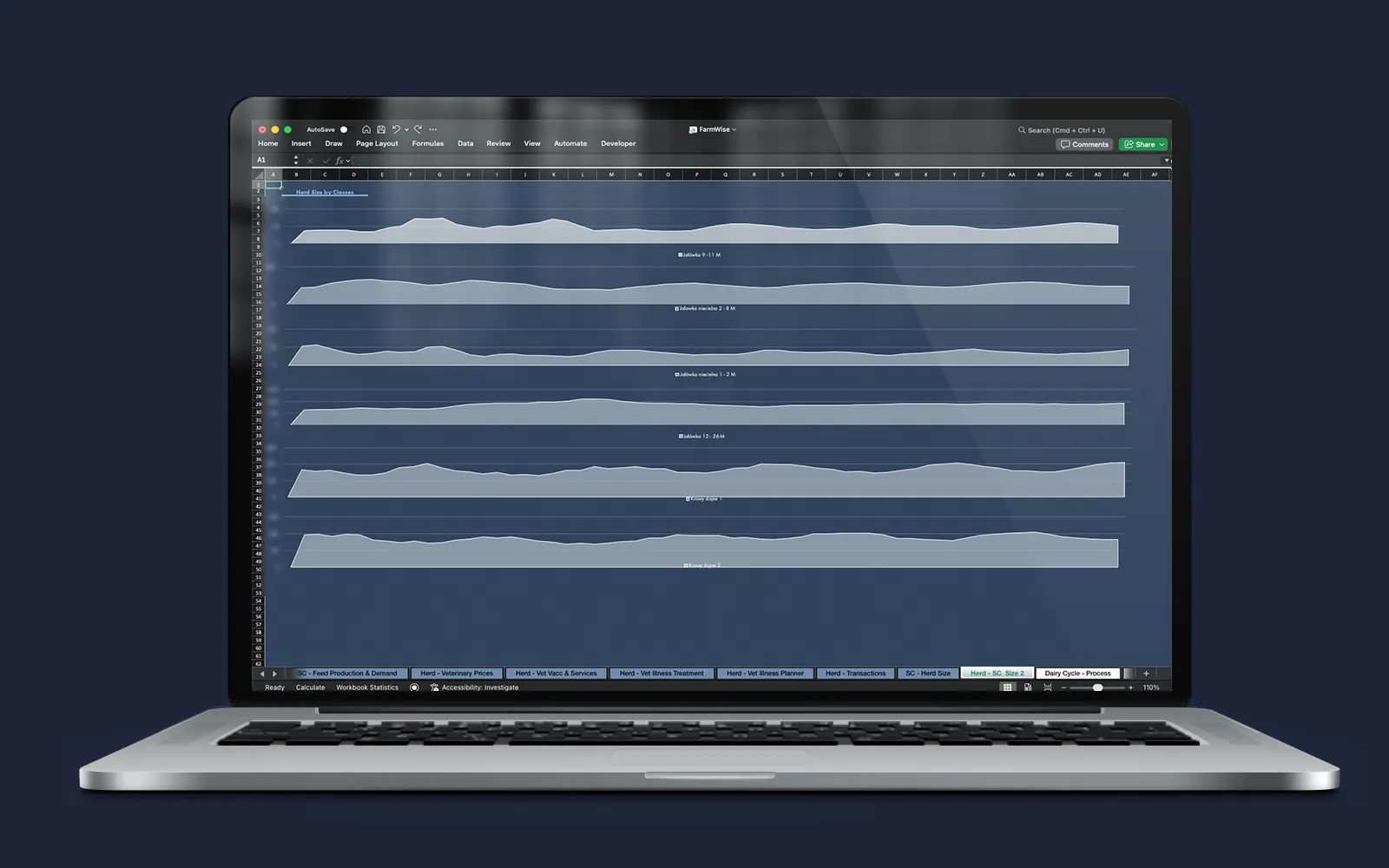
HERD – Feed Demand & Consumption
The “Feed Demand” module is used for comprehensive planning of the herd’s nutritional demand for subsequent quarters, taking into account both feed grown on site and that which must be purchased.
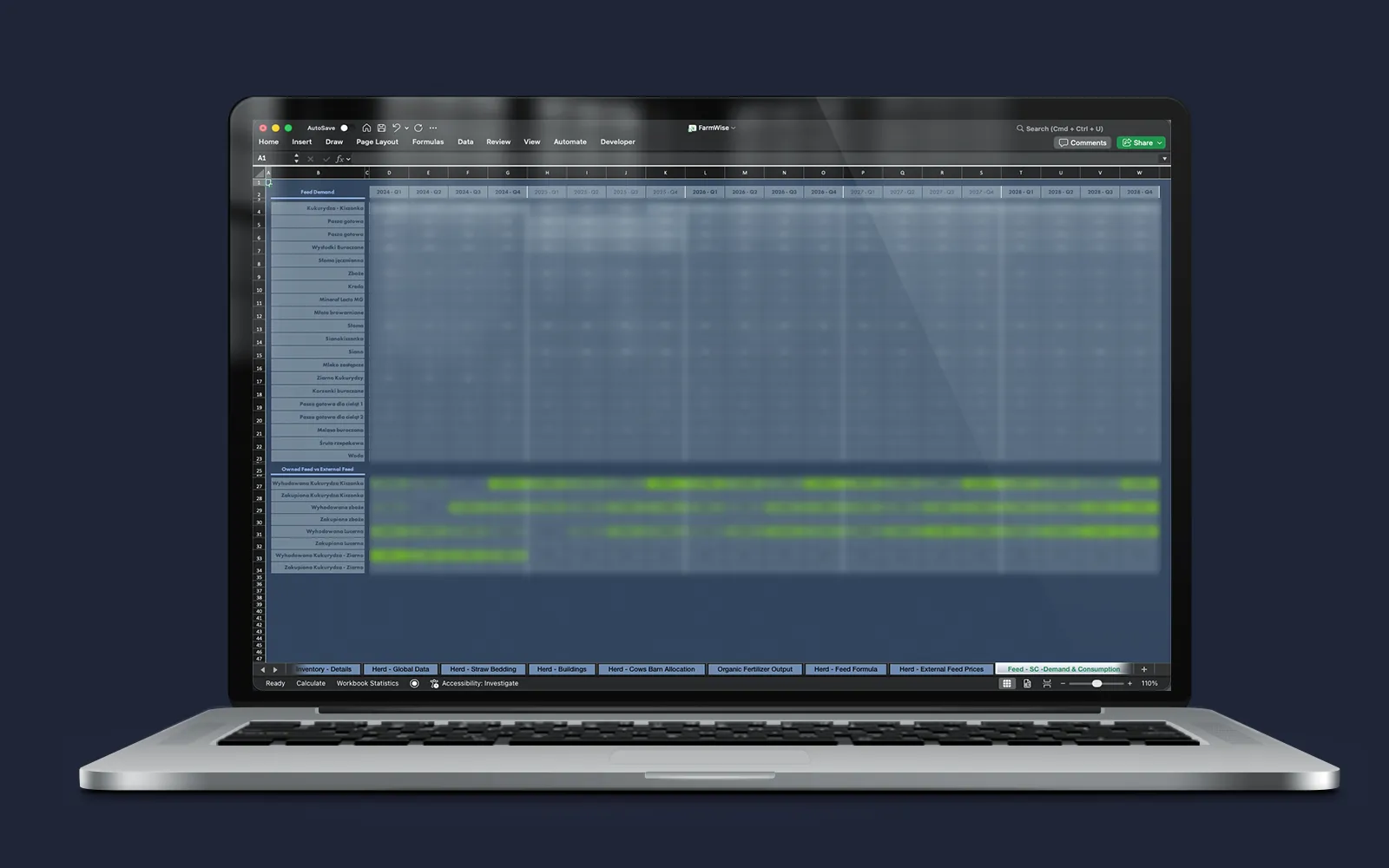
FEED DEMAND & CONSUMPTION – FUNCTIONALITIES
Quarterly demand forecast:
for each feed ingredient, forecasted quantities for the nearest quarters are provided, from 2024 Q1 to 2028 Q4. This allows ongoing tracking of demand and facilitates inventory management and order planning.
Home-grown feed vs purchased feed:
the system distinguishes between feed grown on site and purchased from suppliers. For each item, such as corn silage, grain, alfalfa or corn (grain), information is available on the quantity produced and purchased in a given quarter.
Home-grown feed:
quantities of feed from the farm’s own production, which allows for more efficient resource management.
Purchased feed:
forecasted demand for feed that needs to be purchased from suppliers in case of shortages in own production.
Inventory management and cost optimization:
thanks to the division into own and purchased feed, the module enables the user to more effectively plan purchases and minimize costs by optimizing the use of feed produced on site.
Planning based on feeding cycles:
the module takes into account variable nutritional needs resulting from the production cycles of the herd, such as lactation periods, dry periods and other production phases, which allows precise adjustment of feed demand.
Availability forecast:
the module provides forecasts regarding the availability of key feeds, enabling the farm to prepare for periods of potential shortages or surpluses, which is crucial for production stability.
Thanks to precise data, the user can accurately monitor and analyze the quantities of needed feed ingredients and their availability in warehouses and from external suppliers.
The module provides detailed forecasts, helping to manage inventories and plan feed expenses.

Herd – Organic Fertilizer Output
The Organic Fertilizer Output module is a key tool in planning and monitoring the production of natural organic fertilizers, such as manure and slurry, which come directly from animal husbandry.
This module provides comprehensive information on the amount of organic fertilizers produced each month and day, enabling more precise farm management and minimization of the costs of purchasing synthetic fertilizers.
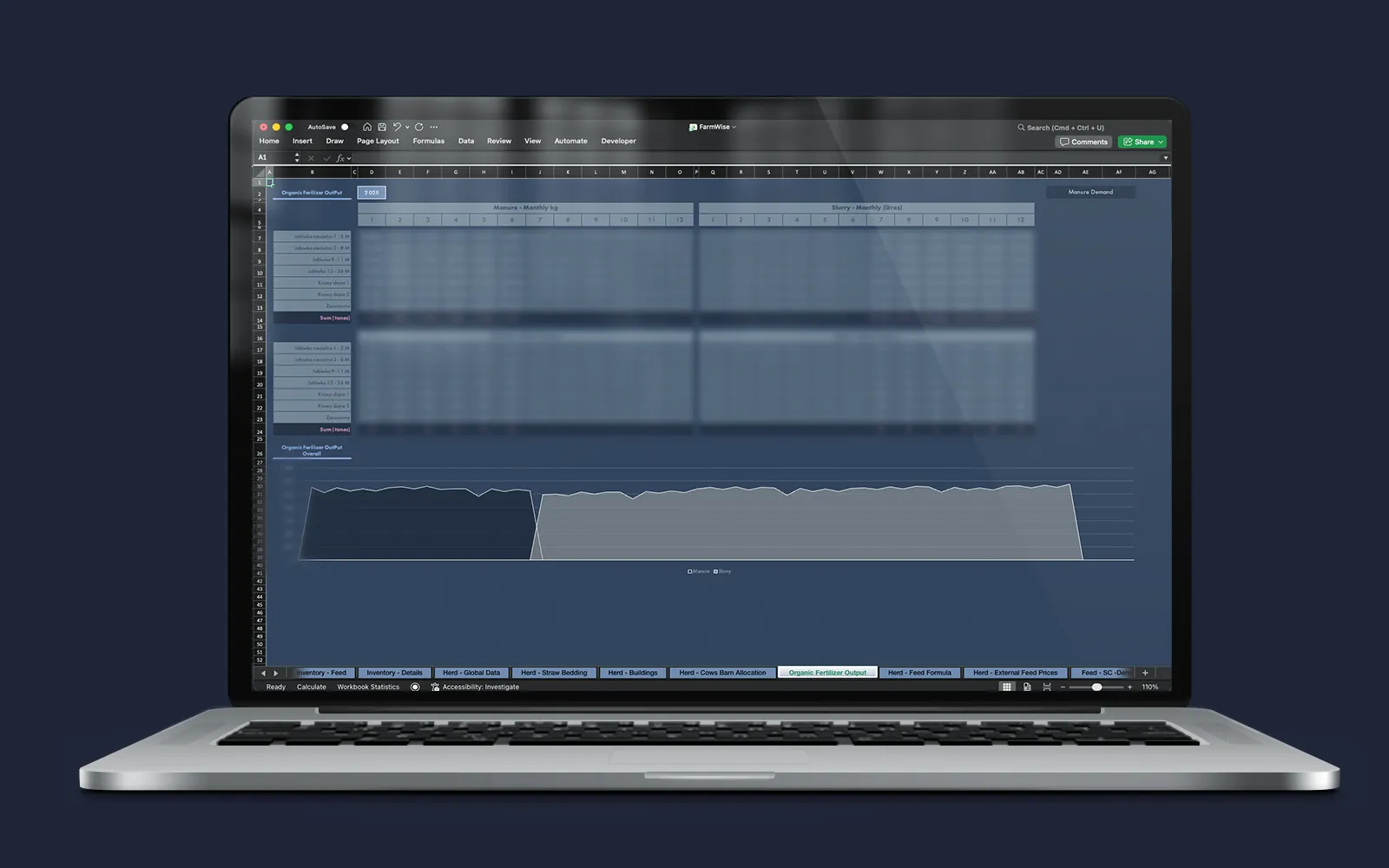
HERD: ORGANIC FERTILIZER OUTPUT – FUNCTIONALITIES
Accurate Monitoring of Fertilizer Production:
The module presents detailed data on the amount of manure (in kilograms) and slurry (in liters) produced, broken down by each month. This allows the user to track monthly and daily levels of fertilizer production from individual animal groups, such as heifers, dairy cows and dry cows.
Daily Average Production:
The module calculates the daily demand for manure and slurry (in tons), which allows for more dynamic inventory management and daily-level adjustment of activities. This allows the user to precisely calculate the daily fertilizer demand depending on the number of animals and their classification.
Integration with Herd Management:
The module is closely linked to herd data, enabling accurate fertilizer production calculations based on animal numbers and type. For example, manure and slurry production for heifers, dairy cows and dry cows is dynamically updated in accordance with herd size and the breeding cycle.
Support for Fertilization Planning:
Information from the module can be used to plan the application of organic fertilizers to fields, which supports sustainable management of soil fertility. Thanks to precise data on the amount of available fertilizer, the farm can effectively use natural resources, minimizing the need to purchase additional chemical fertilizers.
Ease of Using Data for Sustainable Agriculture:
Data from the module help the user implement a sustainable agriculture strategy, where natural fertilizers from animal production can replace synthetic fertilizers. Thanks to this, the user has full control over the amount of fertilizers produced and can match them to the actual field demand, which supports a more ecological and effective approach to crop management.
HERD: VETERINARY SERVICES PRICES
The “Veterinary Services Prices” module enables comprehensive management and monitoring of veterinary service costs, such as vaccinations, prophylactic procedures and disease treatment.
The module provides detailed insight into quarterly operating expenses related to health care for the herd, which allows for accurate budget planning and assessment of the profitability of using prophylaxis and treatment.
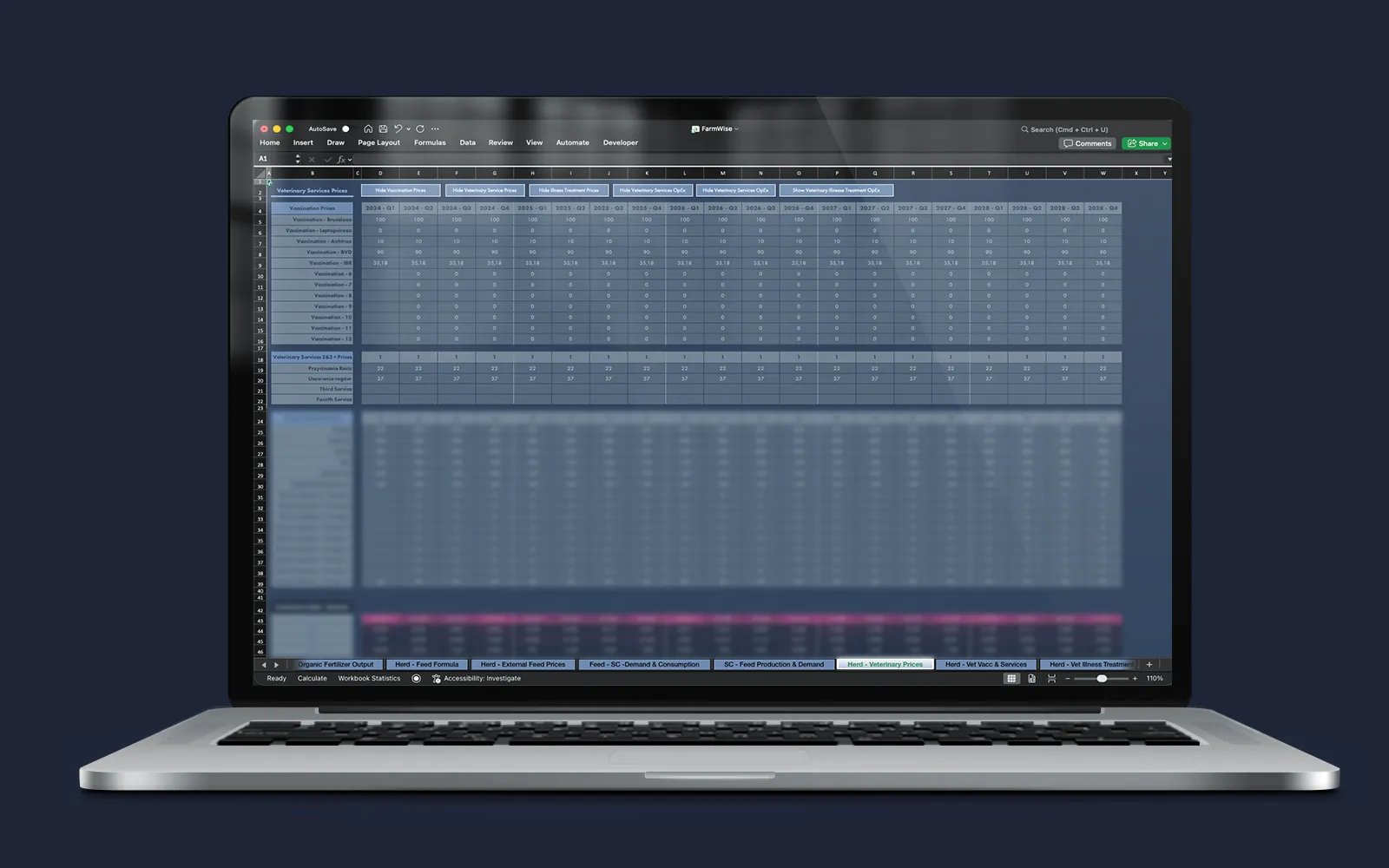
HERD: VETERINARY SERVICES PRICES- FUNCTIONALITIES
Precise forecasts of veterinary expenses:
the user has full insight into future operating costs related to health care, which facilitates budgeting, optimization and expense control.
Analysis of prophylaxis and treatment costs:
possibility of comparing expenses on vaccinations with the costs of disease treatment, which allows assessment of the profitability of prophylactic actions.
Monitoring changes over time:
the module enables analysis of expenses on a quarterly basis, which allows identification of possible increases or decreases in costs and adjustment of the veterinary strategy on the farm.
Thanks to the “Veterinary Services Prices” module, the user can better manage herd health and make decisions based on real data on veterinary costs, which contributes to increasing the efficiency and profitability of the farm.
HERD: VETERINARY VACCINATIONS AND SERVICES
This tool allows precise management of the vaccination and veterinary procedure schedule for cattle, based on animal age.
The module enables planning of health prophylaxis and routine veterinary services, which supports maintaining the health and productivity of the herd.
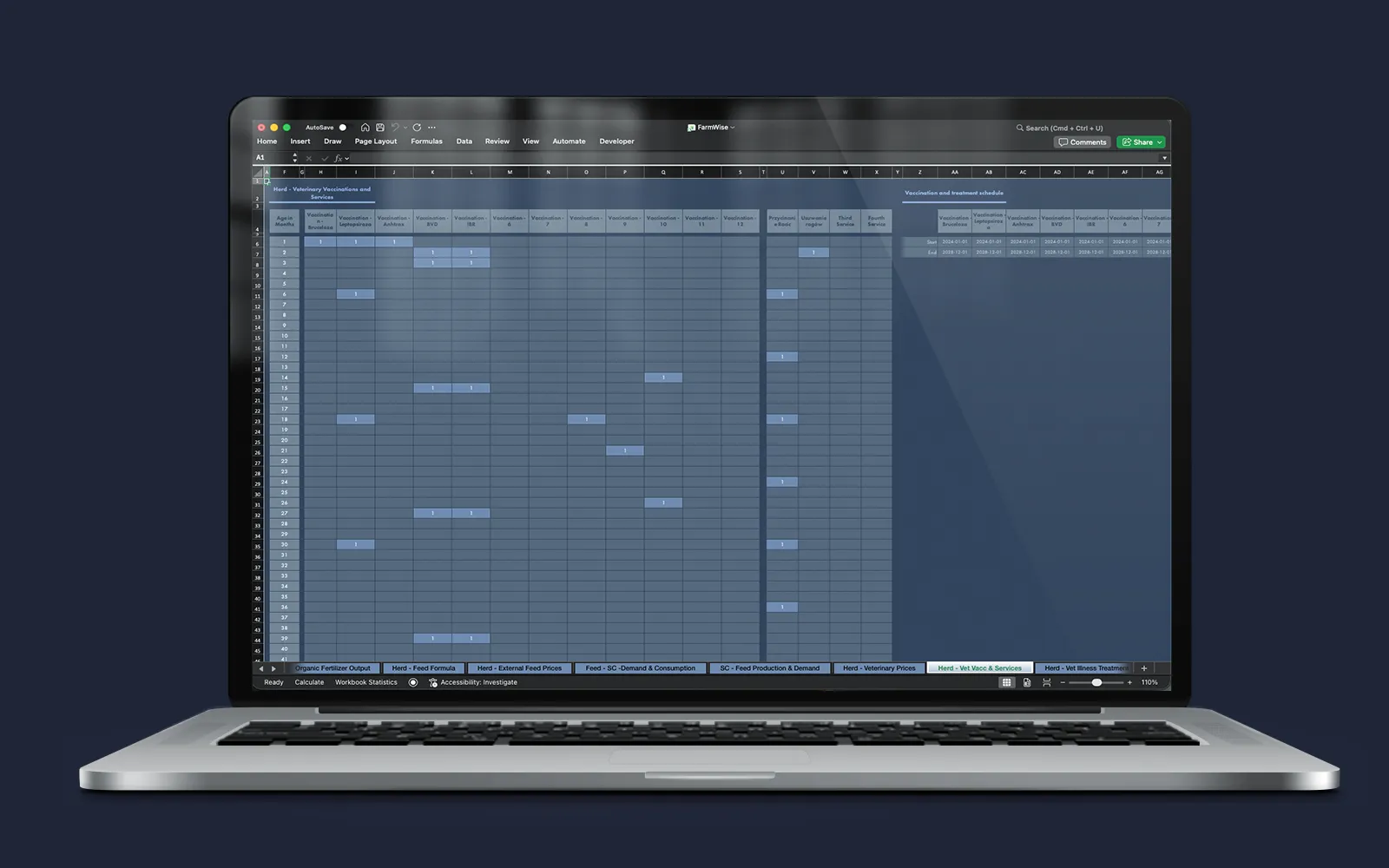
HERD: VETERINARY VACCINATIONS AND SERVICES PRICES- FUNCTIONALITIES
Vaccination Schedule
the module contains a detailed vaccination plan in relation to animal age, taking into account different types of vaccines and the frequency of their use:
Brucellosis
planned vaccinations in specific months of life, which are repeated every few years to maintain immunity.
Leptospirosis, Anthrax, BVD, IBR
detailed months of vaccinations to effectively counteract selected diseases, increasing the health protection of the herd.
Additional vaccines
allow flexible addition of vaccinations in accordance with breeding requirements or specific health needs.
Life cycle monitoring
the module automatically analyzes animal age and assigns it to appropriate vaccination and procedure cycles, thanks to which the user does not have to manually assign a schedule for each animal. The system itself takes into account the beginning and end of the vaccination and procedure cycle, eliminating the need for manual tracking of age and health status of each animal.
Adjustment to start and end dates
the module automatically adjusts the schedule to individual start and end dates for each animal group. Thanks to this, the user can precisely monitor when the prophylactic cycle began and when planned endings or breaks in the schedule are.
HERD: VETERINARY SERVICES PRICES- BENEFITS
Precise prophylaxis planning
vaccination and veterinary procedure schedule, adapted to animal age, allows effective prophylaxis and minimizing the risk of disease occurrence in the herd.
Process automation
automatic assignment of vaccination and procedure cycles eliminates the need for manual schedule tracking and reduces the risk of errors.
Cost optimization
systematic vaccinations and prophylactic procedures help limit expenses related to disease treatment, which affects the improvement of farm profitability.
HERD: TECHNICAL COST – MILK PRODUCTION
The module enables detailed analysis of technical costs of milk production, broken down by production cycles, taking into account all key cost components: feed, energy, straw for bedding, veterinary services and insurance. This allows full management of operating costs of milk production and monitoring of expenses.
Margin and Profitability Analysis:
The module calculates the margin, taking into account the difference between revenues and technical costs. Thanks to this, the user can observe the profitability of production in different cycles and identify the most profitable periods and areas for optimization.
Automatic Calculation of Technical Costs:
Technical costs are calculated automatically based on data on herd size, feed consumption, energy, fuel and other resources. The user can track technical costs of production, as well as analyze their variability in relation to herd structure and forecasted production.
Calculation of Technical Costs per Liter of Milk:
The module allows detailed calculations of technical costs per liter of milk produced, which enables analysis of production cost efficiency. Thanks to this, it is possible to precisely determine profitability per production unit and adjust the production strategy.
Profitability and Margin Forecast for Each Cycle:
The system forecasts margins and production profitability based on the difference between revenues and operating costs for each production cycle. Profitability analysis enables identification of the most profitable production periods and decisions on possible modifications to herd management strategy.
HERD: TECHNICAL COST – MILK PRODUCTION BENCHMARK
The Technical Cost – Raw Milk module is an advanced tool for analyzing technical costs related to raw milk production, which enables detailed monitoring of expenses and revenues related to every aspect of production.
It is designed so that the user can precisely manage costs and effectively analyze production profitability over months and years, taking into account any changes in the technological process – from sowing to raw milk production.
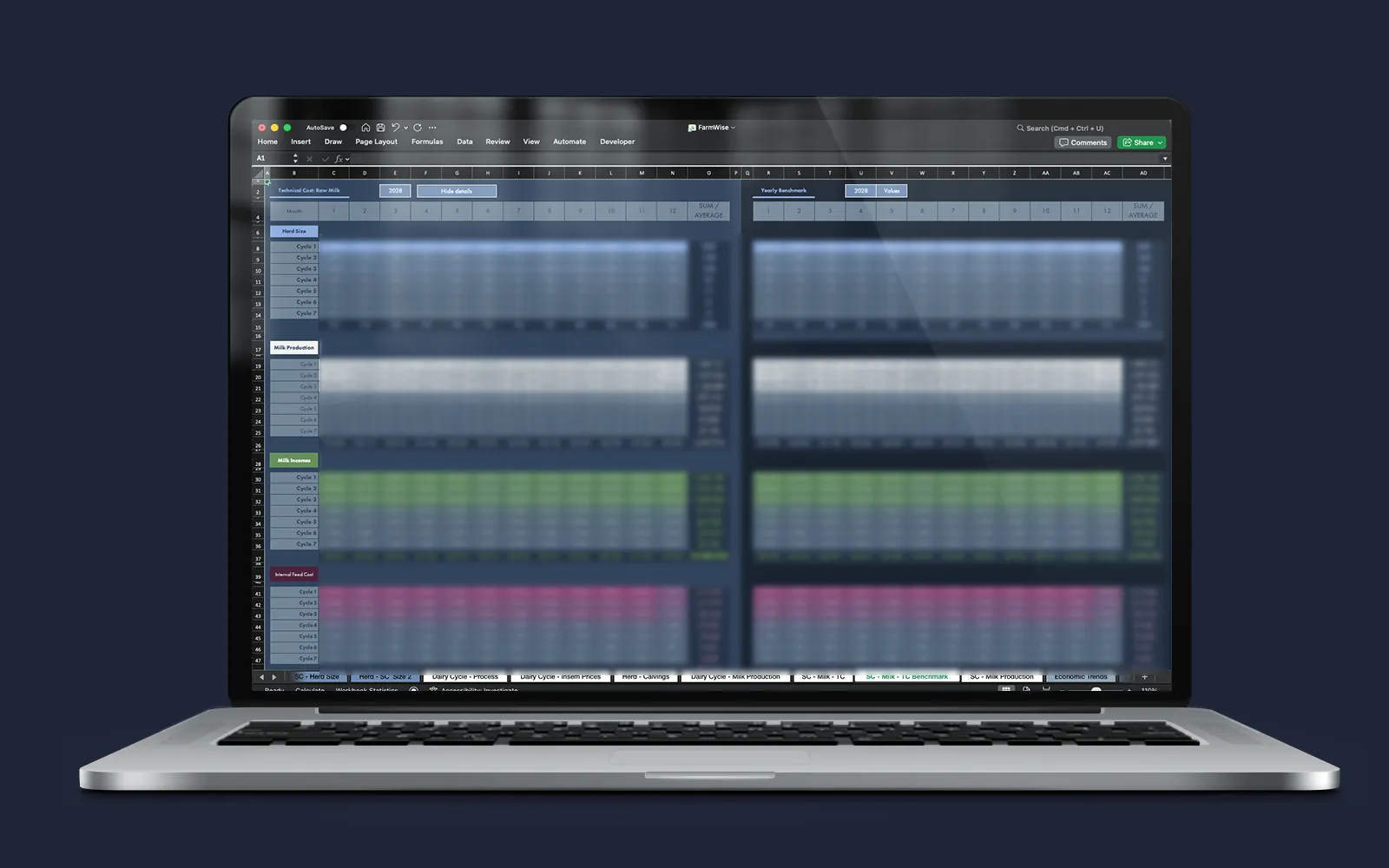
HERD: TECHNICAL COST – MILK PRODUCTION BENCHMARK – FUNCTIONALITIES
Detailed monitoring of costs and revenues:
The user can track all operating expenses related to milk production, such as feed costs, energy, straw for bedding, fertilizers, insemination and veterinary services. Additionally, the module collects data on revenues from milk production, enabling full financial analysis of each production cycle.
Production profitability analysis:
Thanks to the ability to monitor results on a monthly and annual basis, the module supports the user in long-term profitability analysis. The user can identify periods of higher or lower profitability and introduce changes in the production strategy.
Taking into account technological and process changes:
The module was designed with the dynamic nature of the farm in mind – it allows introduction of changes in the technological process, such as new feeding methods, changes in milking technology, or optimization of the insemination system. Thanks to this, the user can simulate the effects of implemented improvements and analyze their impact on costs and margins.
Comparing results with other years:
The module offers functionality that allows comparison of results with previous years or any selected year. In this way, the user can see how changes introduced on the farm – both operational and technological – affect profitability and margins achieved in milk production. Thanks to this function, it is easy to assess which decisions brought the best financial results.
Quick strategy adjustment:
The module is flexible and adapted to conducting financial simulations, which allows the user to quickly respond to changing market or production conditions. Thanks to this, the tool supports cost optimization and margin maximization, taking into account the specifics of agricultural activity at the same time.
EFAR
The EFAR module is an advanced tool for managing fixed assets of the farm, which provides control and analysis of asset value, both from the accounting and market side. EFAR functionality includes full asset records, enabling tracking of investments, depreciation and modernization.
Main functionalities:
- Records of fixed assets and investments.
- Separation of capital and operating costs related to asset maintenance.
- Analysis of the impact of investments on the book and market value of the enterprise.
The EFAR (Extended Fixed Assets Register) module was designed with positions that are not included in the standard Fixed Assets Register in mind.
Its aim is to monitor costs related to these positions and include them in the valuation of the enterprise’s adjusted net assets.
Thanks to this module, it is possible to more precisely manage values that affect the real value of the enterprise’s assets, even if they are not formally included in traditional accounting records.
EFAR – FUNCTIONALITIES
Registration of Fixed Assets:
- Records of fixed assets along with their basic data (purchase cost, acquisition date, useful life).
- Possibility of assigning assets to appropriate categories (buildings, machines, devices).
- Automatic calculation of accounting depreciation of assets and their net value.
Analysis of Market and Book Value:
- Dynamic estimation of the market value of fixed assets based on market parameters.
- Comparison of book value with market value in order to better understand the current value of assets.
- Determining the future value of assets assuming different market scenarios.
Reporting and Visualization:
- Creating reports on the status and value of fixed assets and their impact on financial indicators.
- Visualizations of costs and asset values in different economic scenarios.
- Summaries of operating and capital costs for management, enabling quick decision-making.
Scenarios of Future Asset Valuation:
- Possibility of simulating asset values under different assumptions regarding inflation, changes in market prices and operating costs.
- Dynamic scenario analysis of the impact of investments on the future value of the company.
- Assessment of profitability and return on investment for each scenario.
Depreciation
The Depreciation module allows comprehensive management of depreciation, which is of key importance for the long-term strategy of asset management and the accuracy of financial analyses.
This module allows not only strict monitoring of depreciation costs on an accounting basis, but also analysis of the impact of depreciation on the operating and financial result of the company.
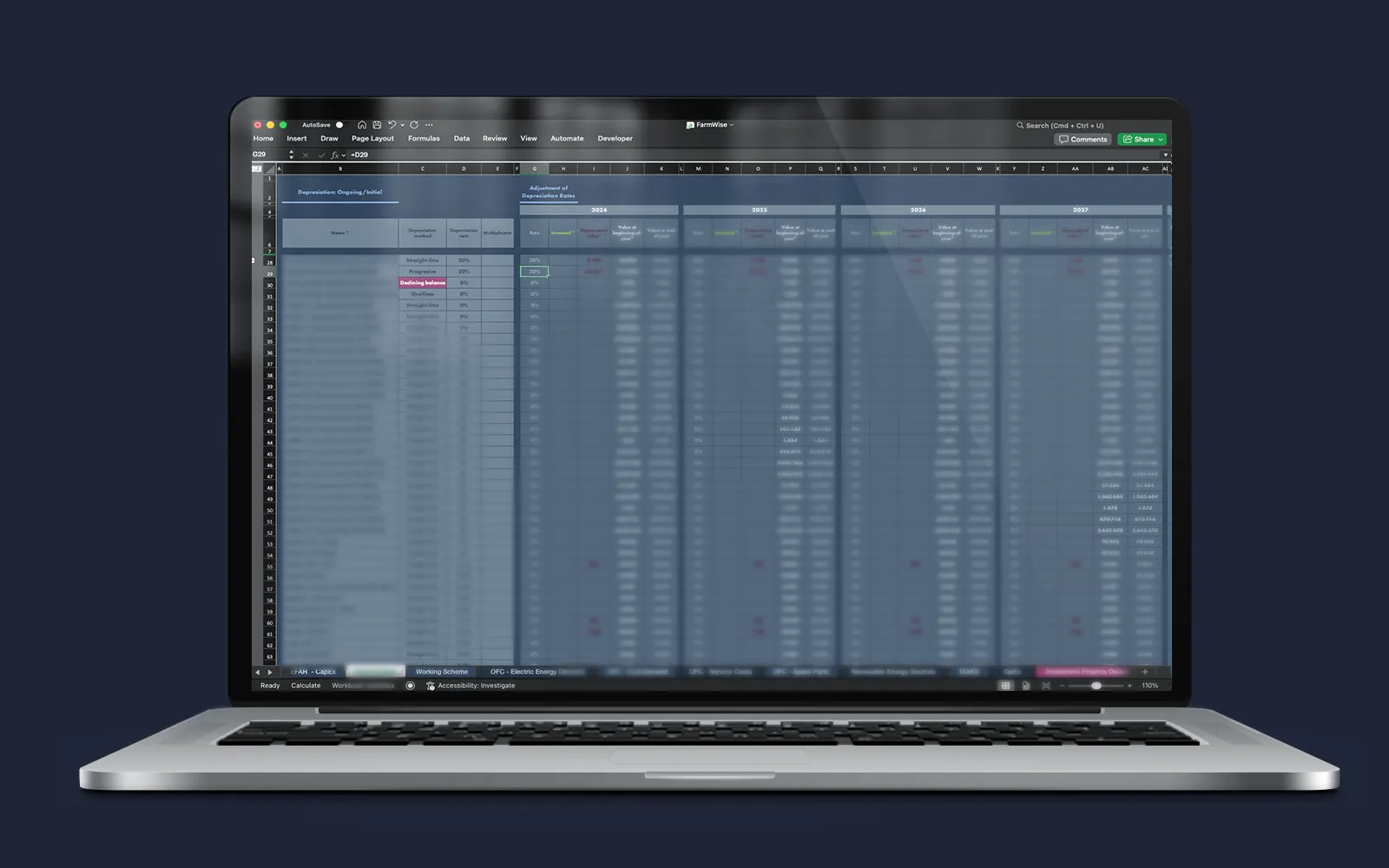
DEPRECIATION – FUNCTIONALITIES
Choice of depreciation method
possibility of choosing the depreciation method for each asset (straight-line, declining balance, other).
Adjustment to investments
automatic updates of depreciation for assets that have been improved or increased in value through investments.
Impact on financial result
calculation of depreciation costs and their direct impact on operating result and book valuation.
Valuation of adjusted net assets
Depreciation reporting
EFAR – CAPEX
The CaPex module in EFAR manages all investment expenses that affect the development and modernization of the farm.
It allows planning and analysis of the profitability of future investments, such as purchase of machinery, construction of buildings or installation of technologies.
EFAR – CAPEX – FUNCTIONALITIES
- Planning of investment expenses broken down by years with dynamically calculated financial results of the enterprise
- Analysis of return on investment and impact on the value of the enterprise.
- Ability to dynamically model investment scenarios depending on market conditions.
EFAR MODULE OFC (OPEX FROM CAPEX)
The module is key to business and investment process planning and management, allowing users to model costs related to the operation of assets within additional OFC type modules such as :
- energy demand,
- fuel,
- maintenance,
- replacement of spare parts,
- insurance.
EFAR – CAPEX & OFC FUNCTIONALITIES
Investment Management and Analysis:
- Handling investment projects as new assets or capitalization of existing ones (division into six investment stages).
- Modeling of investment costs for new projects and their impact on asset value.
Monitoring the implementation of investments at every stage and analysis of their impact on the long-term strategy of the company
Operational Effects of Assets (OpEx):
- Calculation of operating costs related to the operation of fixed assets.
- Analysis of energy consumption, fuel demand, maintenance costs and spare parts.
- Assignment of operating costs to appropriate sections in the financial model for full OpEx analysis.
OFC: Fuel Consumption
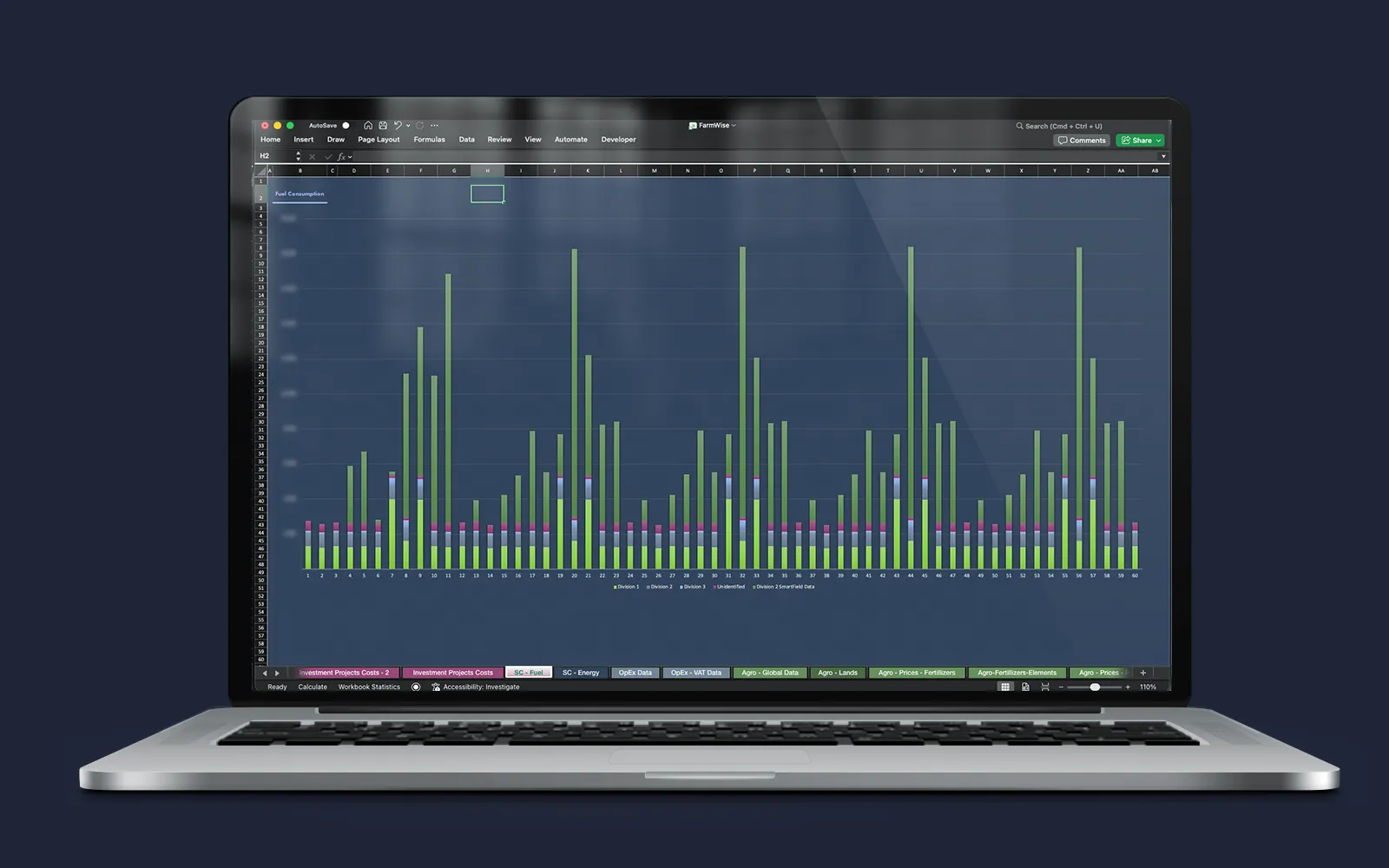
The OFC OpEx From CaPex: Fuel Consumption module is a tool for monitoring and analyzing fuel consumption by individual agricultural machines in the enterprise.
It provides a comprehensive overview of operating costs related to energy consumption in various areas of farm activity.
Thanks to this module, the user can precisely track energy consumption and better manage the budget, which is key in the context of cost optimization.
OFC: FUEL CONSUMPTION – FUNCTIONALITIES
Tracking fuel consumption for different types of vehicles and machines:
The module enables monitoring of fuel consumption for each machine and vehicle separately, regardless of their type (tractors, delivery vehicles, loaders, etc.). This allows the user to accurately analyze fuel costs depending on the equipment category and its use on the farm.
Adjustment of work schedule to monthly fuel demand:
The module allows taking into account different work schedules for individual machines, taking into account the number of working hours per day. This functionality is key in the context of the seasonality of agricultural work, when fuel consumption can vary significantly depending on the time of year.
Modeling of fuel efficiency:
For vehicles used for longer distance transport, the module allows entering a fuel efficiency indicator (fuel consumption per 100 km). This allows the user to better assess fuel costs depending on the distance traveled in a given month.
Monitoring of fuel type:
The module allows entering the type of fuel (e.g. Diesel, CNG), which enables cost analysis based on specific market prices for different fuels. This allows the user to monitor fuel expenses in a more detailed way, which is key in the context of variable fuel prices on the market.
Fuel consumption forecast:
Thanks to the ability to enter working hours and distances traveled in a month, the module allows forecasting monthly fuel demand. This is particularly important in planning operating costs, as well as in the process of budgeting.
Cost division analysis by departments:
The module includes the possibility of assigning fuel costs to different departments, which enables accurate tracking and allocation of fuel costs. This facilitates cost accounting and supports effective management of expenses in individual areas of activity.
OFC: FUEL CONSUMPTION – BENEFITS
Precise control of fuel costs:
The module enables ongoing monitoring of fuel costs and identification of areas where savings are possible.
Operational optimization:
Thanks to the ability to analyze fuel consumption depending on the work schedule and fuel efficiency, the user can adjust the machine work plan to optimize fuel costs.
Support in budgeting:
The module allows forecasting fuel demand in different periods of the year, which is helpful in creating a budget and comparative analyses of actual and planned costs.
Flexibility in cost allocation:
The possibility of assigning fuel costs to individual departments enables better management of expenses on the scale of the entire farm.
The OpEx From CaPex: Fuel Consumption module is a tool supporting comprehensive and precise fuel cost management, adapted to the specifics of agricultural activity and the diversity of equipment used.
EFAR MODULE OFC – SERVICE
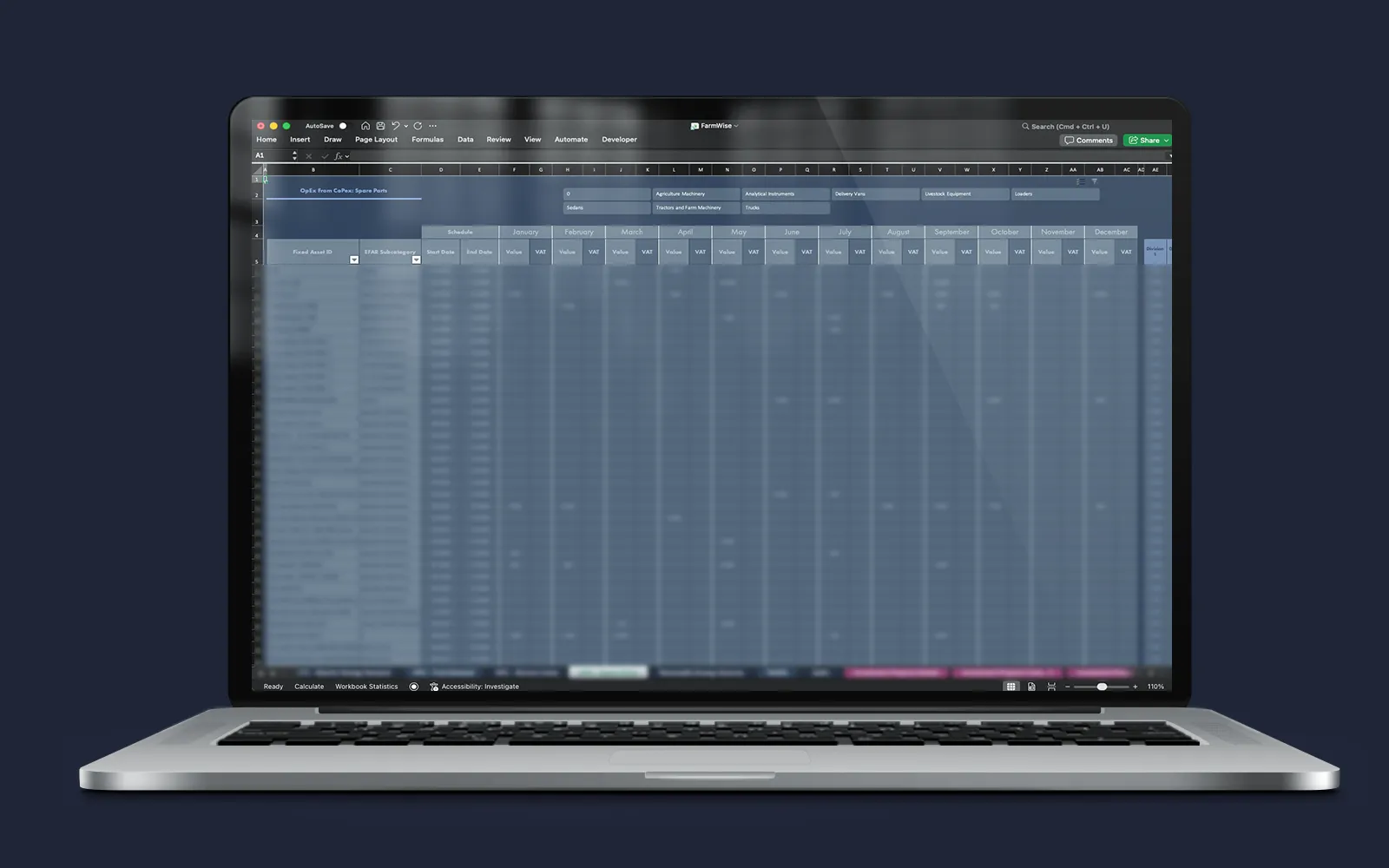
It is a tool in the operating cost management system, focused on recording and forecasting costs of servicing and maintenance of fixed assets on the farm.
In particular, this module enables assignment of service costs to specific assets, such as agricultural machines, vehicles and equipment for animal management, as well as tracking expenses over months.
OFC: SERVICE – FUNCTIONALITIES
Assignment of service costs to assets:
The module allows detailed assignment of service costs to individual fixed assets, such as tractors, trailers, devices for cattle management or agricultural machines. Each piece of equipment is marked with a unique ID, which enables precise tracking of its maintenance costs.
Service schedule management:
Thanks to the function of setting the start and end date for each asset, the user can easily manage the service schedule throughout the year, adapting it to planned seasonal work. The module also takes into account the variability of costs in different periods of the year, which allows optimization of maintenance expenses.
OFC: SERVICE – BENEFITS
Better control of service costs:
The module allows detailed tracking of costs related to servicing assets, which facilitates budget control and identification of areas where savings can be introduced.
Optimization of service planning:
Thanks to the possibility of forecasting service expenses and assigning costs to months, the module supports optimal service planning, which minimizes the risk of costly downtime.
Support in cost allocation:
Division of costs into departments allows precise allocation of expenses, which supports budget management at the level of the entire farm.
OFC: Spare Parts
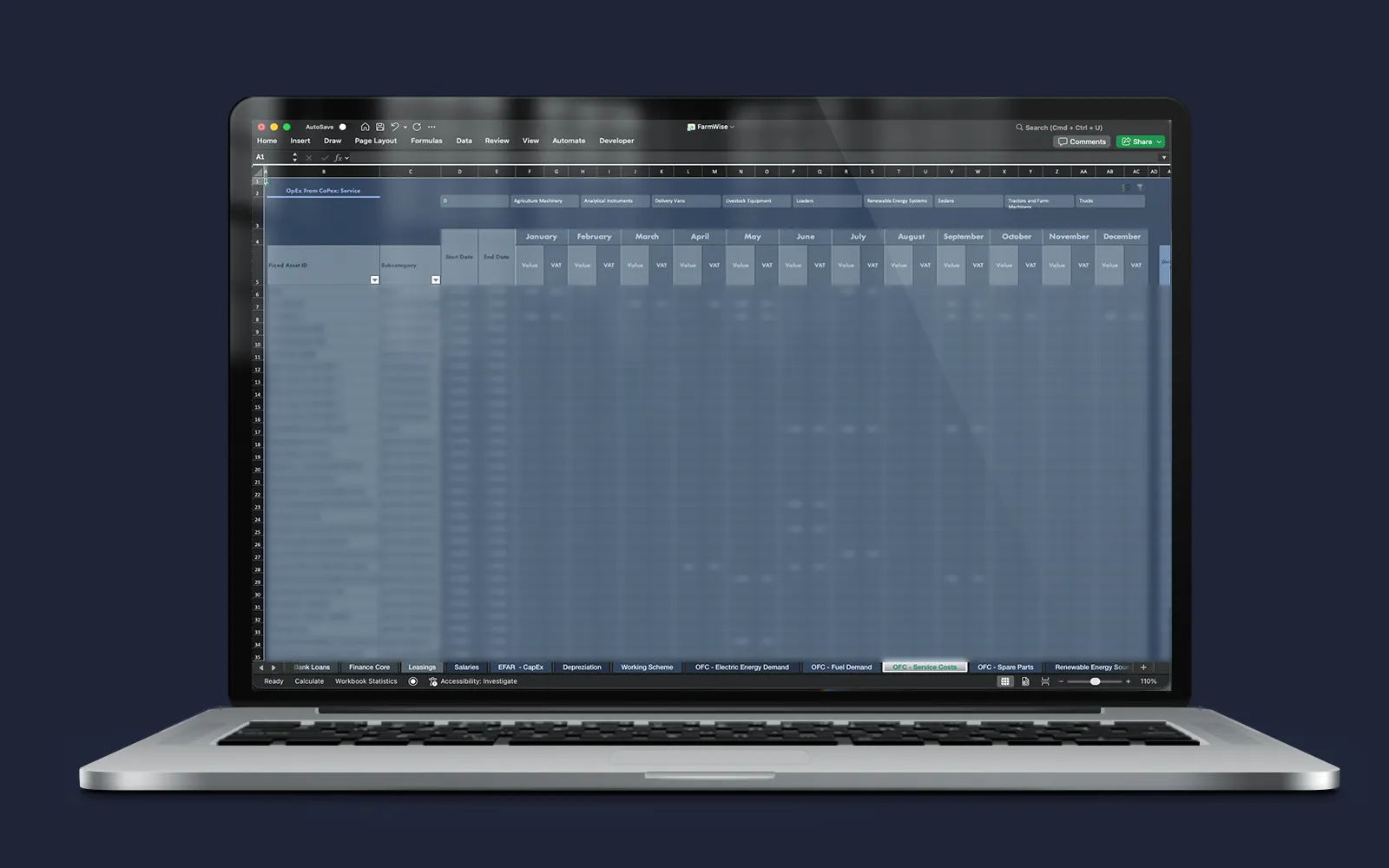
The OFC OpEx From CaPex: Spare Parts module is an integral part of managing operating costs related to the purchase and maintenance of spare parts for fixed assets on the farm.
Thanks to this module, it is possible to accurately track expenses on spare parts that are necessary to keep equipment and machines in good technical condition, which is crucial for the uninterrupted course of operational work.
OFC: SPARE PARTS – BENEFITS
Tracking spare parts costs by assets:
Every cost related to the purchase of spare parts is assigned to a specific fixed asset, which enables accurate monitoring of expenses on individual machines and devices, such as tractors, trailers, devices for animal management or delivery vehicles.
Precise monitoring of spare parts costs:
The module allows detailed tracking of expenses on spare parts, which enables better budget control and planning of future expenses.
Purchase optimization:
Thanks to forecasting costs and the purchase schedule, it is possible to better manage purchases of spare parts, which minimizes the risk of downtime resulting from the lack of availability of key parts.
OFC: ELECTRIC ENERGY CONSUMPTION
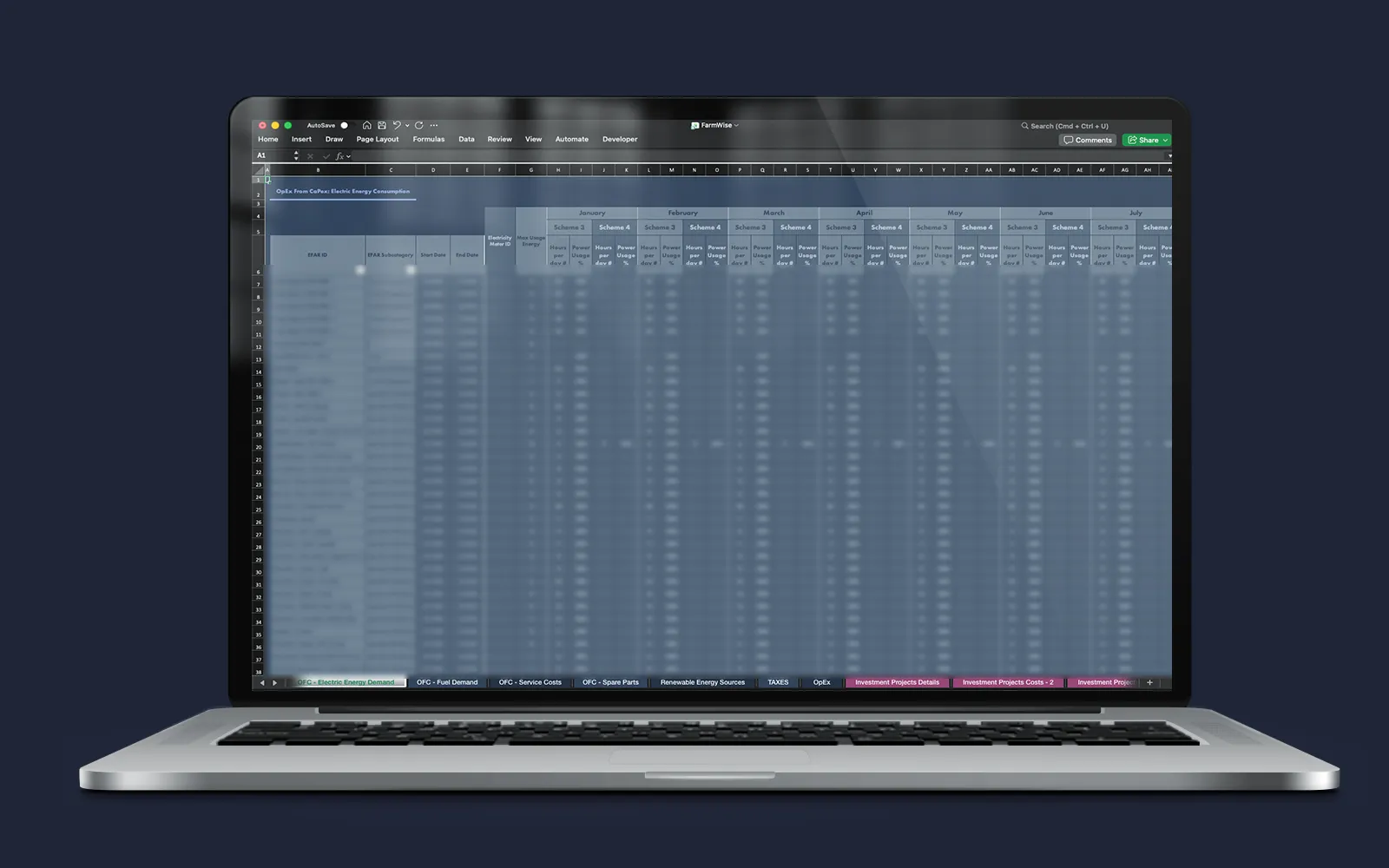
The OFC OpEx From CaPex: Electric Energy Consumption module is a tool for monitoring and analyzing electricity consumption by individual devices and machines in the enterprise.
It provides a comprehensive overview of operating costs related to energy consumption in various areas of business activity.
Thanks to this module, the user can precisely track energy consumption and better manage the budget, which is key in the context of cost optimization.
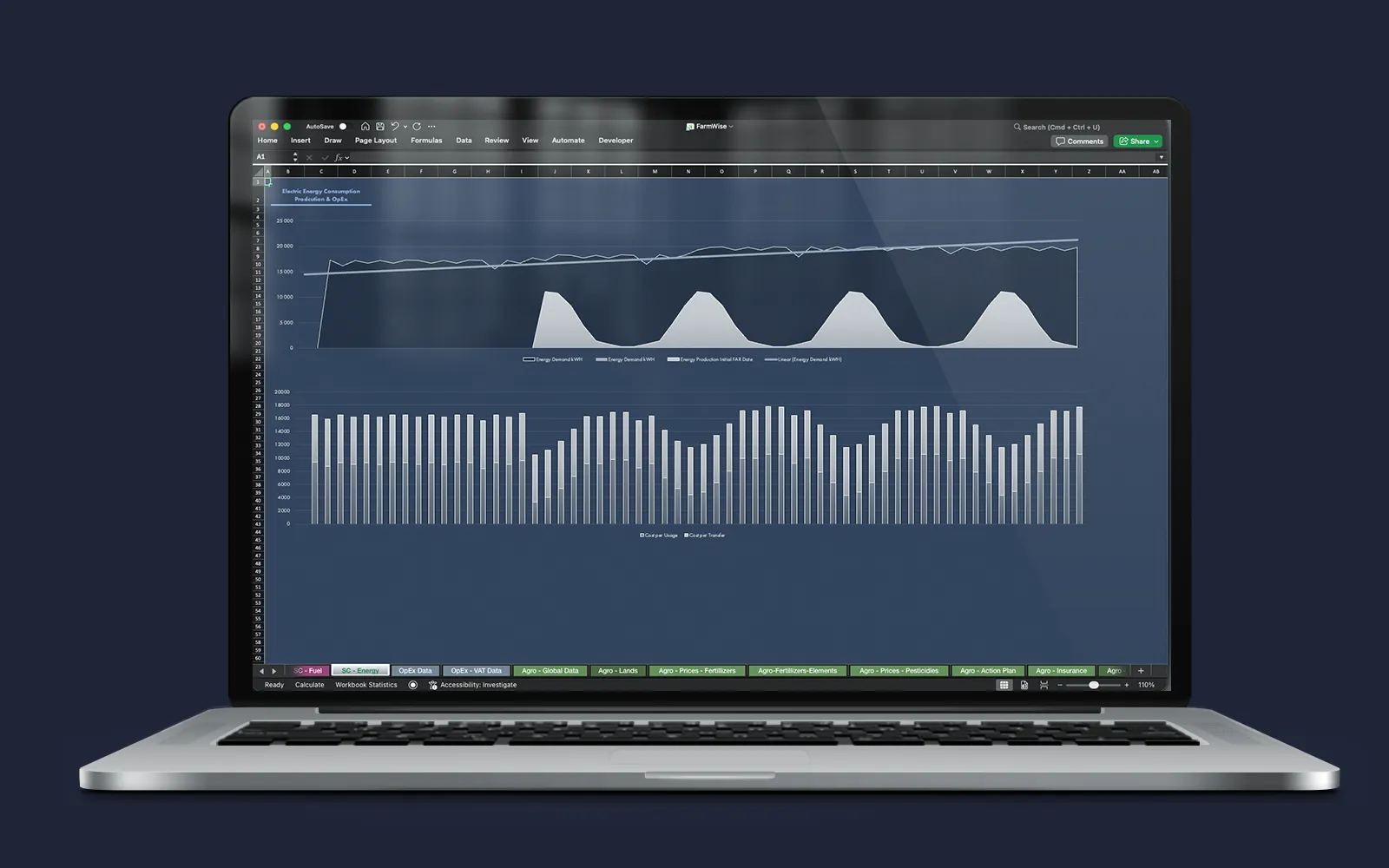
OFC: ELECTRIC ENERGY CONSUMPTION
Registration and classification of devices:
Each device or machine consuming electricity is registered in the module and assigned to the appropriate category and unique identifier (ID), such as EFAR ID and subcategory. This allows detailed tracking of costs related to the operation of each piece of equipment, which facilitates analysis and cost allocation.
Date range of use:
The module allows setting the start and end date of use for each device, which allows precise inclusion of only those periods in which the device is actively used. Thanks to this, costs are more accurately assigned to appropriate periods and future expenses can be better planned.
Maximum power and usage profile:
For each device, its maximum power (kW) is defined, as well as the number of working hours per day and the percentage level of power utilization in different operational schemes. This allows the user to analyze costs depending on the intensity of use of individual machines.
Monthly analysis and operational schemes:
The module allows entering energy consumption data for each month with distinction between different operational schemes (e.g. Scheme 3 and Scheme 4). This allows identification of seasonal patterns in energy consumption and better management of operating costs depending on the time of year.
Cost division by divisions and projects:
Energy consumption can be assigned to different divisions, which enables more detailed cost analysis broken down into individual areas of farm activity.
The module also supports assignment of costs to specific investment projects, which enables assessment of the profitability of individual investments through accurate monitoring of energy costs related to these projects.
OFC: ELECTRIC ENERGY CONSUMPTION – BENEFITS
Precise control of energy costs:
The module allows detailed monitoring of electricity costs at the level of a single device. This enables better budget planning and reduction of unnecessary expenses.
Optimization of seasonal operations:
Thanks to the possibility of entering detailed data at the monthly level, the user can better manage energy consumption in the context of seasonal fluctuations in agricultural activity.
Support in the analysis of investment projects:
Assignment of energy costs to specific projects allows for more precise assessment of the profitability of individual investments, which is important when making decisions on capital allocation.
Increased management efficiency:
Thanks to the module, the user has full insight into energy consumption and can make conscious decisions regarding energy efficiency, which is particularly important in the face of rising energy costs and pressure for sustainable development.
Precise control of energy costs:
The module allows detailed monitoring of electricity costs at the level of a single device. This enables better budget planning and reduction of unnecessary expenses.
Optimization of seasonal operations:
Thanks to the possibility of entering detailed data at the monthly level, the user can better manage energy consumption in the context of seasonal fluctuations in agricultural activity.
Support in the analysis of investment projects:
Assignment of energy costs to specific projects allows for more precise assessment of the profitability of individual investments, which is important when making decisions on capital allocation.
Increased management efficiency:
Thanks to the module, the user has full insight into energy consumption and can make conscious decisions regarding energy efficiency, which is particularly important in the face of rising energy costs and pressure for sustainable development.
RES (RENEWABLE ENERGY SOURCES)
The RES (Renewable Energy Sources) module focuses on the financial and technical analysis of photovoltaic (PV) installations.
The entered data includes installation details, power, commissioning date and insolation factor. Based on this information, the module forecasts energy production, comparing it with energy demand data from the OFC – Energy Demand module.
Energy prices can be dynamically modeled using the Market Trend module, which allows accurate forecasts regarding costs and savings resulting from PV implementation.
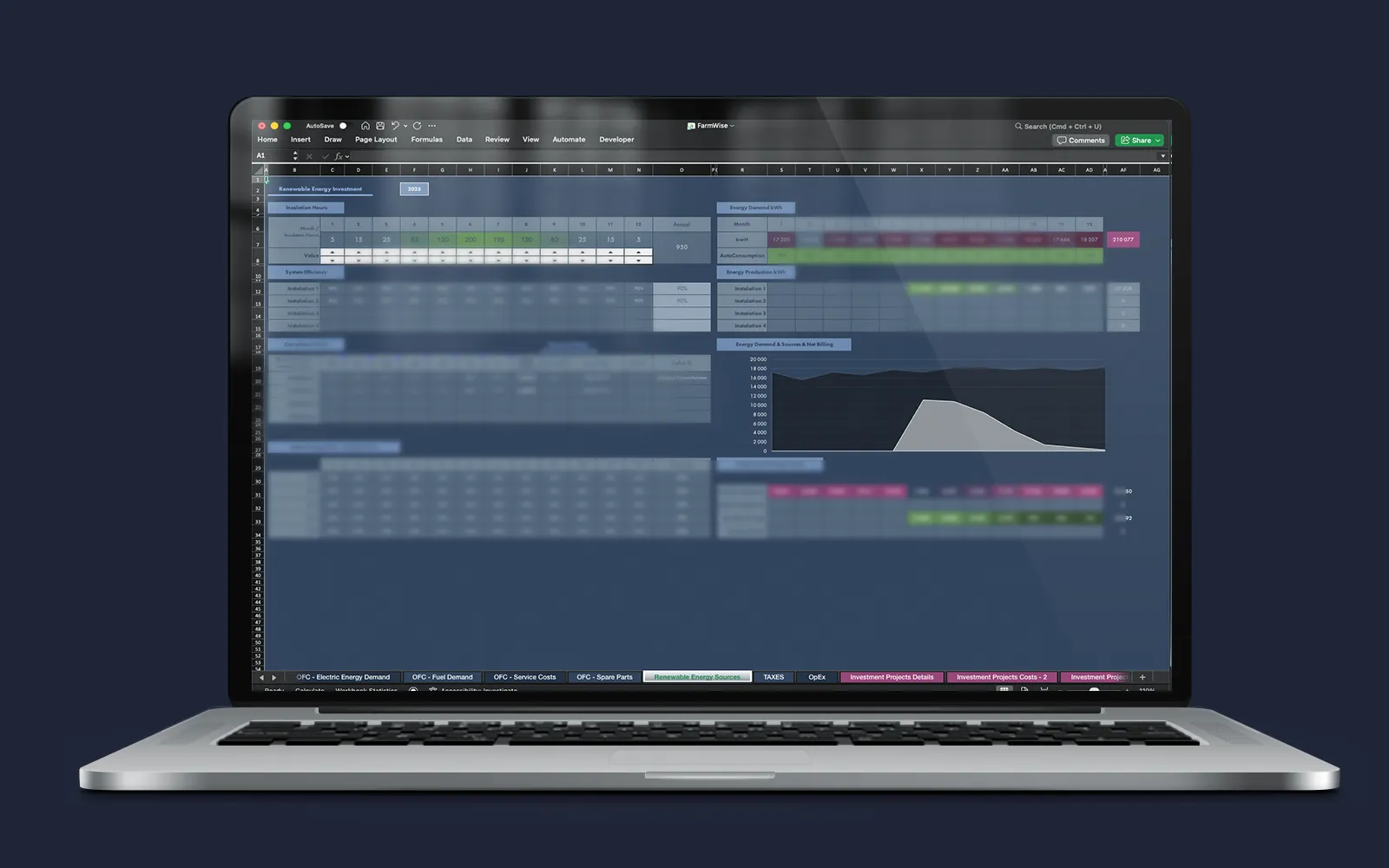
The RES module is a tool designed to model and analyze costs and benefits associated with the use of renewable energy sources, such as photovoltaic (PV) systems.
It allows the user to track and evaluate the efficiency of investments in renewable energy sources and their impact on the farm’s operating costs.
Thanks to this module, a more sustainable structure of energy costs can be achieved, which is important in the context of reducing dependence on traditional energy suppliers and reducing greenhouse gas emissions.
RES (RENEWABLE ENERGY SOURCES)- FUNCTIONALITIES
PV installation configuration:
The module allows entering detailed parameters regarding the photovoltaic installation, such as commissioning date, installed power (kW), panel orientation, system efficiency and insolation data. This allows accurate reflection of the specifics of each installation and its potential energy production.
Energy production modeling:
Thanks to the introduction of insolation data and coefficients of conversion of solar energy into electricity, the module calculates monthly and annual energy production from the PV installation. This allows forecasting how much energy will be produced, and consequently, what percentage of the farm’s energy demand will be covered from renewable sources.
Cost and savings analysis:
The RES module allows accurate comparison of costs of energy obtained from traditional sources with costs related to renewable energy. Thanks to this, the user can analyze savings resulting from investment in a PV system and predict after what time the investment will start to bring real savings (the so-called payback period).
Integration with the OFC – Energy Demand module:
The RES module is linked to the OFC – Energy Demand module, which models the farm’s energy demand. Thanks to this integration, it is possible to precisely compare energy production from the PV system with the actual energy consumption on the farm. This allows assessment of whether the PV installation covers the entire or part of the demand and allows estimation of the costs of purchasing energy from the external grid in case of shortage.
The RES module is an advanced tool enabling precise management and optimization of costs and benefits associated with investments in renewable energy sources, contributing to increased operational efficiency and sustainable development of the farm.
OPEX
The OpEx module provides a comprehensive and integrated insight into operating expenses, thanks to which the user can better understand the cost structure and make more conscious financial decisions. Integration of automatic forecasts with budgeted costs allows full coverage of all aspects of the enterprise’s operations and enables precise financial control.
Thanks to the OpEx module, management of operating costs is much more efficient and adapted to the specific needs of the enterprise, ensuring financial stability and facilitating long-term planning.
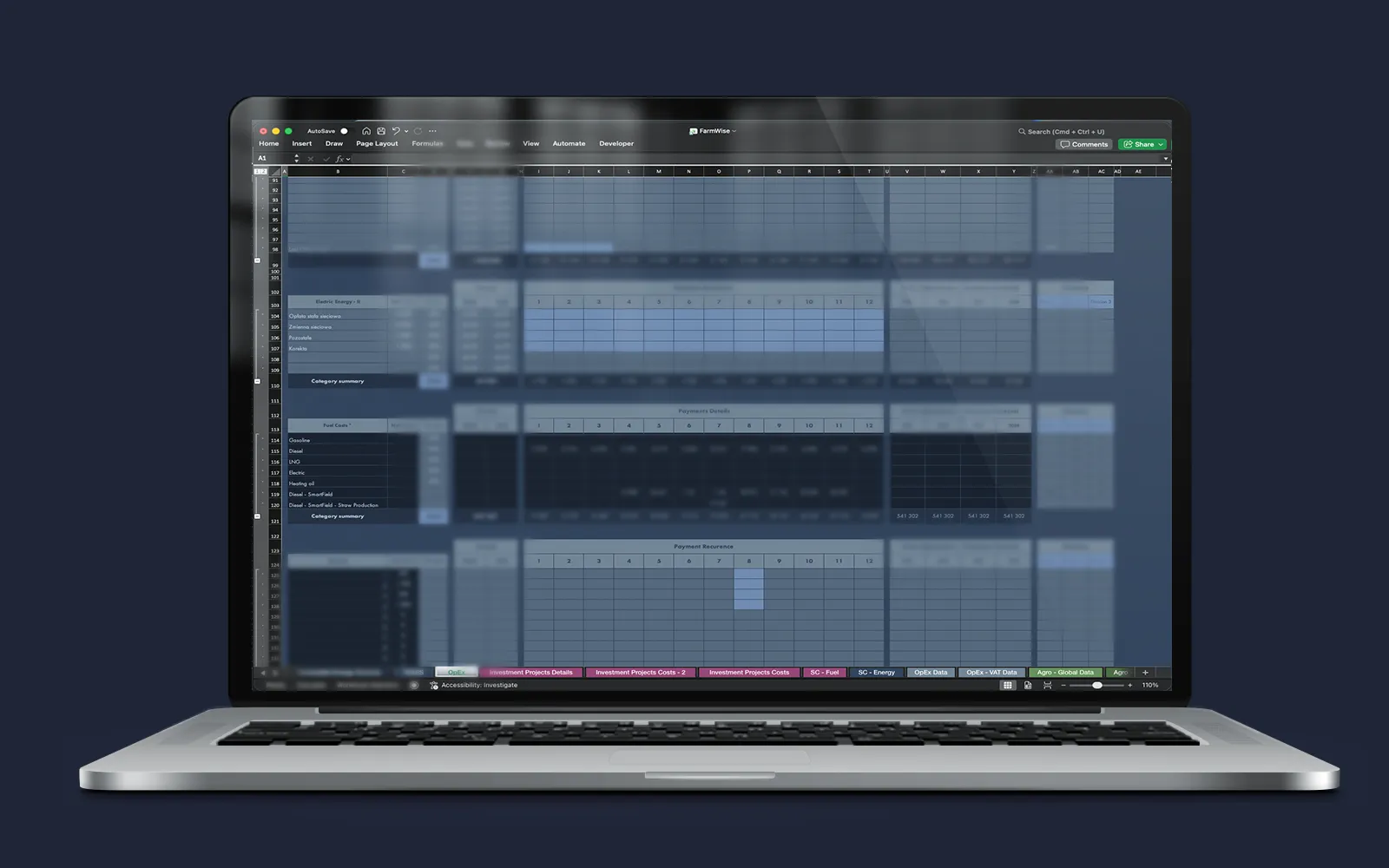
OPEX – FUNCTIONALITIES
The OpEx module is designed to integrate data from various financial modules, enabling a full review of operating costs at the enterprise level. It is based on two main cost categories:
Costs Calculated Automatically by the Model:
Expenses in this group are forecasted in other dedicated modules, such as the crop module (Cultivations). For example, costs related to corn production are calculated based on the assumed crop plan and transferred to the OpEx module. Thanks to this, the model enables detailed tracking and control of costs related to each stage of production. Other modules, such as fertilization planning, calculate the costs of materials and services related to agricultural activity.
These costs are dynamically updated and reflected in the OpEx module, providing a comprehensive analysis of operating expenses.
Budgeted Costs:
The OpEx module also serves as a budget function for expenses that are not calculated by the model. This mainly concerns administrative and business costs that do not have a direct impact on production, but are necessary to conduct business. An example of such expenses are costs of accounting services, business consulting or legal services.
Information on these costs was obtained through additional OMS (Operations Management System) software, which allows precise data entry and control of expenses that are included only in the budget.
Cost Management and Tracking:
The module allows the user to monitor costs on an ongoing basis, taking into account seasonality and cyclicality of expenses, which allows for more accurate planning and management of financial liquidity.
Forecasting and Analysis:
Thanks to dynamic data integration, the user can analyze cost changes over several years and predict their impact on total operating expenses.
Cost Division by Fields and Projects:
The module allows assignment of costs to different departments (e.g. Division 1, Division 2) and investment projects, which facilitates cost analysis in the context of the enterprise’s strategic goals.
Inclusion of Price Adjustments:
In the module there is a function of adjusting prices based on inflationary forecasts or other economic indicators, which enables more realistic expense planning.
TAXES
The TAXES module is an extensive tool that enables detailed tracking and analysis of tax burdens in various areas of farm activity.
This module provides the user with full insight into current rates and contributions, allowing for precise planning and control of tax and contribution costs related to the operations of the agricultural enterprise.
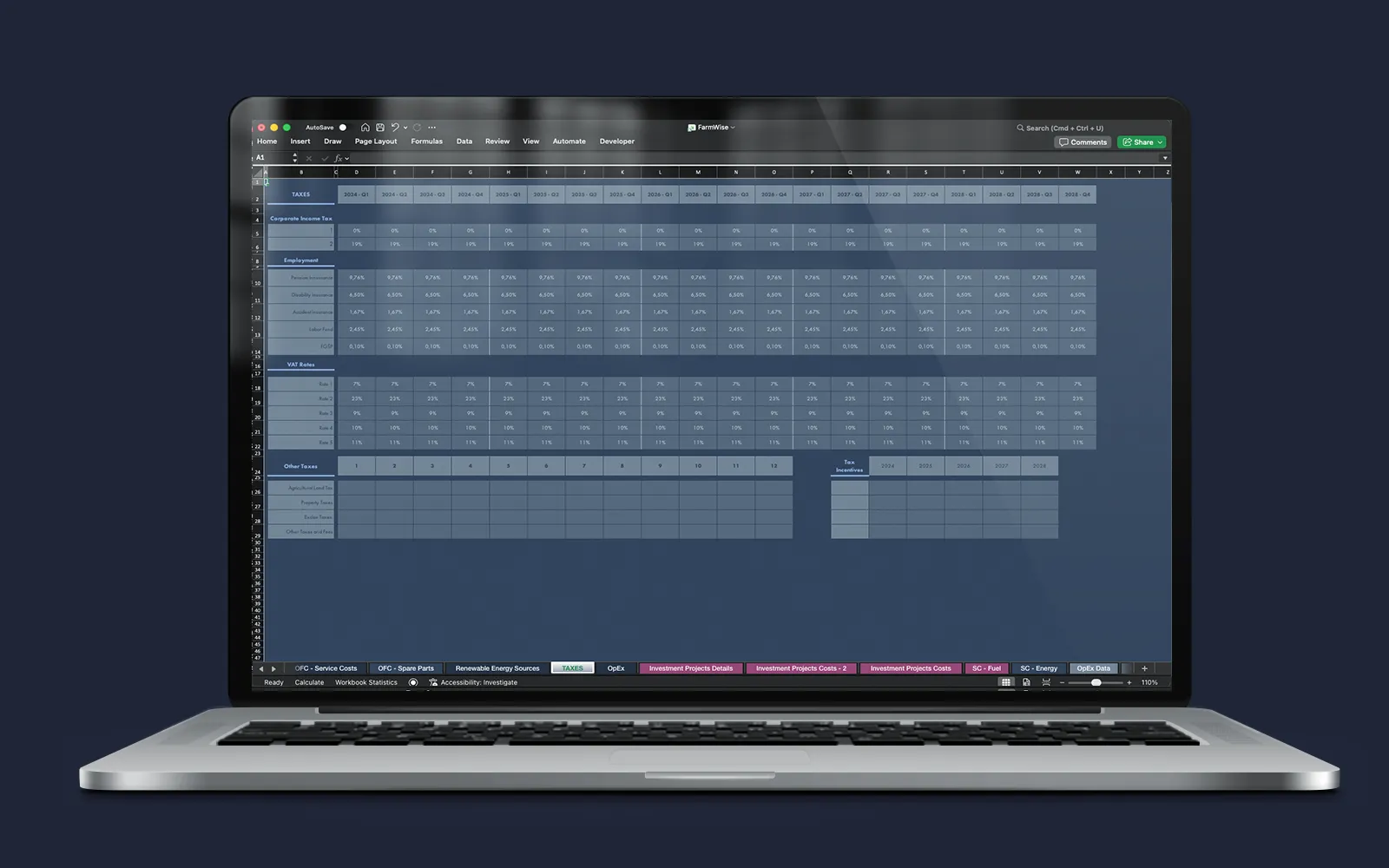
TAXES – FUNCTIONALITIES
Corporate income tax
Taxes and contributions related to employment:
The module contains detailed rates of insurance contributions and funds related to employment, such as:
- Pension insurance
- Disability insurance
- Accident insurance
- Labor Fund
- FGŚP
VAT rates The TAXES module enables tracking of various VAT rates used in the enterprise. For ease of analysis, VAT rates have been divided into several categories
Other taxes and fees:
This section includes taxes and fees such as:
- Agricultural land tax,
- Real estate tax,
- Excise duty and other local and specific fees related to business activity.
The module allows the user to adjust these taxes and fees to the individual needs of the farm, which allows precise planning of annual and quarterly tax liabilities.
Tax reliefs
The module also includes the functionality of taking into account tax reliefs, which allows analysis of potential benefits resulting from available tax exemptions. The user can track reliefs over years, which supports financial planning in the longer term.
SALARIES
The Salaries module was designed to enable detailed management of employee remuneration broken down by quarters and years.
The user can monitor remuneration at the level of each position, both in the central structure and broken down into individual departments.
The system provides the possibility of determining the number of employees at each position and their individual remuneration, which allows precise calculations related to the remuneration budget on a quarterly and annual basis.
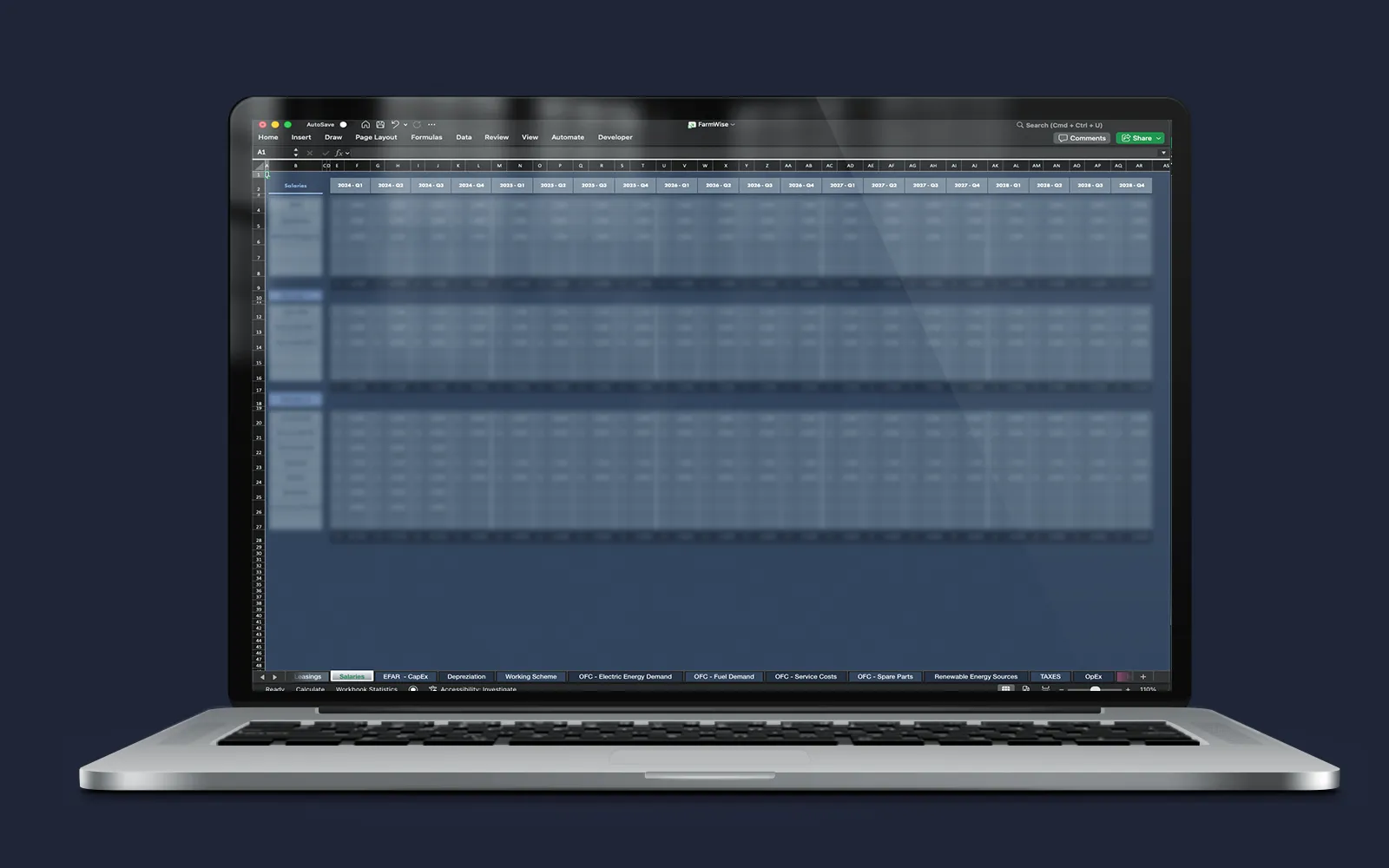
SALARIES– KEY ELEMENTS
Division into departments:
The module also includes the functionality of taking into account tax reliefs, which allows analysis of potential benefits resulting from available tax exemptions. The user can track reliefs over years, which supports financial planning in the longer term.
Dynamic personnel management:
The user can introduce changes in the number of employees at various positions (e.g. adding or removing employees at a given position in a specific quarter), which allows flexible adjustment of the employment structure to current needs.
Analysis of remuneration costs:
Forecasting the remuneration budget: The module supports long-term planning through remuneration forecasts for subsequent years, which is helpful in preparing the operating budget.
Forecasting the remuneration budget:
The module supports long-term planning through remuneration forecasts for subsequent years, which is helpful in preparing the operating budget.
Finance Core
The Finance Core section focuses on the most important financial aspects related to share capital, reserve capital and loans from shareholders.
It enables not only analysis of the current financial structure, but also planning of future capital transactions between partners or potential investors.
Thanks to this, the Finance Core section constitutes the foundation of financial management in the enterprise, with the possibility of simulating phased capital increases, which allows precise financial planning and support for strategic decisions.
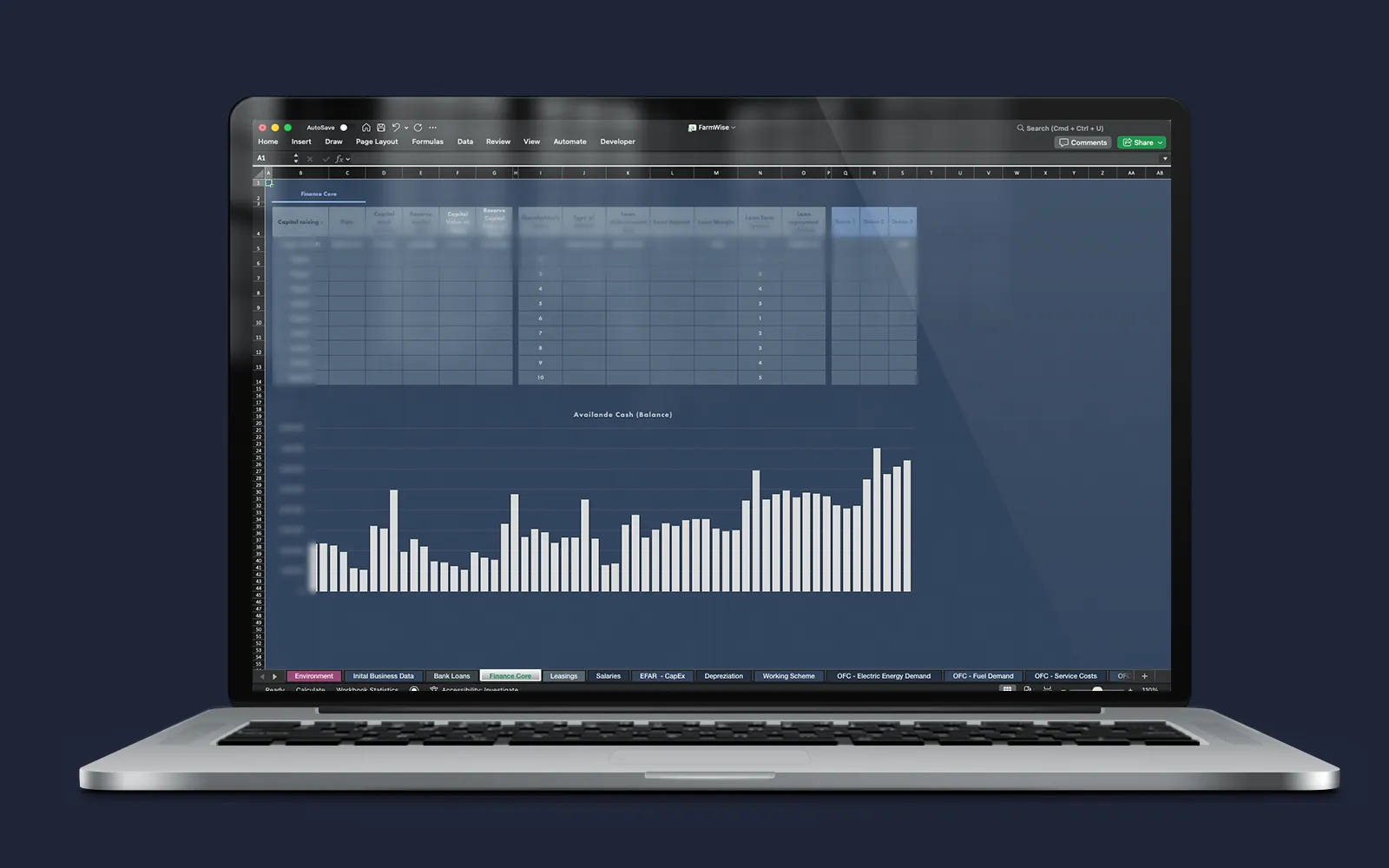
This module is designed with flexibility in mind – it enables carrying out capital simulations and predicting the impact of various financing sources on the ownership structure and financial indicators.
This allows users to make decisions on the best way to raise capital for future investments, without excessive burden of foreign capital.
FINANCE CORE – FUNCTIONALITIES
Share Capital:
- Possibility of monitoring current share capital.
- Planning and simulations of future capital increases.
- Predicting the impact of capital increases on the ownership structure.
Reserve Capital:
- Tracking current reserve capital in the enterprise.
- Analysis of possibilities of using reserve capital for company development or support of operational activities.
- Simulations of using reserve capital in different investment scenarios.
Loans from Shareholders:
- Possibility of recording loans granted by shareholders and their impact on the capital structure.
- Planning repayment schedules, taking into account flexible options.
- Analysis of the impact of shareholder loans on financial indicators, including the debt ratio and liquidity.
Capital Transactions:
- Handling simulations and modeling of capital transactions between partners.
- Possibility of planning phased capital increases in order to attract new investors or for existing shareholders.
- Analysis of the impact of capital transactions on the future ownership structure and development strategy of the enterprise.
BANK LOANS
The “Bank Loans” module enables comprehensive management of the farm’s credit liabilities. The user can specify financing conditions, including interest rate, repayment schedule and refinancing dates.
The module automatically calculates costs related to debt servicing and forecasts the impact of loans on the financial situation in the coming years.
Thanks to integration with other financial sections, the Bank Loans module provides a full picture of financial burdens and their impact on cash flows.
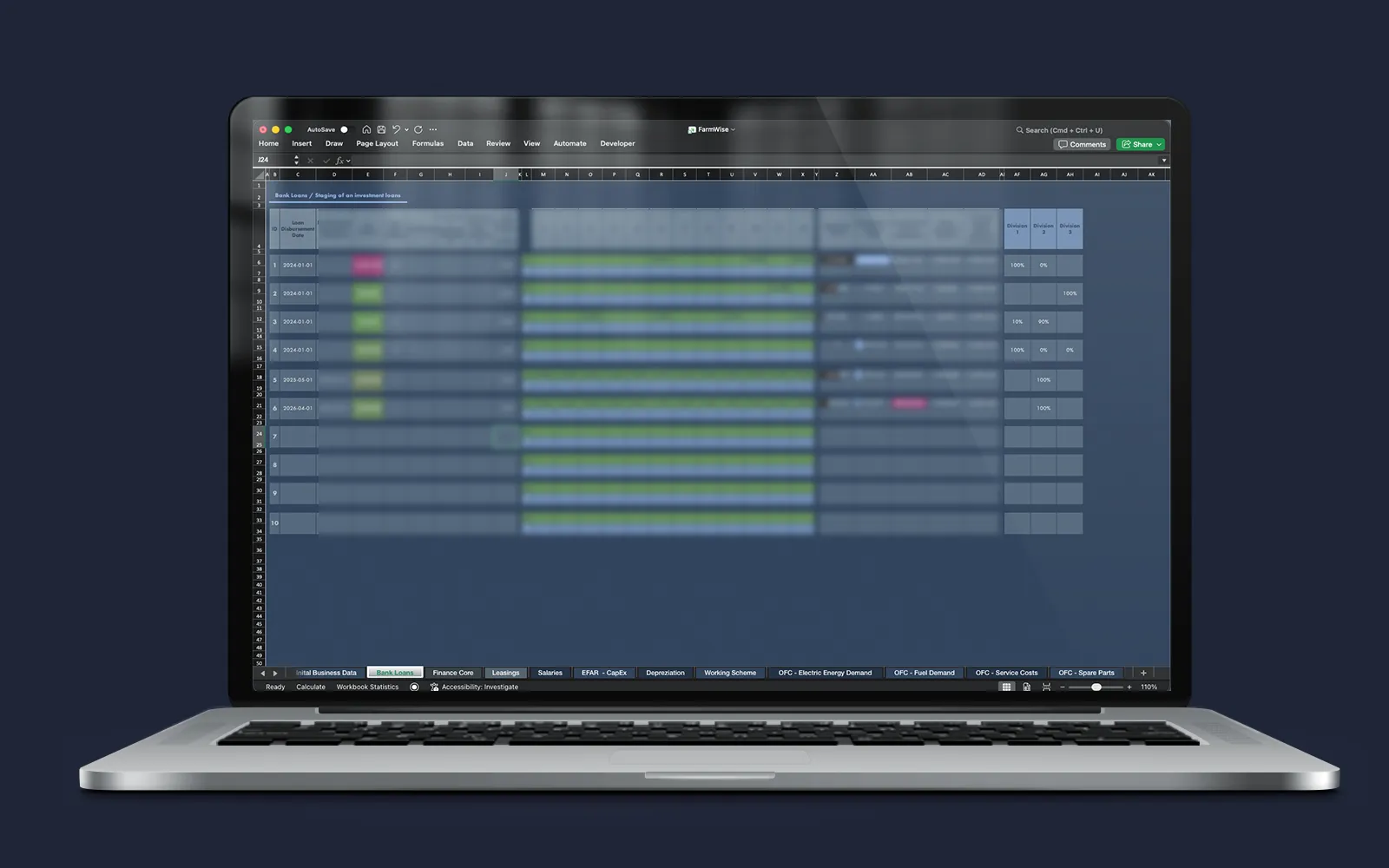
BANK LOANS – FUNCTIONALITIES
Analysis of Impact on Liquidity and Financial Result:
- Automatic calculation of the impact of loan installments on the enterprise’s cash flows.
- Assessment of the impact of loan costs on EBITDA, net profit and debt ratios.
- Simulation of the impact of a new loan on financial liquidity, which helps plan optimal moments for obtaining financing.
Credit scenarios:
- Possibility of creating different loan repayment scenarios depending on changes in interest rates or repayment schedule.
- Analysis of credit risk through simulation of interest rate increases and assessment of their impact on loan costs.
- Scenarios related to early repayment or refinancing of the loan, taking into account possible additional costs.
Adding New Loans:
- Possibility of adding new loans with specified parameters, such as loan amount, start date and loan period.
- Choice of loan type (e.g. working capital, investment) and type of interest (fixed, variable).
Repayment Schedule Management:
- Creating a loan repayment schedule divided into principal and interest installments adjusted to the company’s cash flows
The Bank Loans module is ideal for enterprises that manage multiple loans and want to have full control over their costs and impact on the financial result.
For example, if an agricultural enterprise is considering purchasing a modern machine on credit, it can simulate different financing options. Thanks to this, the enterprise can choose the best repayment period, type of interest and assess whether it is better to take a loan for a shorter period with higher installments, or for a longer period with smaller, but more expensive interest.
This module supports strategic financial decision-making, helping the enterprise effectively manage debt and minimize its impact on profitability and financial liquidity.
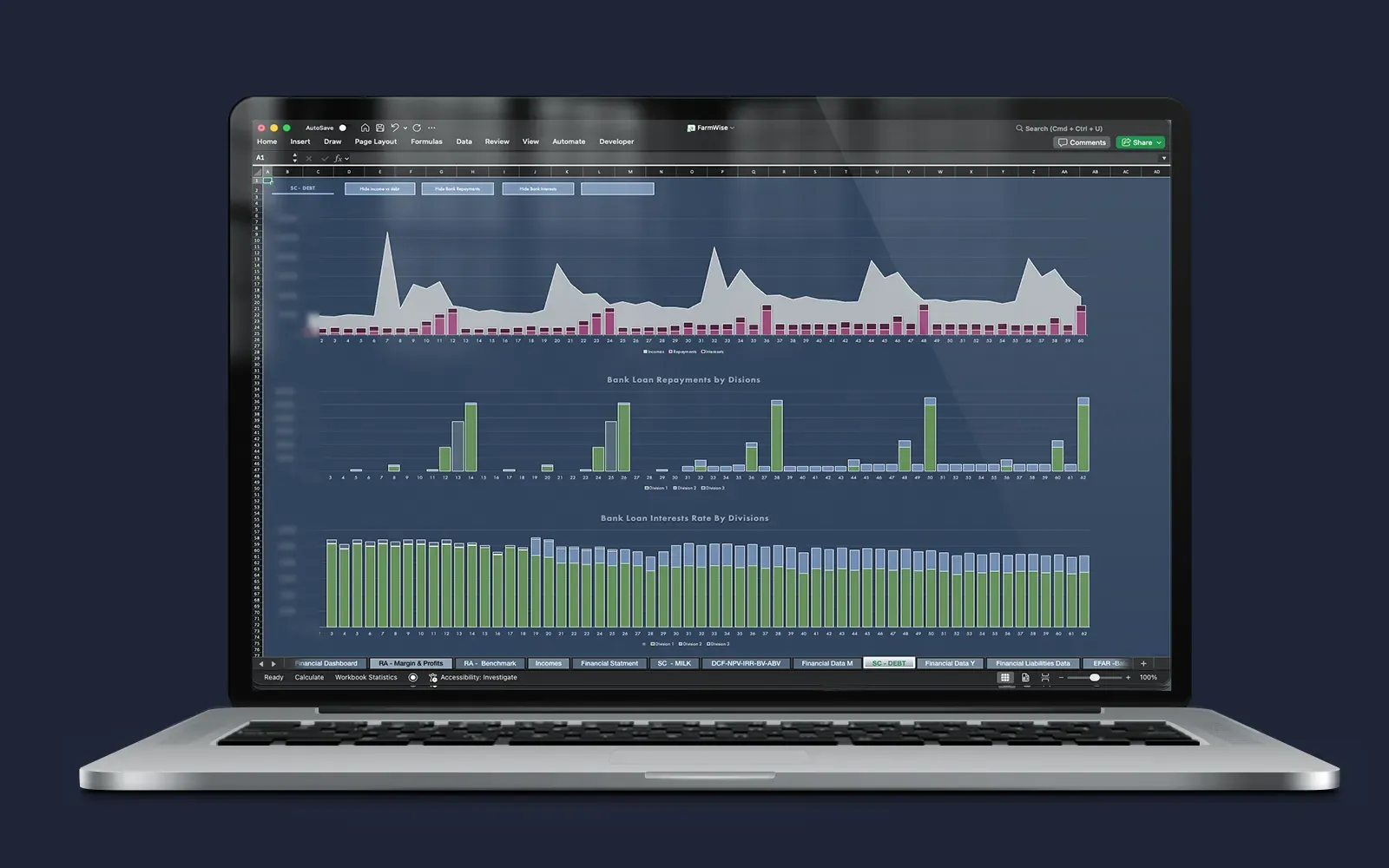
Leasings
The Leasing module covers both operating and financial leasing, with the possibility of choosing the start date and type of interest.
The module also provides dedicated comparative analyses that allow assessment of the profitability of leases in the context of total cost of ownership, as well as their impact on the financial condition of the enterprise in the long term.
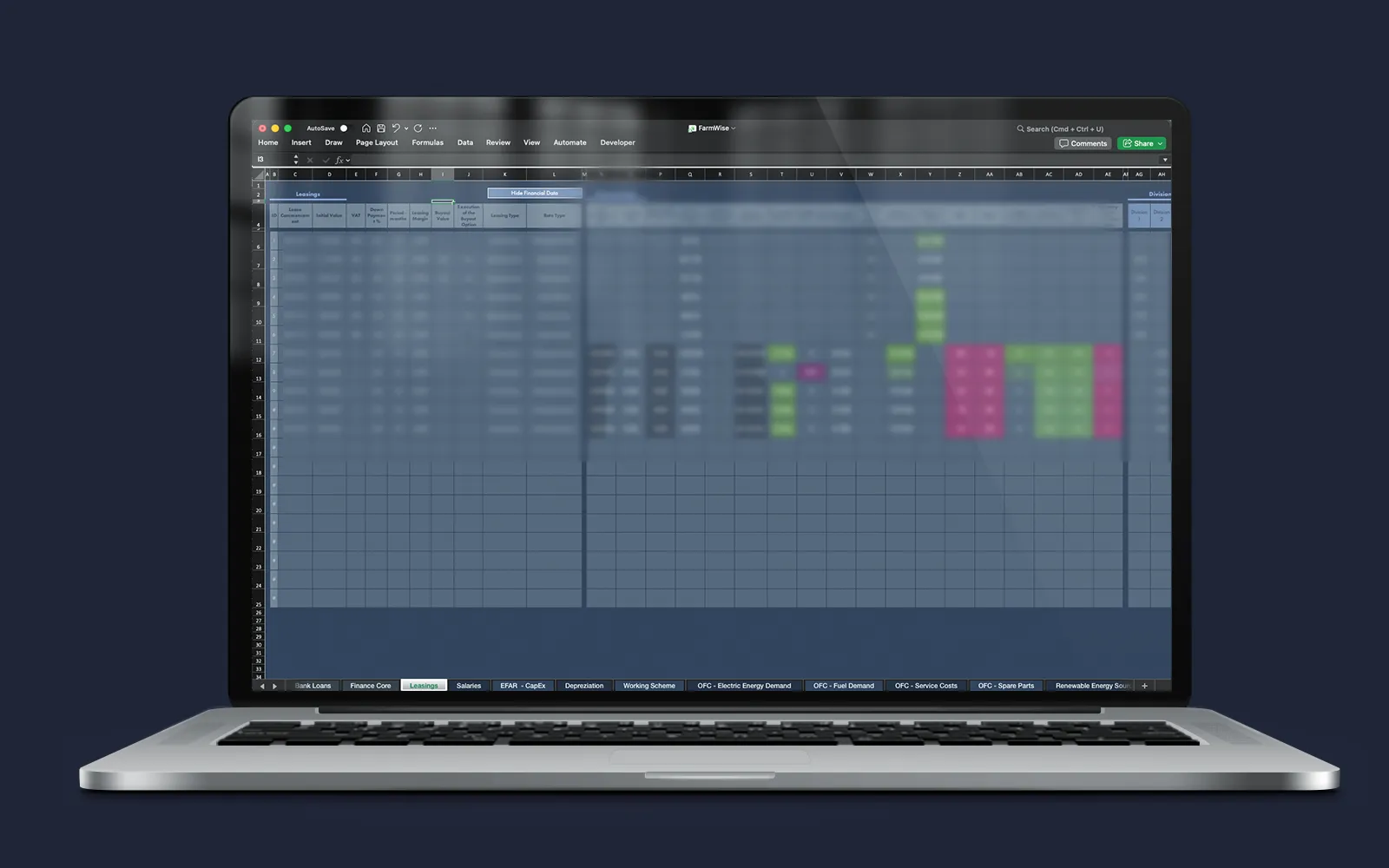
LEASINGS- FUNCTIONALITIES
Types of Leasing: Operating vs. Financial:
- choice between operating and financial leasing, which allows flexibility in managing liabilities and depreciation write-offs.
- Possibility of analyzing the impact of individual forms of leasing on the balance sheet and financial result of the company.
- Automatic settlement of operating leasing as an operating cost and financial leasing as a liability and asset.
Analysis of Impact on Cash Flow and Financial Result:
- Calculation of the impact of leasing payments on the enterprise’s cash flows and financial result.
- Simulation of the impact of leasing costs on EBITDA, net profit and key financial indicators.
- Assessment of how different forms of leasing affect the financial liquidity and profitability of the company.
Choosing the Best Leasing Option:
- Comparing different leasing offers in terms of total costs, payment conditions and financial benefits.
- Simulations that allow assessment of whether operating or financial leasing is more profitable for a given type of asset.
- Analysis of the impact of leased assets on the profitability of operating activities and assessment of the possibility of their replacement or sale after the end of the contract.
Leasing Scenario Simulations:
- Possibility of creating different scenarios of leasing repayments depending on changes in contract terms or external factors, such as increases in interest rates.
- Analysis of leasing variants, such as extensions, early termination of the leasing contract, and their costs and benefits.
- Financial scenarios that allow the user to compare leasing with other forms of financing (e.g. bank loan).
INVENTURE & WORK IN PROGRESS
The module was designed with the aim of providing precise management of inventory levels and enabling constant reporting to financial institutions, such as banks.
Thanks to dynamic data updating, this module provides current information on inventory levels, which allows quick response to changes in inventory levels and facilitates operational and financial decision-making.
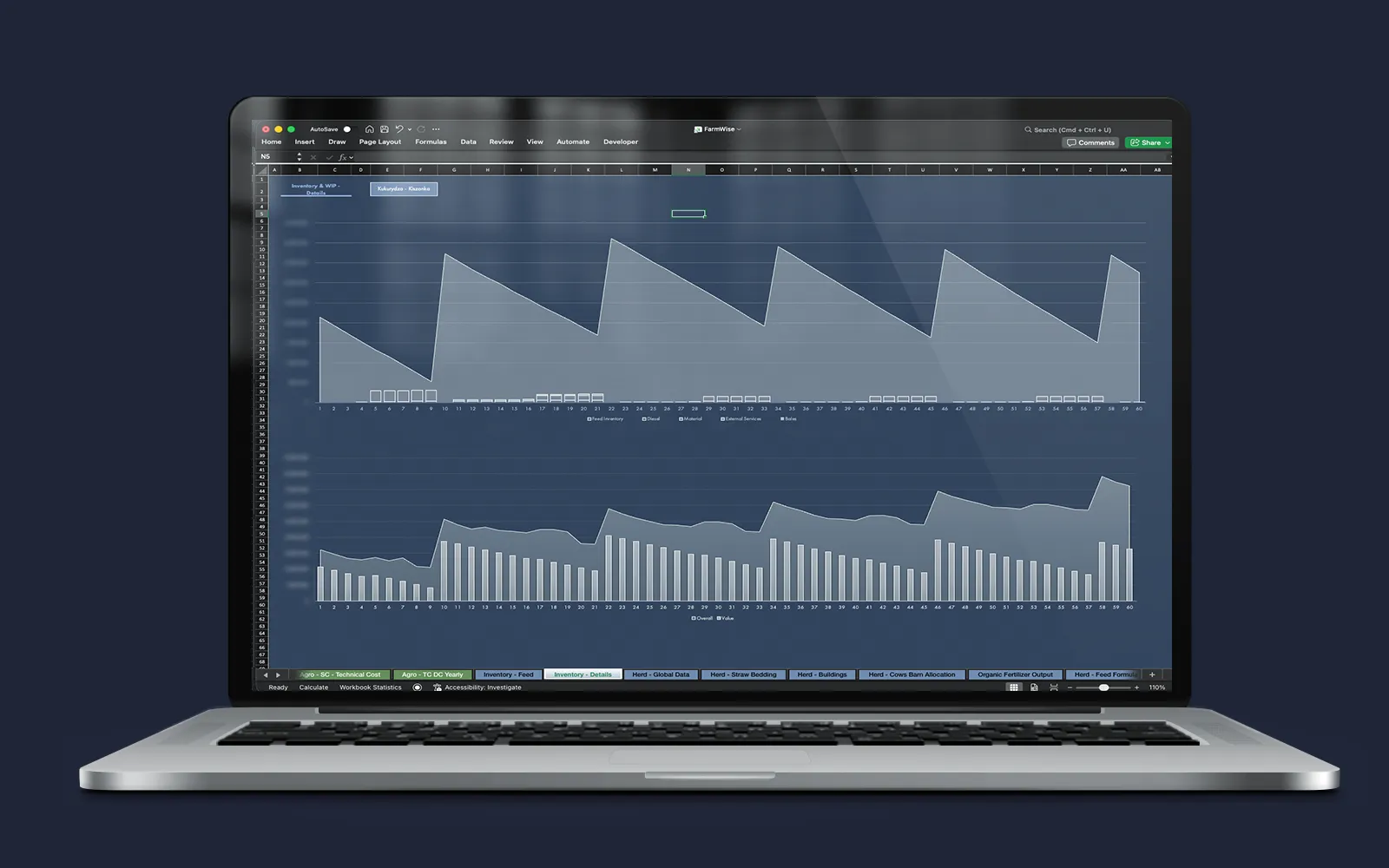
DYNAMIC INVENTURE – FUNCTIONALITIES
Automatic updates of inventory levels:
The module constantly monitors and updates information on inventory levels in real time, which ensures precise data on possessed stocks.
Reporting to the bank:
This functionality enables generation of inventory reports compliant with bank requirements. Thanks to this, banks can better assess the value of the company’s current assets, which may affect financing conditions.
Reporting of work in progress:
tracking of work in progress (WIP – Work in Progress), which gives a fuller picture of the value of goods produced at various processing stages. This is important when assessing resources that are already involved in production but have not yet been realized as finished products.
Economic Trends
The Economic Trends module is a comprehensive tool monitoring key economic indicators that can significantly affect the costs and profitability of the farm. It includes analysis of quarterly changes in variables such as the EUR/PLN exchange rate, prices of raw milk in Poland and Germany, WIBOR, and prices of energy, gas, diesel and gasoline.
Thanks to ongoing tracking of the values of these indicators, the user can easily identify trends and predict potential market changes.
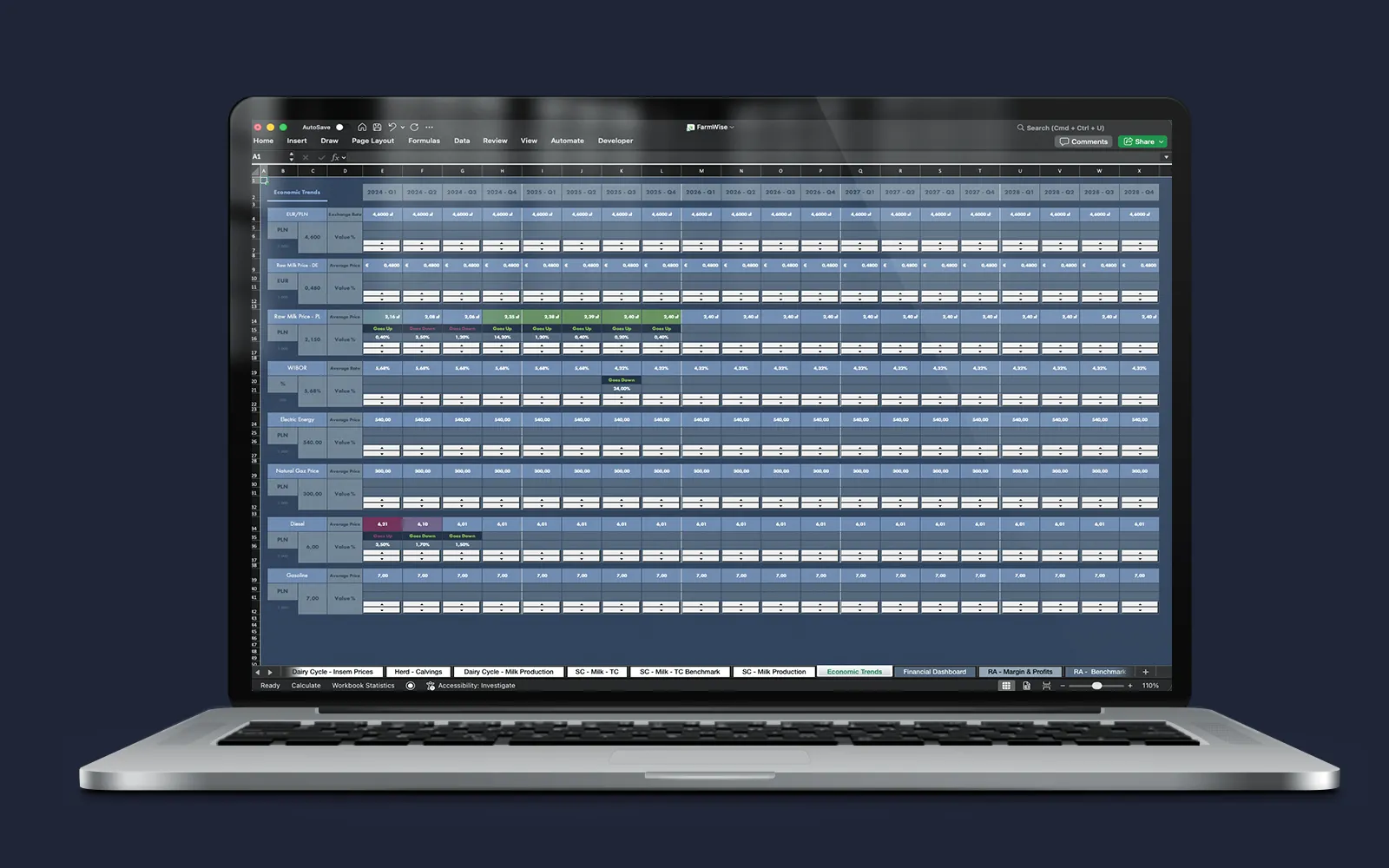
ECONOMIC TRENDS – FUNCTIONALITIES
Proactive risk management
The module enables identification of threats resulting from early signals of market changes (e.g. increase or decrease in exchange rates, energy or raw material prices), which allows quick protective actions. Thanks to this, the company can better prepare for potential risks.
Precise cost analysis
The module allows tracking quarterly changes in key economic indicators, such as WIBOR, energy prices, fuels, as well as exchange rates. The user can directly link changes in these indicators with specific activity costs, which facilitates budget optimization and reduction of unnecessary expenses.
Strategic budget planning
Thanks to the analysis of economic trends, the farm can more precisely forecast future operating costs and revenues, which allows better budget planning and long-term financial management.
Sensitivity analysis
The module supports sensitivity analysis, which allows understanding how changes in economic indicators affect costs and profitability. The user can test different scenarios (e.g. increase in fuel price or decrease in exchange rate) and assess their impact on the company’s finances, which enables conscious strategic decision-making.
ECONOMIC TRENDS – EXAMPLE SCENARIOS
Increase in interest rates. The MPC signals the possibility of raising interest rates.
Action: The user enters an update of interest rates in the module.
Result: The model automatically recalculates financial costs related to loans and leases and assesses the impact on future operating costs. Additionally, the user can check how changes in interest rates will affect overall profitability and the margin on milk sales.
Benefit: Early identification of the risk of cost increases allows preparation of a financial protection plan or renegotiation of credit terms.
Increase in electricity prices
Situation: Expected increase in electricity prices, an important cost in production.
Action: Updating the electricity price forecast in the module.
Result: The model analyzes how the increase in energy prices will affect total operating and production costs and the final profitability. The user can consider investing in renewable energy sources or other ways to minimize energy consumption.
Benefit: Possibility of preparing a savings strategy or implementing more energy-efficient solutions that will mitigate the impact of rising energy costs.
Change in EUR/PLN exchange rate: Economic forecasts predict weakening of the zloty against the euro, which may affect costs and revenues.
Action: The user enters the forecasted change in the EUR/PLN exchange rate in the module.
Result: The model calculates the impact of the exchange rate change on the costs of purchasing imported materials and on revenues if part of the sales takes place on the international market. It is also possible to assess the impact on the overall operating margin.
Benefit: Understanding how exchange rate changes affect the financial balance allows preparation of a currency hedging strategy or contract negotiations.
FINANCIAL STATEMENT
The Financial Statement module is a comprehensive tool for generating full financial statements of the enterprise, including the balance sheet, profit and loss account and cash flow statement. It enables detailed analysis of the company’s financial situation on a historical and forecasted basis, which supports management of liquidity, profitability and operational efficiency.
Thanks to this module, it is possible to quickly obtain a full picture of the organization’s financial condition, facilitating strategic decision-making based on reliable financial data.
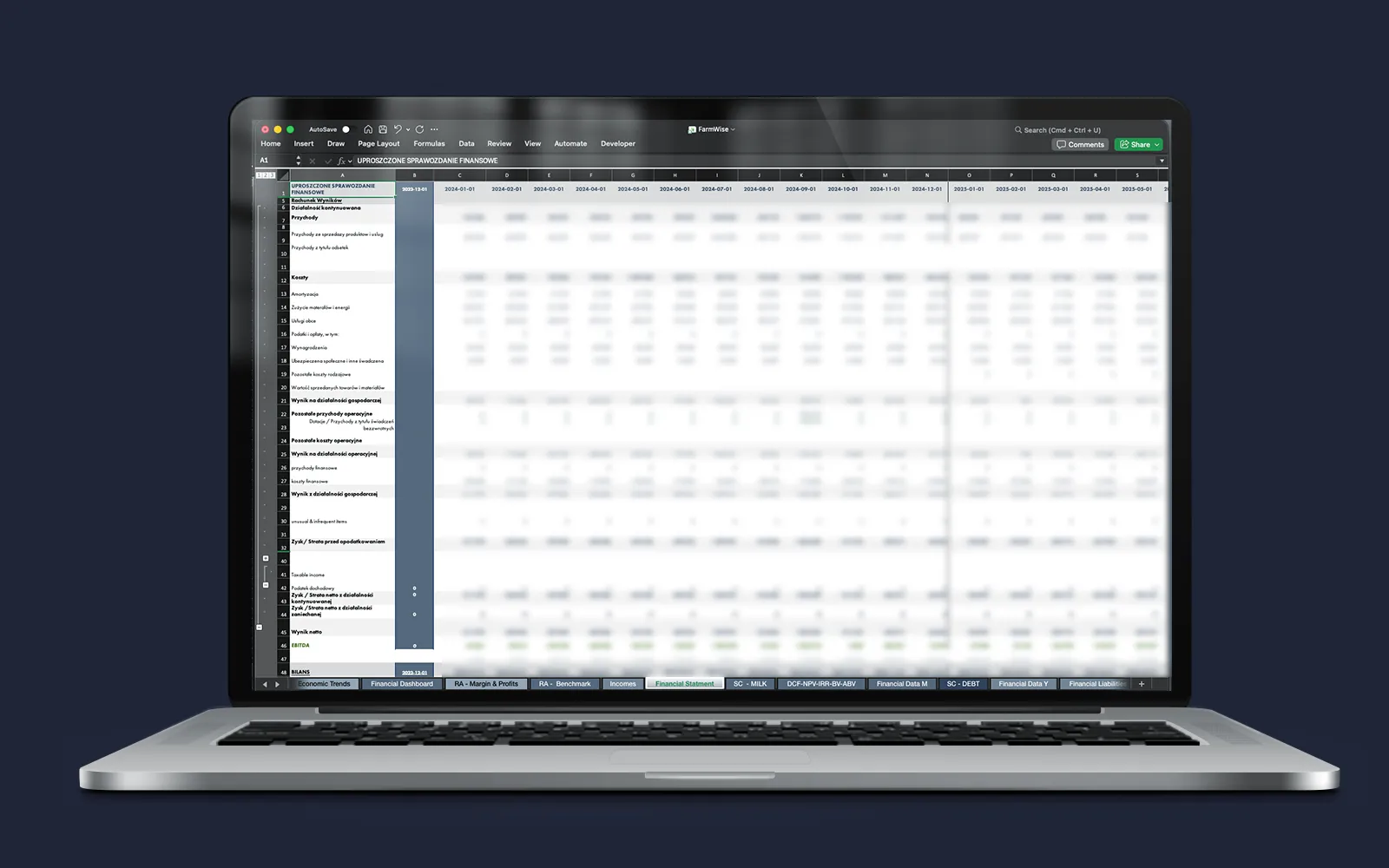
FINANCIAL STATEMENT – BENEFITS
Current financial control:
It enables quick insight into the company’s financial condition, which allows making conscious decisions in response to current market conditions.
Precise forecasting:
The possibility of simulating different scenarios allows predicting future financial results and better preparation for possible market changes.
Optimization of cash flows:
Managing financial liquidity allows better planning of expenses and control over liabilities.
Monitoring of financial indicators:
Calculated indicators give a full picture of profitability and financial stability, which supports effective management and planning of further investments.
Support for strategic decisions:
Dynamic data updating enables managers and investors to adapt the financial strategy to current needs and economic situation.
Ratio Analysis Benchmark
An analytical tool used to monitor and evaluate key financial indicators of the enterprise. It enables ongoing comparison of results with established reference points (benchmarks), which allows quick detection of deviations from assumptions and identification of areas requiring improvement.
The module includes, among others, analysis of liquidity, debt, profitability and operational efficiency, providing managers with valuable information for making conscious strategic and operational decisions.
Thanks to clear data visualization, the module supports financial management and long-term planning in the organization.
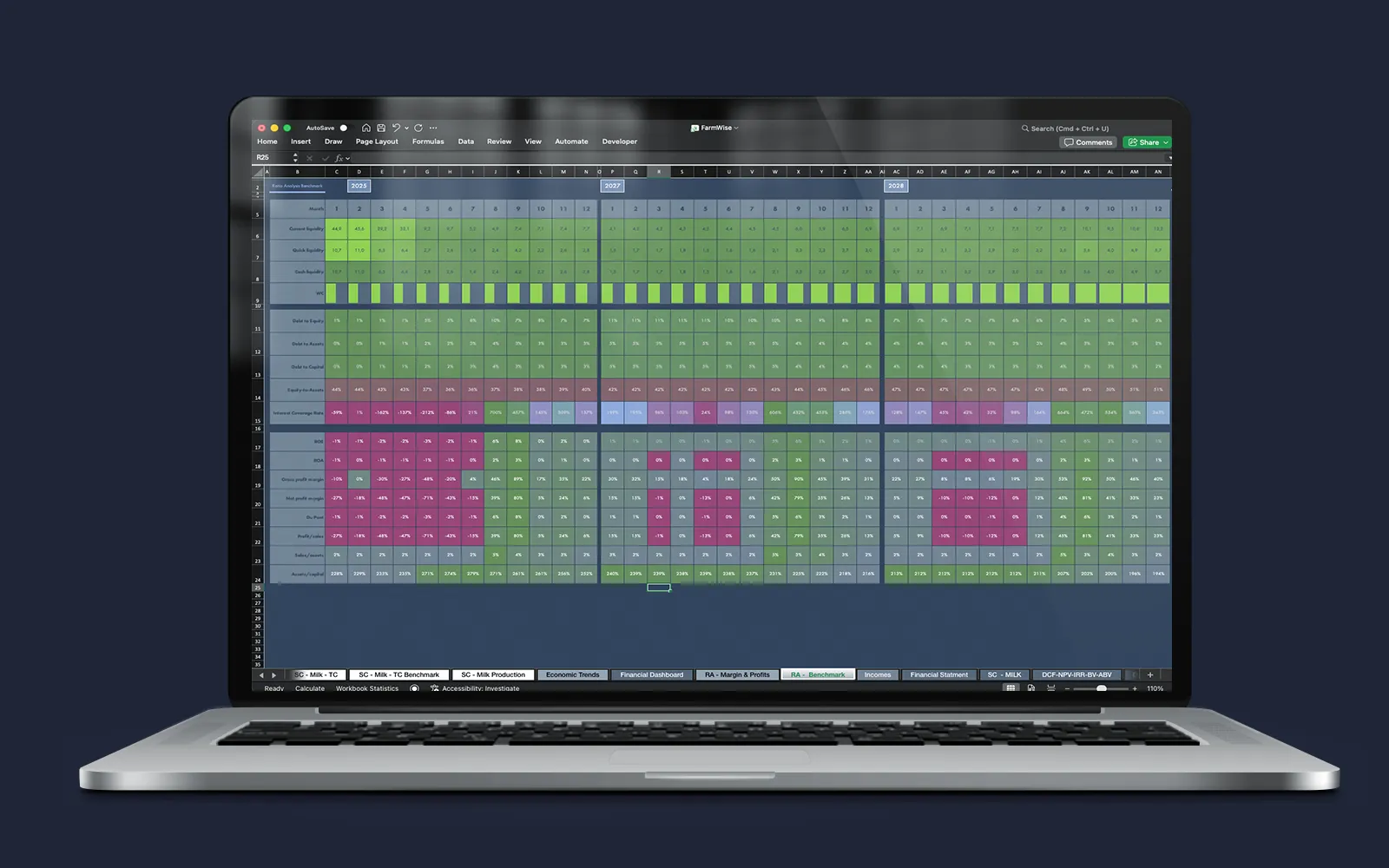
RATIO ANALYSIS BENCHMARK – BENEFITS
Quick Assessment of Financial Condition
Thanks to the juxtaposition of key financial indicators in one place, the module allows for instant assessment of the current financial condition of the company. The user can quickly assess financial liquidity, debt level, profitability and operational efficiency without the need to analyze raw data.
Monitoring Trends and Identifying Anomalies
The module enables analysis of indicators over a long period of time (month by month, year by year), which allows detection of trends and changes in the company’s financial results. This helps identify anomalies, such as a sudden drop in liquidity or increase in debt, which may signal problems or the need for corrective actions.
Benchmarking and Comparative Analysis
The module offers the possibility of comparing the company’s results with established benchmarks or industry standards, which allows assessment of whether the company achieves results at the appropriate level in relation to industry standards. Benchmarking is particularly useful in the process of financial control, as it facilitates identification of areas in which the company deviates from the competition and requires optimization.
Support in Risk Management
Monitoring financial indicators, such as the debt ratio, liquidity, or interest coverage, allows assessment of the risk associated with debt and the ability to service financial liabilities. Regular analysis of risk indicators can help minimize potential financial problems and maintain the company’s financial stability.
Increasing Operational Efficiency
Thanks to the analysis of profitability and efficiency indicators, such as gross margin, net margin, ROE, ROA, the user can assess which aspects of activity bring the greatest profits, and which require improvements. These indicators provide valuable management information that can lead to operational improvements and increased process efficiency.
Basis for Strategic Planning and Investment Decisions
The module supports the process of strategic planning, providing key information on the company’s financial condition, which can form the basis for decisions on new investments, external financing or capital management. Analysis of profitability and debt indicators allows assessment of the profitability of planned investments and selection of the optimal source of financing.
Improving Transparency of Reporting and Communication with Stakeholders:
The module of financial indicators allows transparent presentation of financial results to management, investors, banks and other stakeholders, which strengthens trust in the company. Reports in graphic form are clear and easy to interpret, which facilitates communication and allows better understanding of the company’s financial situation.
Support in Assessing Profitability and Achieving Financial Goals:
Regular analysis of indicators such as margin, return on equity (ROE) or assets (ROA) allows assessment of whether the company achieves its financial and profitability goals in accordance with assumptions. This allows ongoing correction of the strategy to maintain profitability and increase value for owners.
Possibility of Quick Identification of Areas for Cost Optimization:
The module of financial indicators can also be helpful in analyzing operating costs and their impact on financial results, which can help identify and eliminate unnecessary costs. Operating profitability indicators and cost structure analysis can support expense optimization and improvement of operating margin.
Adaptation to Changing Market Conditions:
Thanks to the dynamic nature of the module, which takes into account variable financial data, the user can adapt their decisions to changing market conditions, e.g. by adjusting the level of debt to current loan costs or optimizing the capital structure. This allows flexible response to economic changes and maintaining financial stability.
DYNAMIC DISCOUNTED CASH FLOW
The DCF-NPV-IRR-BV-ABV valuation module is key to enterprise value analysis. It offers dynamic valuations:
- discounted cash flow method (DCF),
- book balance sheet value (BV)
- adjusted net asset value (ABV/NAV).
The module also includes IRR and NPV indicators, which allow assessment of the profitability of investments in various projects.
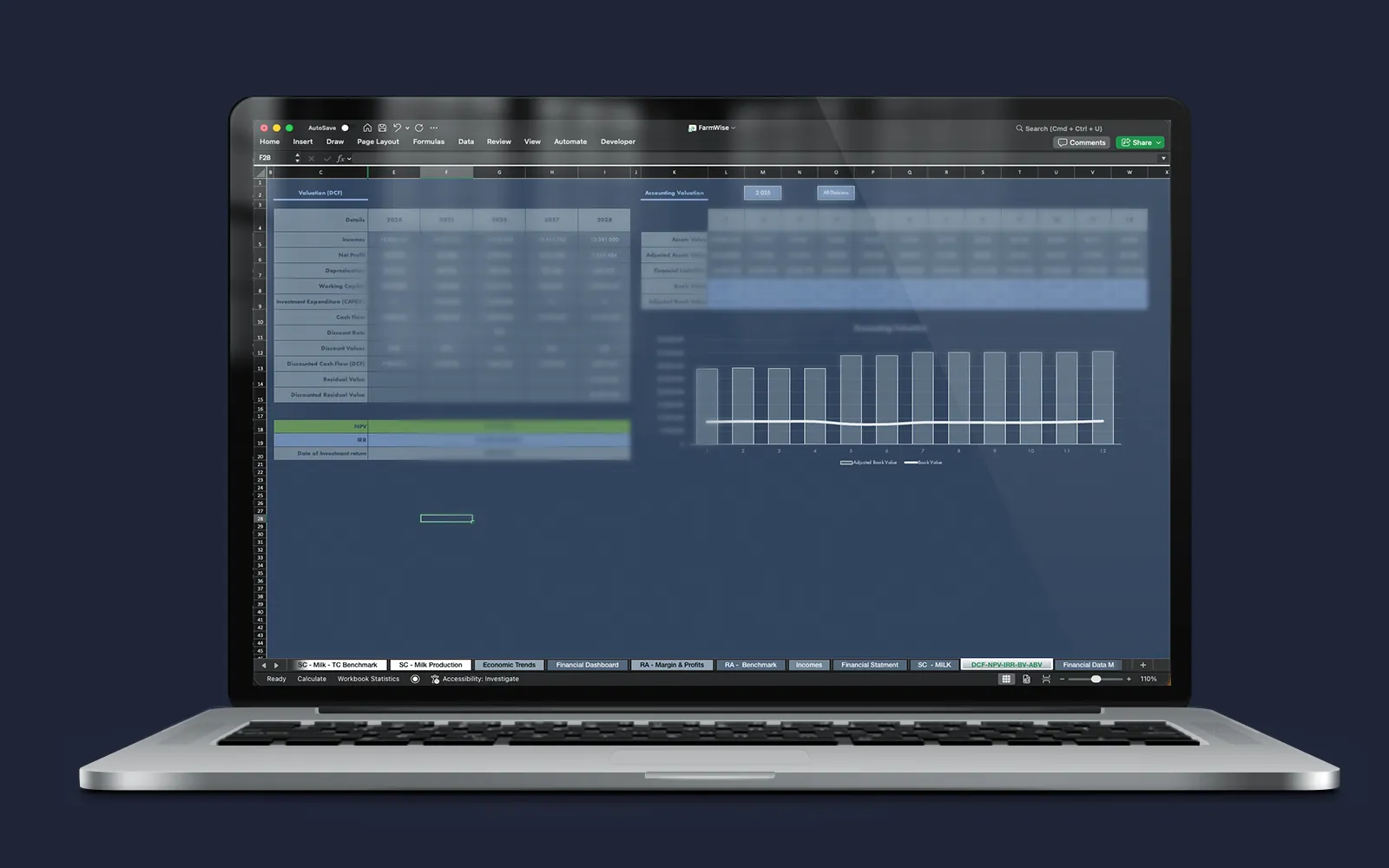
DYNAMIC DISCOUNTED CASH FLOW – BENEFITS FOR SHAREHOLDERS
Forecast of the future value of the company:
The DCF method takes into account future cash flows, which allows assessment of how much the company will be worth in the future. For shareholders, this is particularly important because they can predict the growth in the value of their investment.
Investment profitability analysis:
DCF takes into account the time value of money, which allows objective assessment of investment profitability and provides the basis for planning a long-term growth strategy.
Better control over cash management:
Thanks to this method, shareholders can monitor how the company’s operations translate into cash flows. This allows assessment of whether the company generates enough cash to cover its liabilities and whether potential investment projects are well financed.
Risk assessment and financial ratio analysis:
DCF takes into account market and operational risk (through the discount rate), which allows shareholders to more accurately assess the impact of economic variables on the value of the enterprise. Thanks to this, shareholders can make decisions based on a real risk assessment.
DYNAMIC BOOK VALUE
Thanks to dynamic book valuation, which includes both past and future data, shareholders gain a fuller picture of the enterprise’s value over time.
Such valuation allows them to track changes in the value of assets and equity over the years, which allows assessment of the stability and development potential of the company.
It is also a valuable tool for predicting future financial results based on current trends and forecasts, which can be useful when making investment decisions and during negotiations with potential investors.
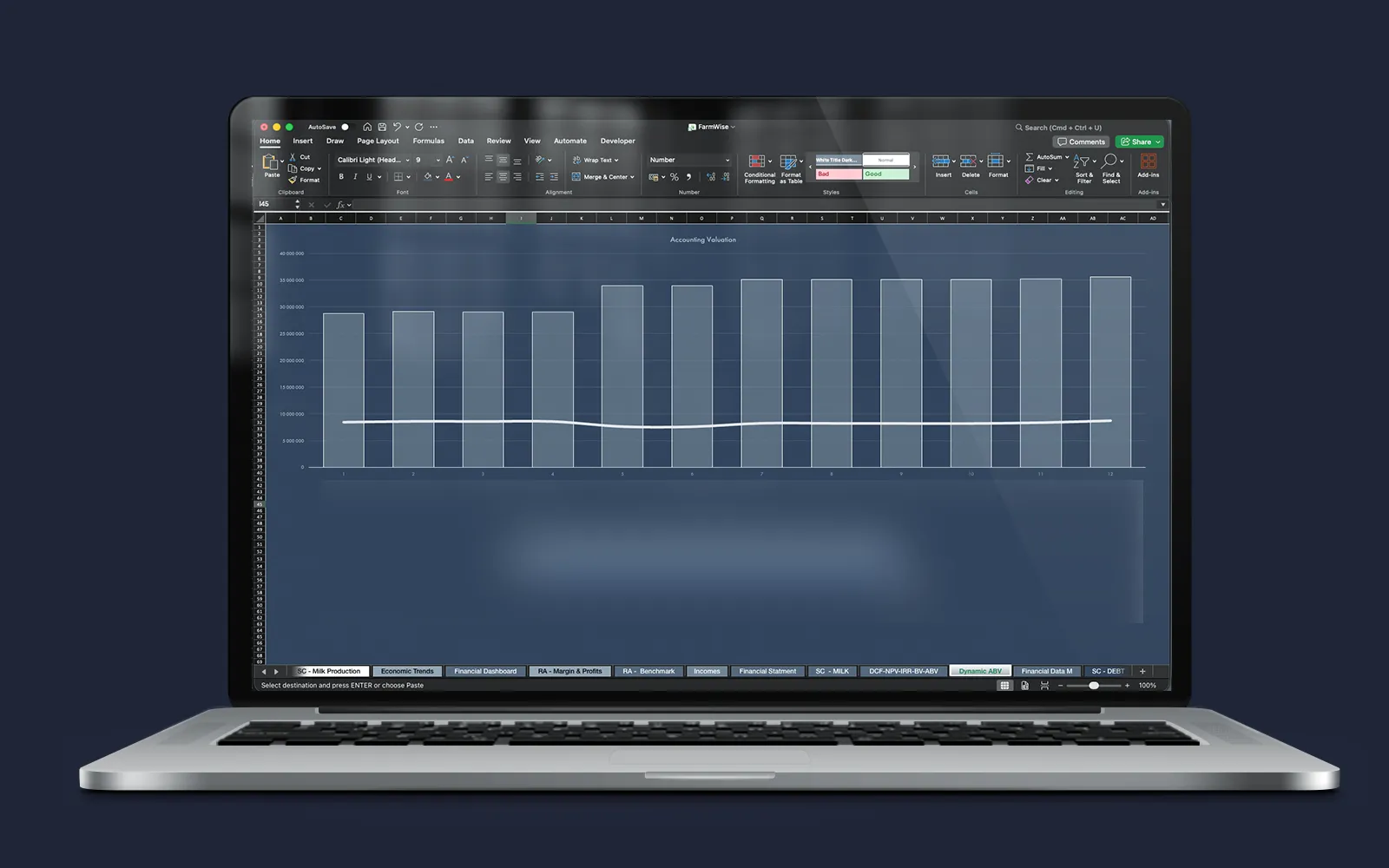
DYNAMIC BOOK VALUE – BENEFITS
Transparency and control:
Dynamic book valuation enables accurate tracking of changes in the book value of the company over time, covering both history and the future. Thanks to this, shareholders can monitor how the enterprise uses resources and capital, and better understand how specific business decisions affect the value of the company’s assets.
Flexibility in management:
The dynamic book valuation model allows current updating of the book value of the enterprise in response to changing market, operational and financial conditions. In the case of sudden events, such as changes in interest rates, raw material costs or capital expenditures, this model can immediately recalculate the value of the company, which allows quick adaptation of the strategy.
Better forecasting and planning:
Thanks to taking into account both historical and forecasted data, dynamic book valuation supports the creation of realistic scenarios for the company’s development. Shareholders can analyze future financial results and predict the impact of investment strategies or operational activities on the company’s value, which helps in making more conscious long-term decisions.
Basis for negotiations:
Having current book valuation that works dynamically based on up-to-date data strengthens the position of the enterprise in talks with investors, banks and business partners. It shows that the company has full control over the value of its assets and capital, which builds trust and increases its credibility.
Risk management:
Dynamic book valuation enables quick identification of risk areas in the company’s finances. In the case of significant fluctuations in book value, shareholders and management can take appropriate steps to limit potential losses or adjust the action strategy.
Capital optimization:
Analysis based on dynamic book valuation supports management of the company’s capital, helping in resource allocation in the most efficient way. It allows identification of suboptimally used assets or unnecessary investments, which in turn can lead to improvement of the capital structure and better use of equity.
Data reliability:
Thanks to dynamic book valuation, shareholders gain confidence that information on asset value is up-to-date and accurate. This valuation takes into account the latest financial and operational changes, which eliminates the risk of making decisions based on outdated data.
Do you need someone who instantly understands the problem — and knows what to do with it?
Most companies have data. What is missing is the idea of what to do with it — and someone who will actually execute it. Origami Effect provides both.