


How to calculate ROI for a VoD platform
Creation of a financial model supporting the launch and development of a VoD service within a cable network operator’s operations.
Project goal: Assessment of the investment profitability of a VoD service
SCOPE OF THE FINANCIAL MODEL:
Revenues:
- Subscriptions (basic and premium packages)
- Pay-Per-View (one-time transactions)
- Advertising revenue (AVOD or hybrid models)
The model allowed separation of financial results for the VoD segment from the operator’s existing business – enabling assessment of margin and return on investment for the VoD service separately.
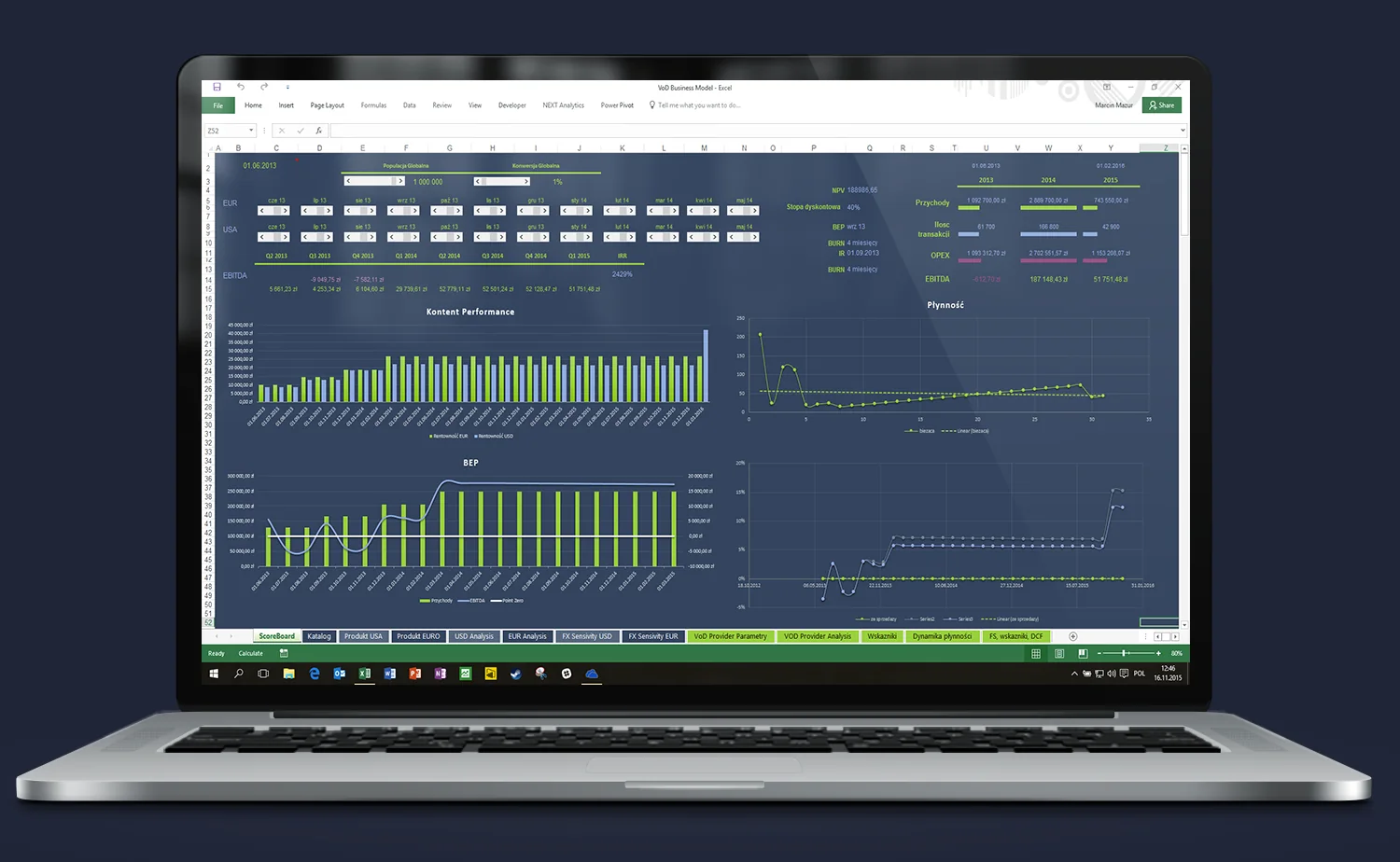
Levels of cash burn were estimated, along with the break-even point at a given ARPU and churn level.
Costs:
- Content (licenses, pay-per-use settlement)
- Technical costs (platform maintenance)
- Marketing and user acquisition
- Customer service, administration
Investments (CAPEX):
- Technological platform (OTT)
- Integration with existing systems
- Launch campaigns
BUSINESS SCENARIOS
The model was designed to compare commercial offers from various content and technology providers.
It enabled evaluation of:
- total cost of individual proposals,
- licensing terms (fixed fee vs revenue share),
- required initial investments (technology, integrations, campaigns).
It also supported decisions regarding:
- offer structure (premium, package-based),
- length and flexibility of contracts with suppliers,
- potential impact on EBITDA and cash flows.
The model enabled evaluation of:
- Content packages – different scopes from various aggregators
- Settlement models – flat fees / per user / revenue share
- OTT technology platform offers – differences in implementation costs, SLA, and user support
- Required marketing investments.
Each scenario had its reflection in:
- revenue and cost forecasts
- investment schedule
- cash flow and financial indicator analysis (NPV, IRR)
PRICING STRATEGIES
The model allowed testing of various pricing strategies and service development paths for VoD:
Pricing strategies and ARPU:
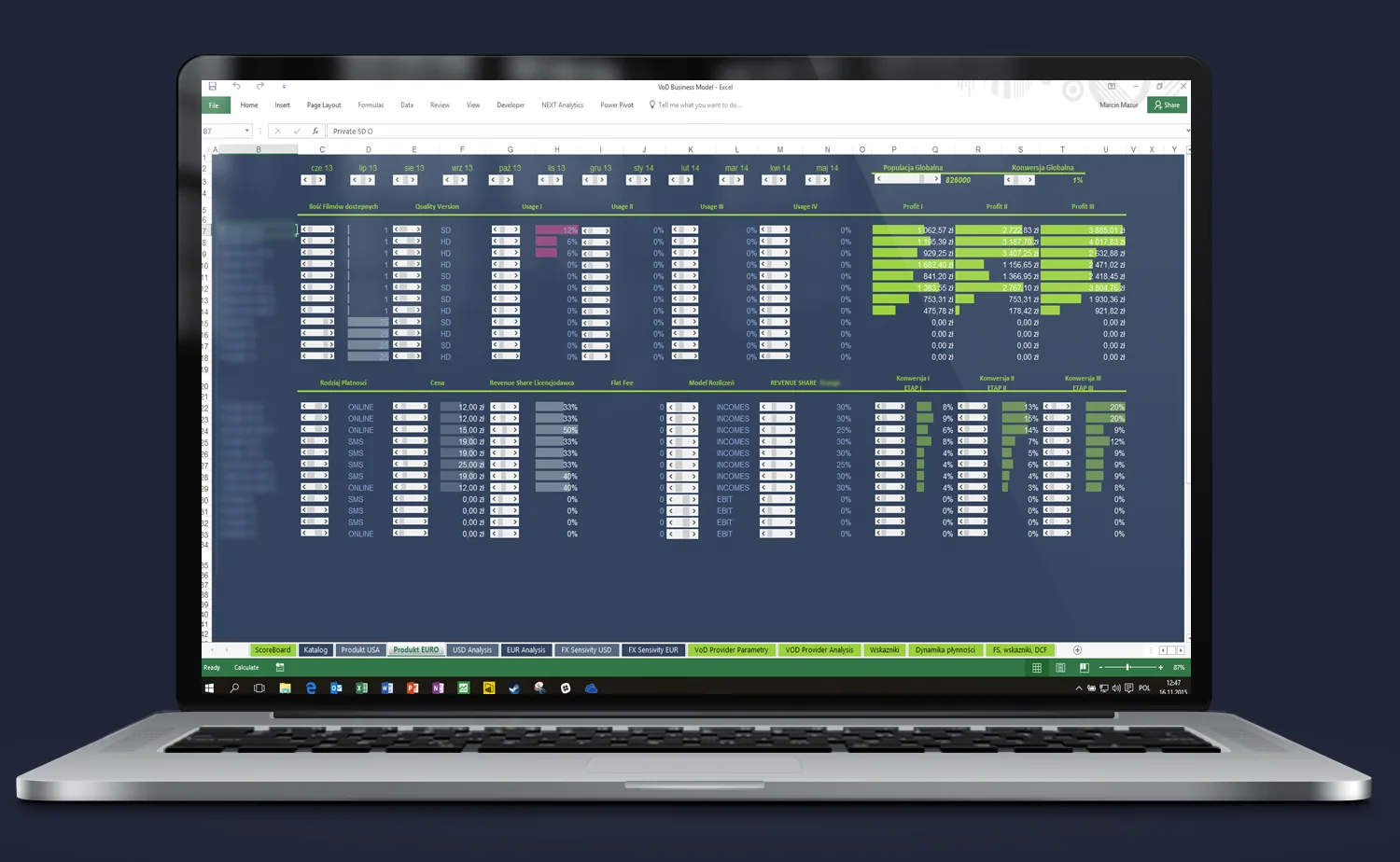
- Different price levels for packages were defined (basic, premium, pay-per-view).
- The model allowed assessment of the impact of ARPU changes on profitability and EBITDA level.
Growth scenarios:
- Various scenarios were simulated:
- Each had its own assumptions regarding customer acquisition pace, retention, churn, and acquisition costs.
- The impact of marketing campaigns on user growth could be tested.
LTV/CAC and churn analysis:
- Customer Lifetime Value (LTV) was calculated based on ARPU, customer lifetime, and service costs.
- It was compared with Customer Acquisition Cost (CAC) under different marketing strategies.
- Dynamic recalculation of indicators over time was possible – e.g. after a 5% churn increase or a change in marketing budget.
Cash flow modeling:
- Cash flow was generated on a monthly and quarterly basis.
- The impact of investment delays or campaigns on liquidity could be analyzed.
- Payment schedules for content, integrations, and delays in customer inflows were taken into account.
The model allowed testing of various pricing strategies and VoD service development paths:
Pricing strategies and ARPU:
- Different price levels for packages were defined (basic, premium, pay-per-view).
- The model allowed assessment of the impact of ARPU changes on profitability and EBITDA level.
Growth scenarios:
Various scenarios were simulated:
- Each had its own assumptions regarding customer acquisition pace, retention, churn, and acquisition costs.
- The impact of marketing campaigns on user growth could be tested.
FINANCIAL MODEL – FINANCIAL DASHBOARD
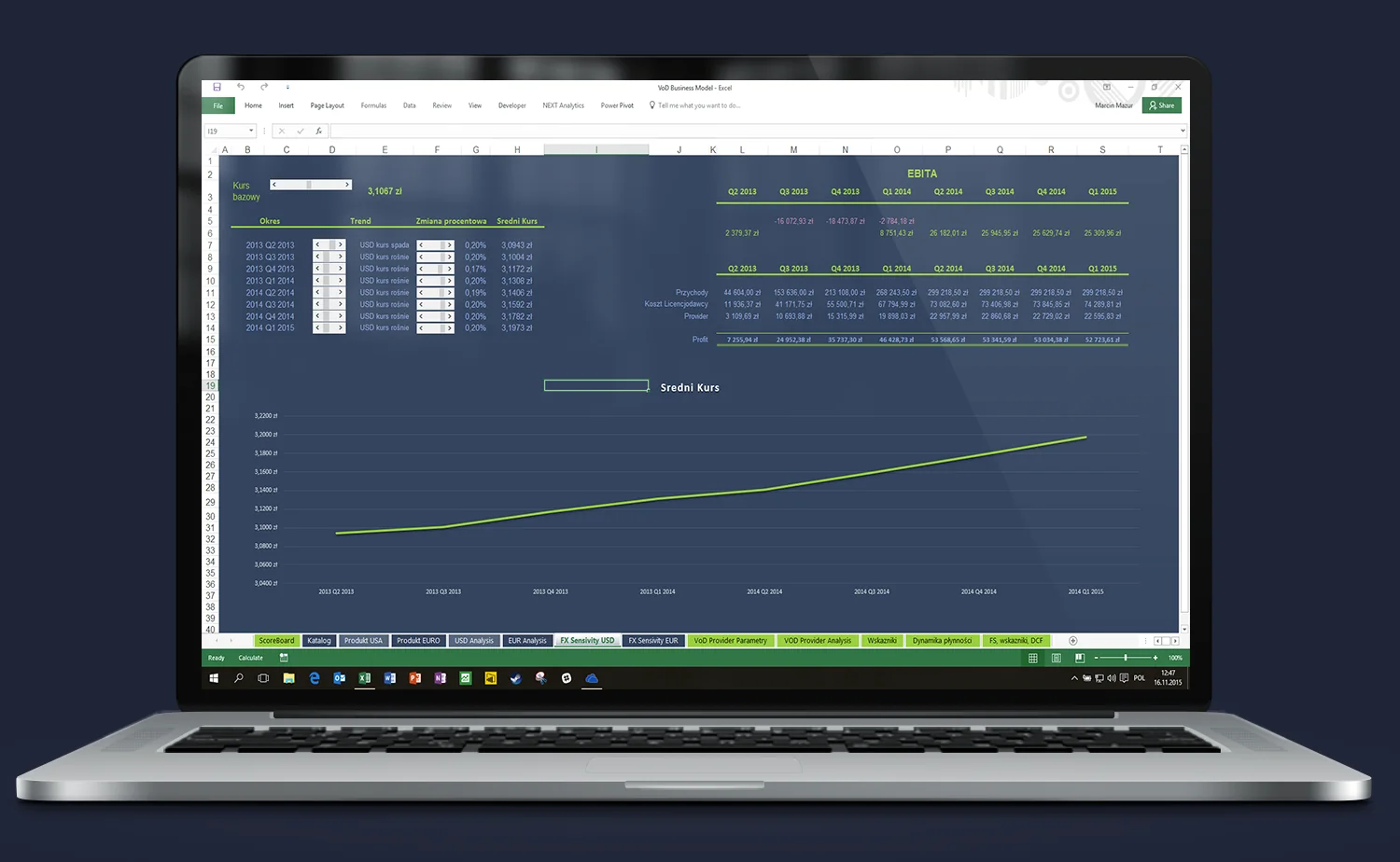
The financial model took into account that the main licensing and technological contracts were denominated in USD and EUR. A module was built in to simulate the impact of exchange rate changes on:
- total costs of content providers,
- profitability and EBITDA level.
Dynamic change of exchange rates over time was possible (taking into account forecasts or strategic assumptions).
The model user could test any variants, including:
- stable exchange rate (long-term contract),
- strengthening of the zloty (cost reduction),
- weakening of the zloty (risk of increased CAPEX and OPEX).
For each scenario, the model generated:
- update of projected cash flows,
- changes in project IRR and NPV,
- new profitability points for each analyzed supplier.
HOW THE MODEL WAS USED IN PRACTICE
Levels of cash burn were estimated, along with the moment when the service would become profitable (break-even at a given ARPU and churn level).
The model was used for:
- presenting the project to the management board and industry investors,
- comparing 3 alternative market entry strategies,
- developing arguments for content supplier contract negotiations,
- planning the investment financing path – using own funds and debt financing.
Do you need someone who instantly understands the problem — and knows what to do with it?
Most companies have data. What’s missing is the idea of what to do with it — and someone who will actually execute it. Origami Effect provides both.