
Agricultural farms produce data that no other industry generates.
Every hectare, every cow, every combine run, every ton of milk, every laboratory sample — all of this generates numbers that directly impact the financial result. The problem is not a lack of data. The problem is that it sits in separate spreadsheets, in the agronomist’s head, in the records kept by the zootechnician, in last week’s lab results, and in Excel files that the owner won’t open between meetings at the bank.
Demeter, Gaia , Echo and Hebe change these proportions. Demeter is likely the most accurate financial and operational model of an agricultural farm — built in Excel, mapping the complete physics of production.
Gaia records every field activity and every logistical event. Hebe is a dedicated dairy analytics system — production, quality, deliveries, nutrition, costs, and herd health.
Clio aggregates data from all three layers and loads it into a structured database. Iris turns these raw structures into interactive dashboards available in the browser — without opening a file, without asking an analyst for a summary, without waiting for the end of the month.
Five systems. One interface. The entire farm in a single view.
[/col] [/row] [/section] [section label=”Problem który rozwiązuje Artemis”] [row v_align=”middle”] [col span__sm=”12″ padding=”10px 0px 0px 0px”]The problem solved by Iris · Demeter · Gaia · Hebe
An agricultural farm is one of the most operationally complex businesses. Revenues depend on weather, contracts, procurement prices, and herd yield simultaneously. Variable costs — feed, fertilizers, plant protection products, fuel — change every season. CapEx spans multiple years and is difficult to link to the current result. Milk quality measured daily translates into the procurement price — and this difference seen monthly amounts to hundreds of thousands of PLN on an annual scale.
The problem is that traditional ERP systems for agriculture are too rigid to reflect the specifics of a particular farm, and Excel is unreadable when the owner wants to make a decision before heading out to the cowshed at six in the morning.
What reality looks like without this system
The owner wants to know if milk production is on track and how fat and protein performed last month compared to the previous year. The answer requires opening at least three files — the Demeter model, the Hebe sheet, and the laboratory results — and manually compiling the data.
Comparing the cost of producing a ton of wheat on plot no. 12 with plot no. 43 requires combining operational costs from Gaia, yields from harvest records, and procurement prices from contracts. Without the system, no one does this — because it takes hours.
Seasonal feed demand is estimated by the agronomist from memory or last year’s data — without taking into account the current herd composition and current milk yield broken down by feeding groups.
Wet events — herd illnesses — are recorded in a separate spreadsheet. No one links them to cow productivity during the same period.
The owner and management operate on reports dated a week or a month ago. Decisions on feed purchase, contract sales, or machine investments are made based on a gut feeling reinforced by selected numbers — not on a complete model.
What Iris changes
The system doesn’t just show dry results — it allows for an immediate drill-down through all three data layers simultaneously. See a deviation in milk production? Click and drill down to the level of a specific month, lactation cycle, and animal group — and right next to it, see what they ate during that period. See that the cost of producing rapeseed is higher than the procurement price? Iris shows on which plot and under which cost item the problem lies.
[/col] [/row] [/section] [section label=”Jak wygląda rzeczywistość bez Artemis” bg_color=”#202537″ dark=”true”] [row v_align=”middle”] [col span__sm=”12″ padding=”10px 0px 0px 0px”]System architecture — three data sources, one image
Demeter — financial and operational model (Excel + Clio)
The computational core remains a precise financial model in Excel — Demeter — which maps the complete physics of the farm: DCF, three financial statements (P&L, Balance Sheet, Cash Flow), CapEx, revenue structure, operational costs (OpEx), dairy and crop production broken down by years and months. The Clio engine automatically aggregates data from the calculated model and loads it into a structured database — preserving history and versions between years.
Gaia — field and logistics operational recording
Gaia records every field activity (who, with what machine, on which plot, when, how much), every harvest logistics run (date, plot, crop, quantity, load level, operator, vehicle, warehouse), and every crop production event. The agronomist keeps their spreadsheet just as before. Clio fetches Gaia data automatically and links it with the Demeter model — creating operational views that do not exist in any separate system.
Hebe — dedicated dairy analytics
Hebe is a separate system layer focused exclusively on dairy production. It aggregates data on milk production broken down by lactation cycles, laboratory sample results (fat %, protein %), daily deliveries and monthly procurement prices, feeding parameters broken down by animal groups, herd health (vet events), and milk production costs. The data goes to Clio and becomes available in Iris alongside financial data from Demeter and operational data from Gaia.
Iris — visual layer in React
Iris connects to the Clio API and renders data from all three systems as interactive dashboards. Available via browser — on phone, tablet, and laptop — no installation, no VPN, without opening a file. Every dashboard features a one-click XLSX, PDF, and JSON AI export.
[/col] [/row] [/section] [section label=”Wizualizacje Artemis”] [row v_align=”middle”] [col span__sm=”12″ padding=”10px 0px 0px 0px”]Dashboard Catalog — what Iris visualizes
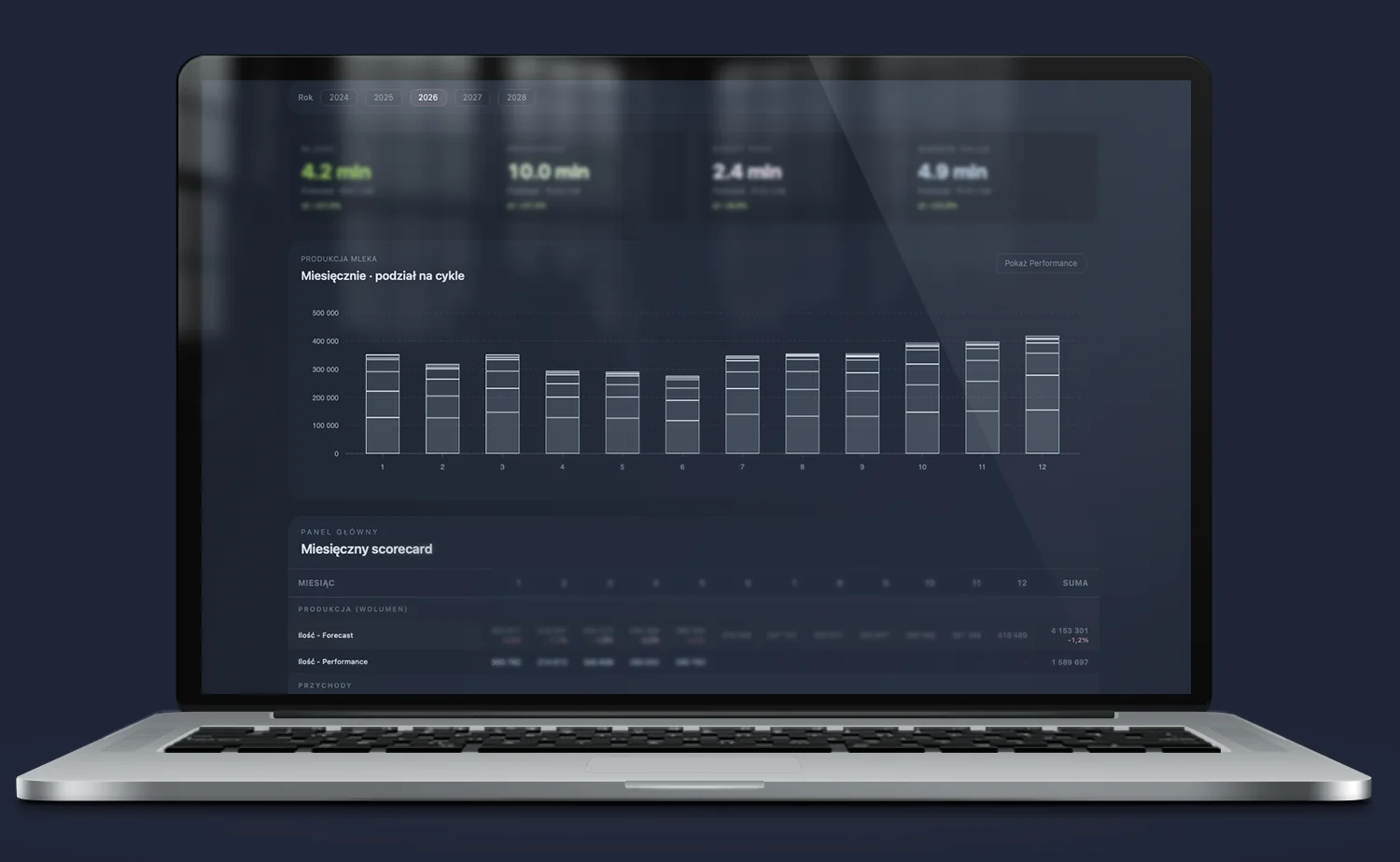
[/col] [/row] [row v_align=”middle”] [col span=”6″ span__sm=”12″ padding=”10px 0px 0px 0px”]Milk Production Costs — the operational and financial compass of a dairy farm
Most agricultural systems report the past.
This view automatically consolidates production and zootechnical data, transforming it into a forward-looking decision-making tool. Instead of manually linking tables, the manager receives an immediate answer regarding herd profitability.
[/col] [col span=”6″ span__sm=”12″ padding=”10px 0px 0px 0px”] [ux_image id=”31610″] [/col] [col span__sm=”12″ padding=”10px 0px 0px 0px”]Early detection of herd anomalies (Lactation Structure): Breaking down monthly production into lactation cycles (Cycle 1–7) directly verifies herd replacement efficiency. A drop in performance in key cycles is visible immediately, rather than showing up later in the quarterly financial result.
Automatic audit of assumptions (Forecast vs Performance): The monthly scorecard relieves traditional controlling from the duty of searching for variances. The system itself indicates whether production, herd structure, or the market price per liter is drifting, while providing dynamic year-over-year (YoY) context.
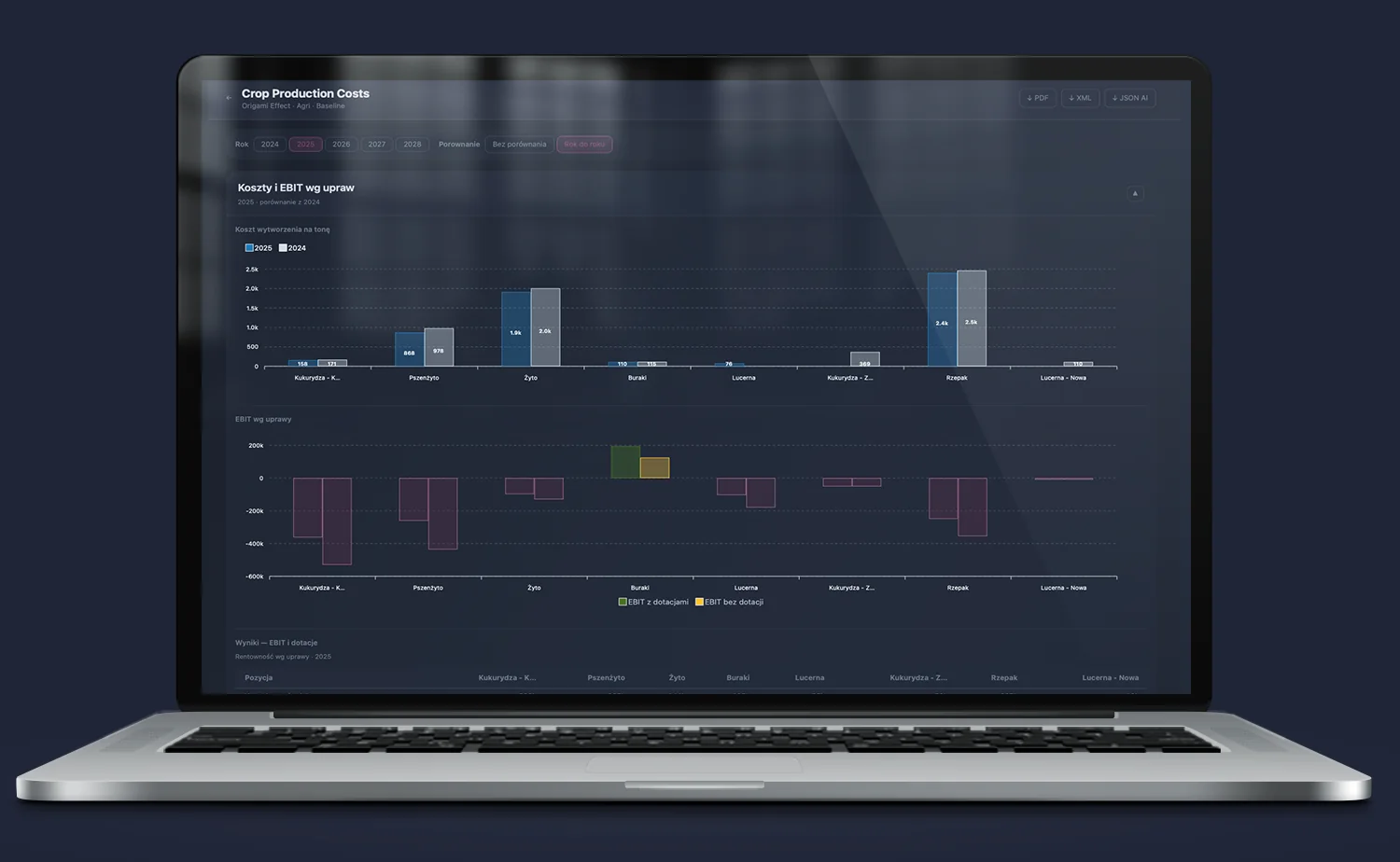
[/col] [/row] [row v_align=”middle”] [col span=”6″ span__sm=”12″ padding=”10px 0px 0px 0px”]Crop Production Costs — absolute profitability audit of crops
Moving from simple field cost tracking to multi-variant financial engineering.
This module consolidates scattered machine, agrotechnical, and material costs, reducing them to a single, key decision unit: the real production cost of one ton and the pure EBIT result.
The true picture of profitability (Verification of subsidy dependency): The feature comparing results with and without subsidies immediately exposes the market health of individual crops.
[/col] [col span=”6″ span__sm=”12″ padding=”10px 0px 0px 0px”] [ux_image id=”31611″] [/col] [col span__sm=”12″ padding=”10px 0px 0px 0px”]Precise unit cost benchmark (PLN/t): The system converts the total operational input per ton of finished crop (from 57 PLN/t for Alfalfa to 1.5k PLN/t for Rapeseed). This gives the manager clear information on exactly where the break-even point lies amidst dynamic price changes on commodity exchanges.
Trend geometry (Dynamic crop structure management): Automated year-over-year (YoY) analysis eliminates the distortion of weather anomalies from a single season. Instead, the trader and agronomist see long-term margin dynamics, allowing them to design crop structures for real profit rather than historical habits.
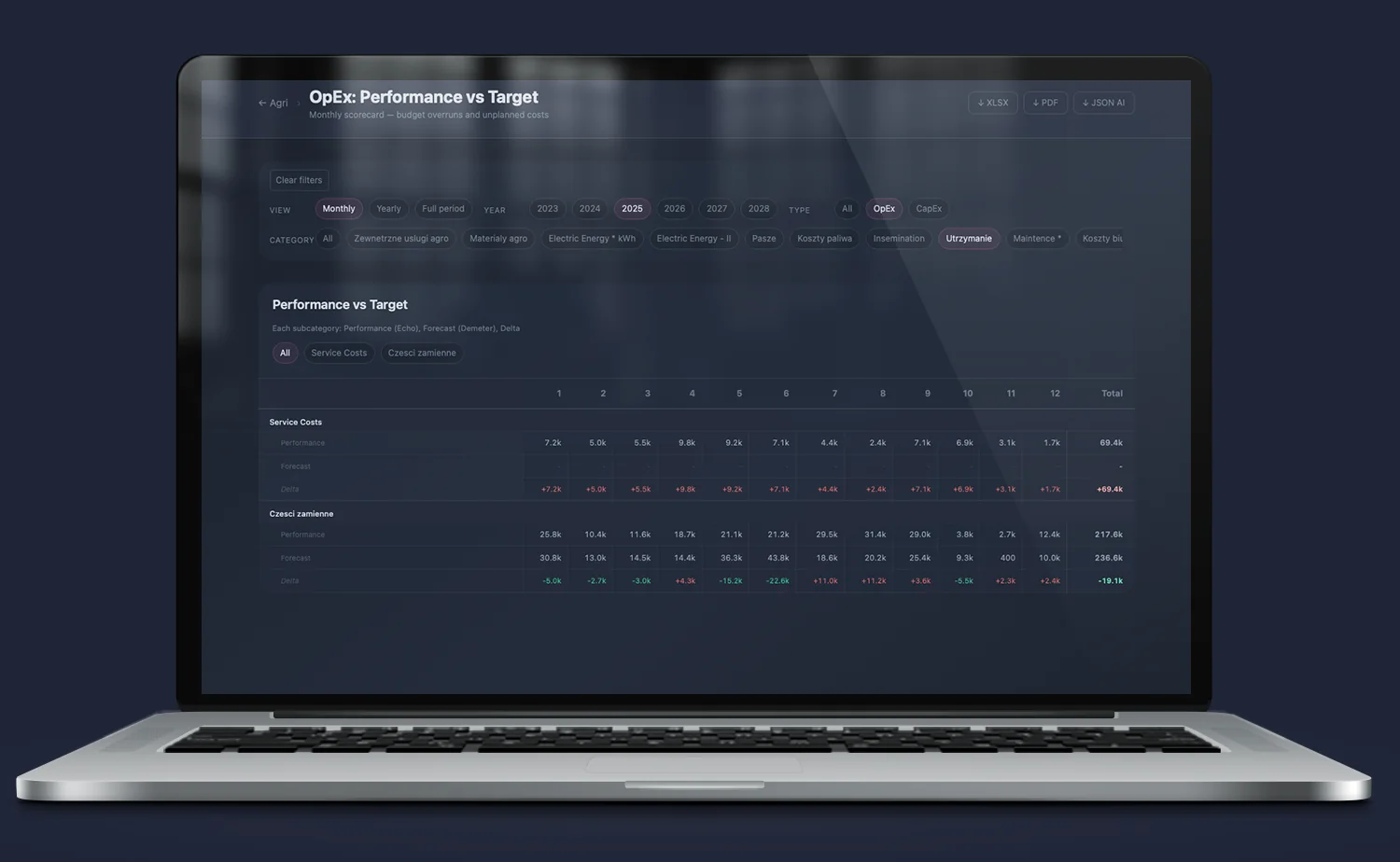
[/col] [/row] [row v_align=”middle”] [col span=”6″ span__sm=”12″ padding=”10px 0px 0px 0px”]Performance vs Target (OpEx) — automatic feedback loop between budget and reality
No more dead budgets in spreadsheets and post-mortem accounting analytics. This module is the central controlling hub that automatically closes the loop between prediction and execution.
The system matches hard operational data and invoices in real time with the operational targets set by the simulator’s algorithms.
[/col] [col span=”6″ span__sm=”12″ padding=”10px 0px 0px 0px”] [ux_image id=”31613″] [/col] [col span__sm=”12″ padding=”10px 0px 0px 0px”]Automatic detection of cost anomalies (Smart Delta): The manager does not need to analyze dozens of line items manually. The system automatically maps and aggregates deviations across key departments (from fuel and energy, through agro services and materials, to feed and zootechnics), immediately pointing out under-budgeted areas or spaces where the budget is being burned through.
Simultaneous volume and value monitoring: Controlling is not limited to a dry amount in PLN. For critical items, such as electricity, the system audits volume consumption (kWh) and cost (PLN) in parallel, allowing for a precise distinction between the farm’s operational errors and external market price changes.
Multi-dimensional time perspective at a single click: The view architecture (Monthly / Yearly / Full period) allows for instant switching between tactical management of the current month and strategic assessment of the health of the entire production cycle. A single glance is enough to distinguish a temporary invoice timing delay from a permanent over-budget trend.
[/col] [/row] [row v_align=”middle”] [col span=”6″ span__sm=”12″ padding=”10px 0px 0px 0px”]OpEx Browser — immediate analytical sovereignty for the finance department
Traditional controlling often runs out of time: detecting a cost anomaly triggers an avalanche of emails, phone calls to accounting, and days of waiting for ERP exports.
This interactive browser completely eliminates these frictions, giving managers direct, unfettered insight into the company’s cost architecture in real time.
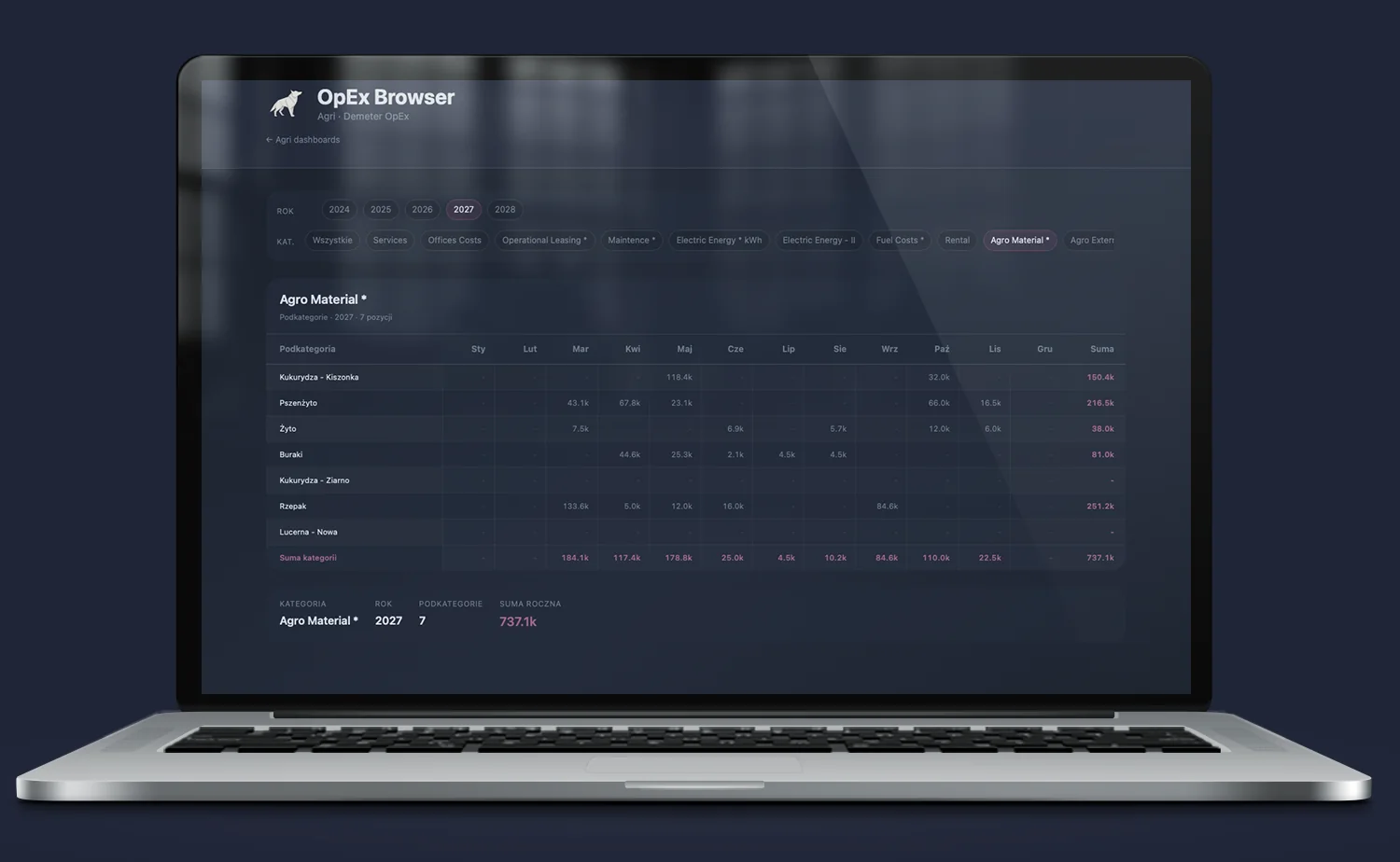
Drill-Down Analytics (From macro-scale down to a single document): The tool allows you to go from the consolidated annual total for the entire holding, through precise subcategories, down to a specific, single invoice item in a selected month within seconds. The path from a synthetic chart to the source of truth is shortened to just a few clicks.
Instant anomaly isolation without intermediaries: The CFO or controller gains full autonomy. When the system alerts about a budget overrun – for example, on agro services in March – the manager independently identifies the culprit on a single screen, without involving or waiting for dedicated summaries from the billing department.
Precise separation of capital streams: Thanks to instant filtering and categorization (year, category, cost type), the system precisely distinguishes operational expenses (OpEx) from capital investments (CapEx). This prevents large, irregular infrastructure purchases from distorting the view of the farm’s current profitability.
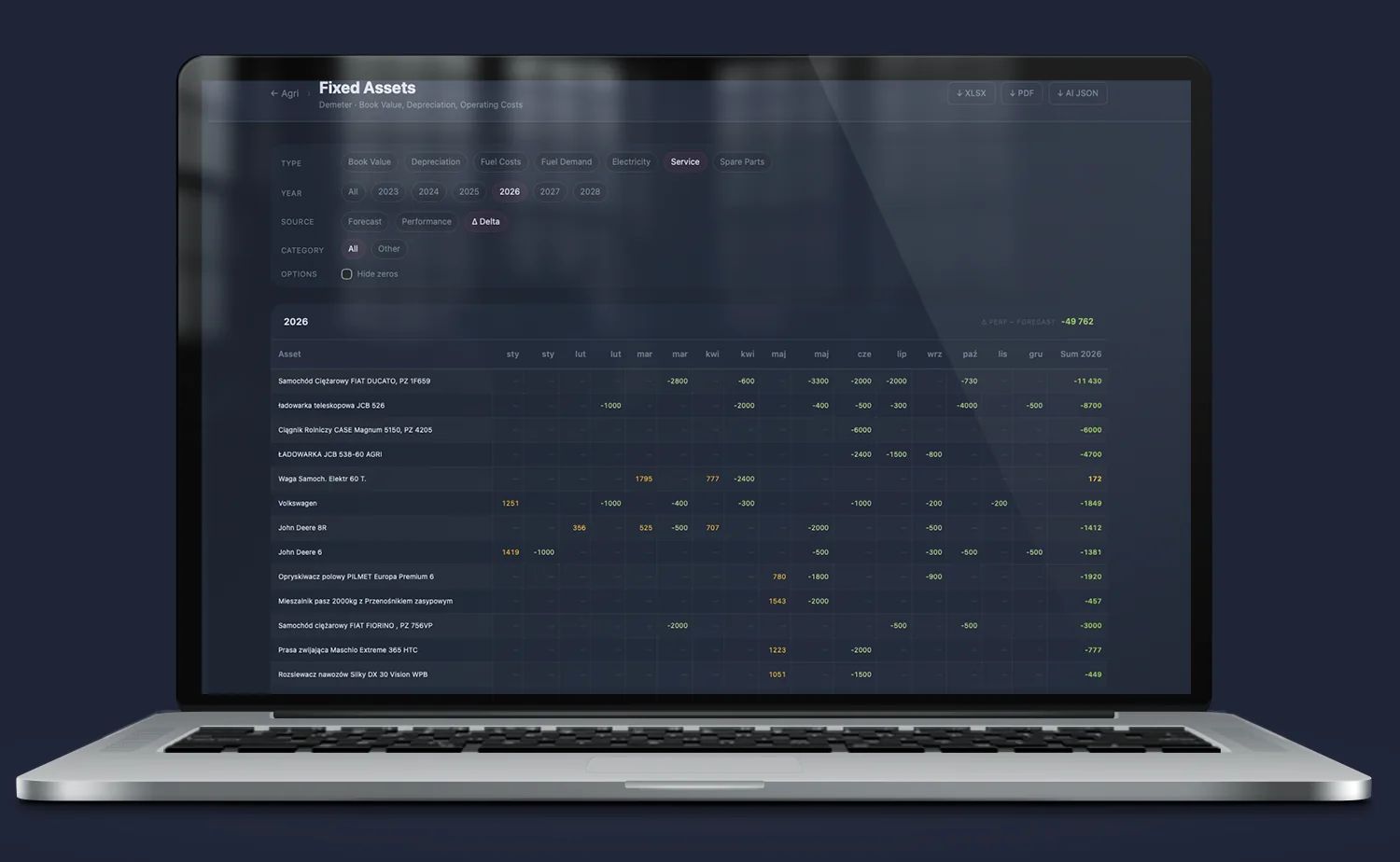
[/col] [/row] [row v_align=”middle”] [col span=”6″ span__sm=”12″ padding=”10px 0px 0px 0px”]Fixed Assets — dynamic efficiency and cost model for the machinery park
In most companies, the fixed asset register is a dead tax document. This module transforms it into a living, bi-directional asset optimization system. Every asset – from a tractor to a production line – is treated here as a separate business unit, whose balance sheet value has been permanently linked to its real, daily operational physics.
Three-dimensional asset health audit (Plan vs Reality): The system not only tracks depreciation and book value but constantly tests engineering predictions against reality. By combining forecasts (Demeter), actual cost invoices (Echo), and variances (Delta), the manager instantly sees which machines are generating hidden losses.
Full granularity of maintenance costs (TCO in real time): Every fixed asset is scrutinized month by month for its Total Cost of Ownership. The system automatically aggregates and breaks down expenditures on fuel (volume and cost), energy, servicing, and spare parts, eliminating the risk of overlooking skyrocketing operating costs of older equipment.
Multi-year aggregation with instant synthesis: The Aggregate Comparison view consolidates data across a multi-year horizon (2023–2028). Combining monthly tables with an automatic annual total allows the CFO and chief operating officer to instantly assess the validity of the holding’s long-term purchasing and service strategies.
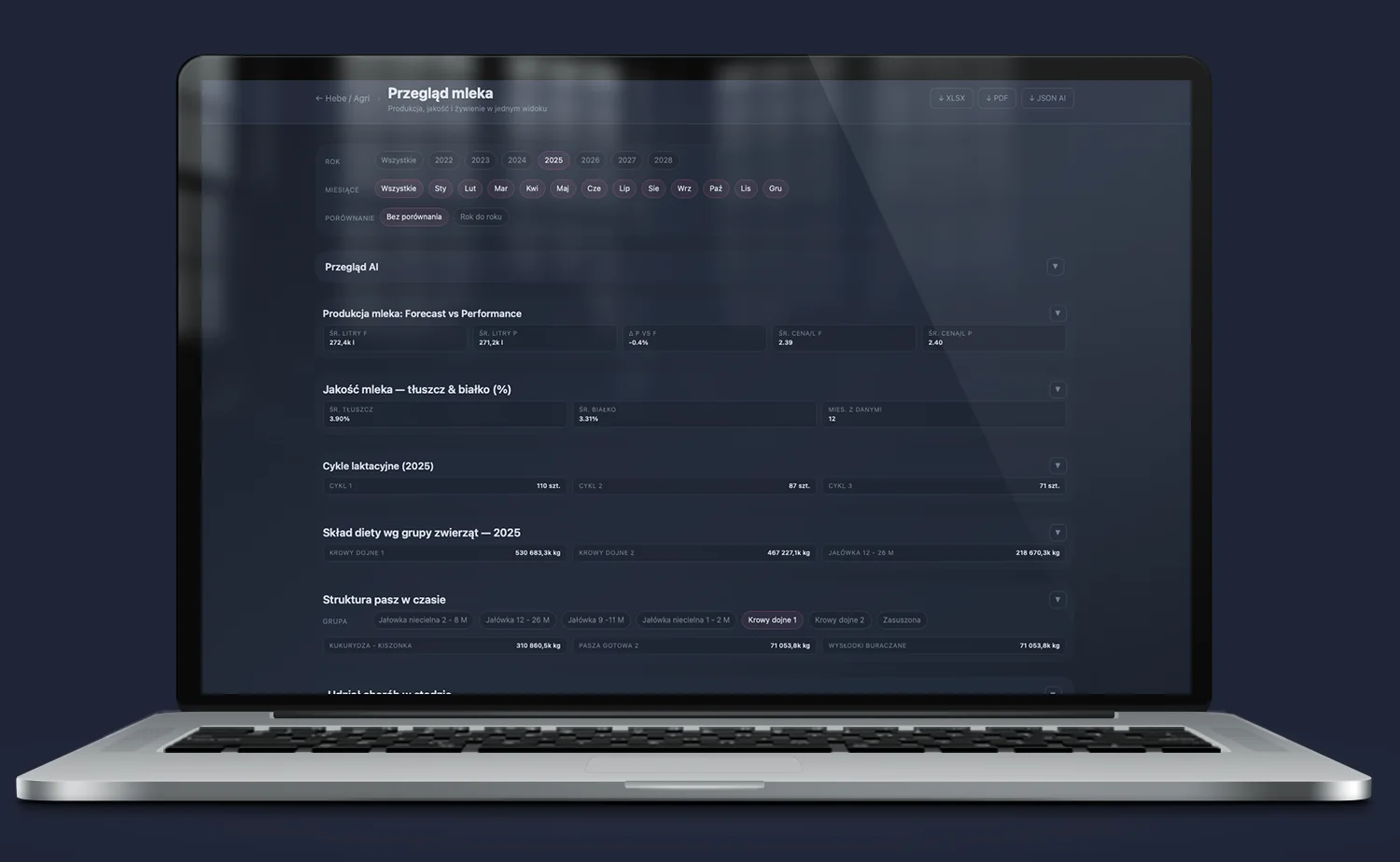
[/col] [/row] [/section] [section label=”Wizualizacje Hebe”] [row v_align=”middle”] [col span=”6″ span__sm=”12″ padding=”10px 0px 0px 0px”]Hebe: Milk Overview + AI — multi-dimensional production engineering and herd nutrition
Traditional milk production management often suffers from a lack of connection between the nutritionist’s work, laboratory results, and the financial balance sheet.
This central analytical cockpit dissolves these silos, combining zootechnics, milk chemistry, and feed structure into a single, complementary decision-making organism.
[/col] [col span=”6″ span__sm=”12″ padding=”10px 0px 0px 0px”] [ux_image id=”31619″] [/col] [col span__sm=”12″ padding=”10px 0px 0px 0px”]Three-dimensional efficiency profile (Volume, Quality, Nutrition): The system automatically matches the execution of milking plans (Forecast vs Performance) against the physicochemical parameters of the raw material (fat and protein content) and the precise structure of the diet. This allows you to instantly capture the correlation between a change in feed composition and the real caloric value and market value of the milk.
Dynamic management of herd structure and feed base: By combining the number of livestock in individual lactation cycles with an analysis of feed ration components over time (from silage and concentrates to specialized minerals), the holding gains full control over TMR/PMR cost optimization. Changes in herd structure are automatically absorbed by adjustments in the feeding strategy.
Autonomous management synthesis (AI Module): The “AI Overview” feature relieves managers of the time-consuming interpretation of multi-faceted charts. One button triggers the engine, which analyzes correlations between diet, lactation phase, and milk yield in seconds, generating ready-to-use natural language suggestions for the COO and board.
[/col] [/row] [row v_align=”middle”] [col span=”6″ span__sm=”12″ padding=”10px 0px 0px 0px”]Hebe: Deliveries and Prices — operational and commercial guardian of milk contracting
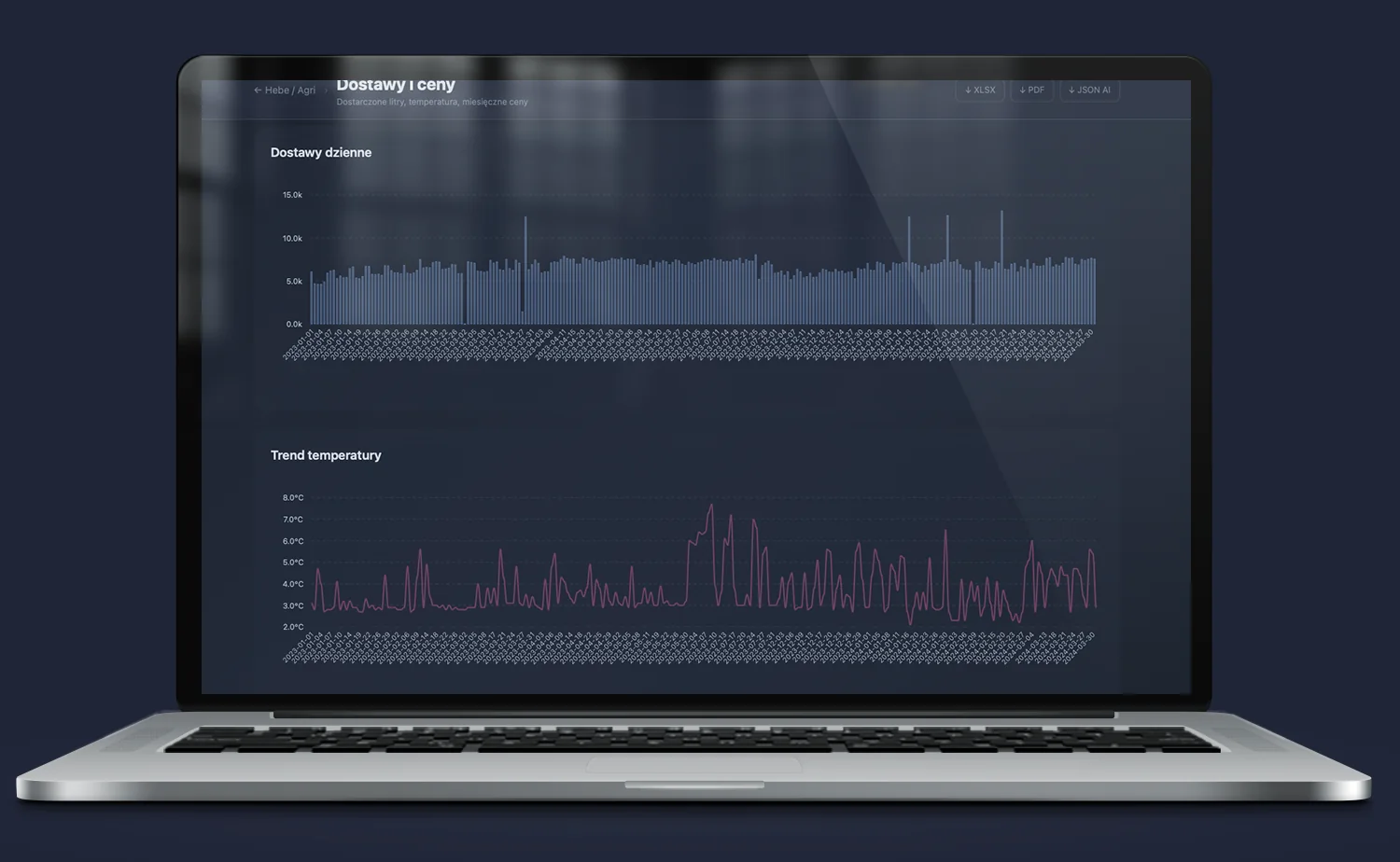
This module brings global dairy contracts down to the level of daily delivery physics and strict quality requirements. Instead of analyzing averaged monthly reports when it’s already too late to react, the system aggregates procurement parameters day by day, protecting the farm from raw material losses and contractual penalties.
Continuous monitoring of technological requirements (Cold chain): Automatic tracking of average temperature and daily thermal trends of deliveries is a direct quality control tool. It allows for the immediate detection of cooler failures or transport deficiencies before they cause a drop in milk class and real financial loss.
Visual detection of anomalies and milking seasonality: Mapping daily deliveries as precise volume profiles (measured in millions of liters) instantly exposes any production disruptions. The manager sees natural seasonal trends and sudden, anomalous spikes, allowing for rapid logistics and feed corrections.
Price navigation tool for the board: Comparing daily delivery dynamics with historical and current procurement prices (on a multi-year basis) gives the holding owners solid arguments for discussions with dairies. The system allows for a precise evaluation of how the farm’s production flexibility responds to macroeconomic price trends in the raw materials market.
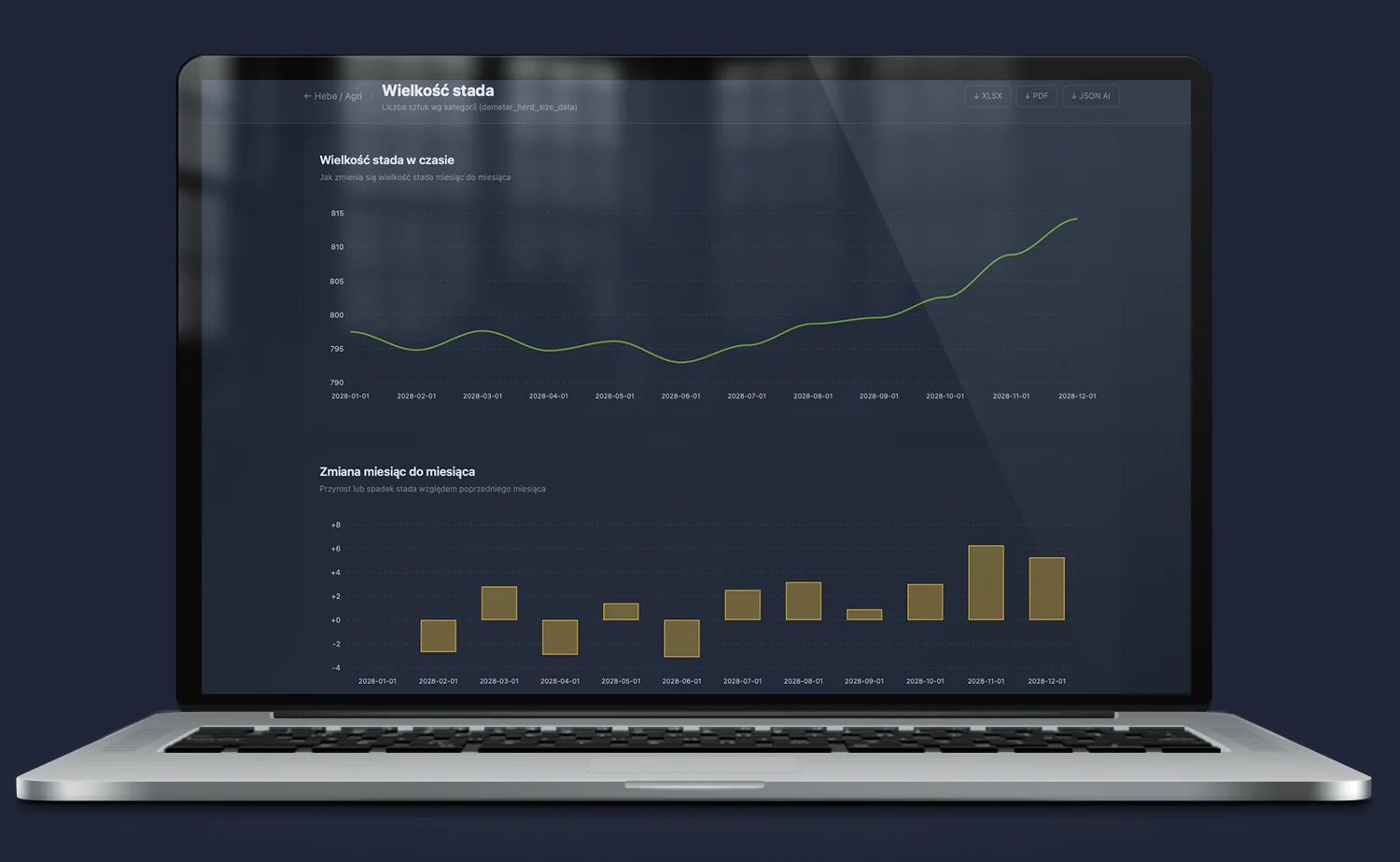
[/col] [/row] [row v_align=”middle”] [col span=”6″ span__sm=”12″ padding=”10px 0px 0px 0px”]Hebe: Herd Size — dynamic control of the holding’s structure and production potential
The herd is a living production infrastructure, whose age and technological structure directly determine future financial flows. This module moves away from static cattle counting toward advanced herd demographic analytics, allowing for precise synchronization of the biological base with the farm’s business goals.
[/col] [col span=”6″ span__sm=”12″ padding=”10px 0px 0px 0px”] [ux_image id=”31625″] [/col] [col span__sm=”12″ padding=”10px 0px 0px 0px”]Assumption verification matrix (Herd physics vs Business model): The module serves as a hard benchmark for feed and production models. Automatically matching actual herd composition with theoretical assumptions allows for the immediate detection of discrepancies that could lead to feed shortages or underestimation of future milk volumes.
Granular management of herd replacement structure: The system precisely categorizes animals in key technological phases – from calves and heifers in narrow age brackets (indicating herd renewal potential in subsequent years) to milking and dry cows. This gives management full visibility into the continuity of the production cycle.
Strategic forecasting and retrospective analysis (YoY Analysis): The ability to dynamically examine herd structure on an annual basis allows for the identification of long-term demographic trends. The holding board can precisely assess the effectiveness of the breeding policy and plan herd size for long-term commercial contracts.
[/col] [/row] [row v_align=”middle”] [col span=”6″ span__sm=”12″ padding=”10px 0px 0px 0px”]Hebe: Feed Consumption — precise audit and optimization of herd feeding costs
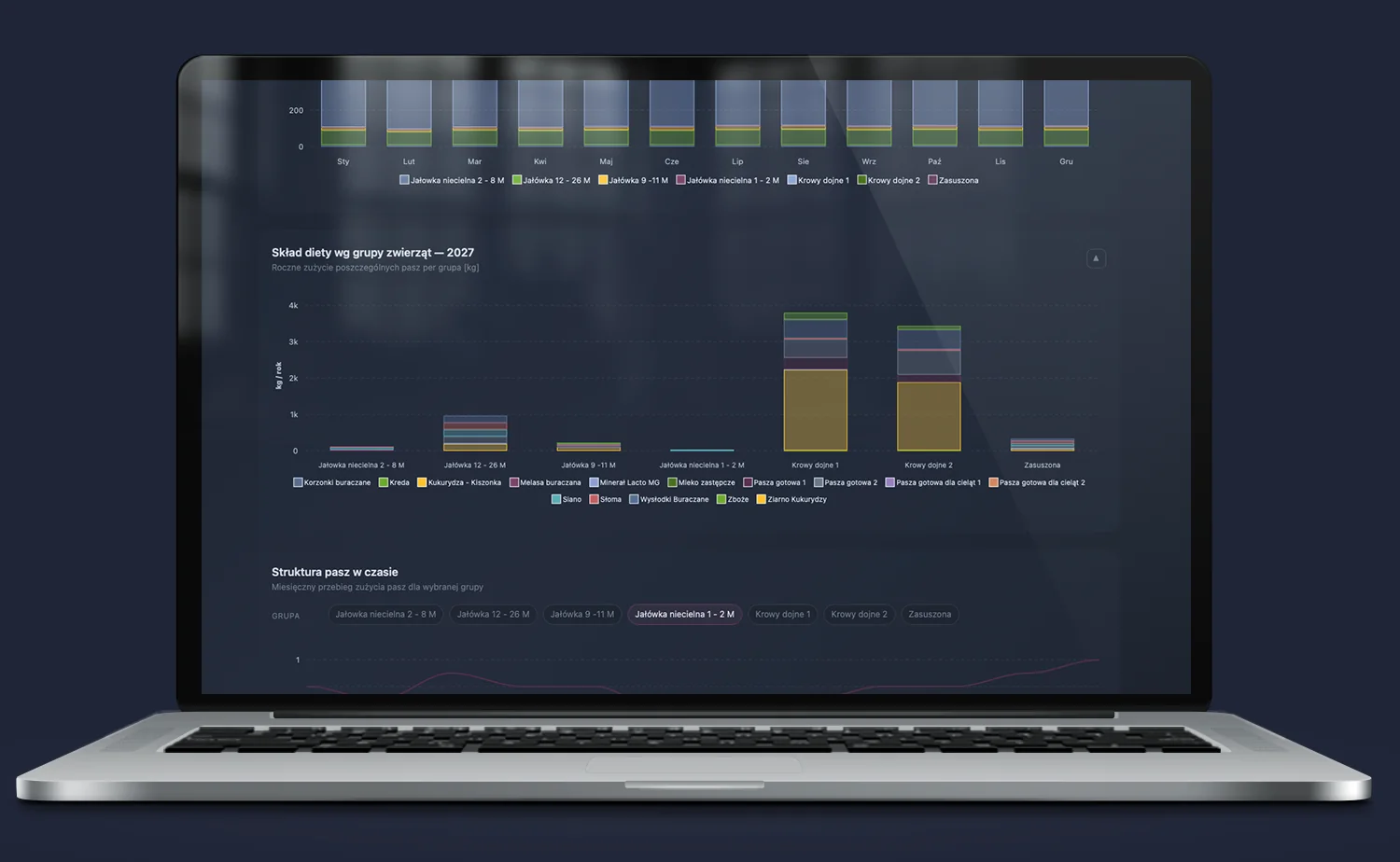
Feeding is the largest and most variable cost in milk production. This module consolidates daily feed distribution data, transforming raw weight reports from mixer wagons into a clear picture of feeding economics.
The system allows for real-time monitoring of the correlation between ration composition, its real cost, and its impact on yield.
Absolute control over ration cost structure: Utilizing cumulative diet structure profiles (stacked bar chart) broken down by specific livestock technological groups allows for an immediate assessment of the share of the most expensive components (e.g., concentrates and minerals) relative to forage. Recipe changes are instantly visible in the cost structure.
Anomaly detection over time (Monthly trends): Comparing diet composition with time axes on a monthly basis allows for rapid identification of deviations from the planned feeding schedule. The production coordinator sees if and when the feeding structure of a given animal group actually changed, enabling immediate reaction to hidden cost increases.
[/col] [/row] [/section] [section label=”Wizualizacje Artemis”] [row v_align=”middle”] [col span=”6″ span__sm=”12″ padding=”10px 0px 0px 0px”]Gaia: Technical Cost of Production — margin per ton from every plot
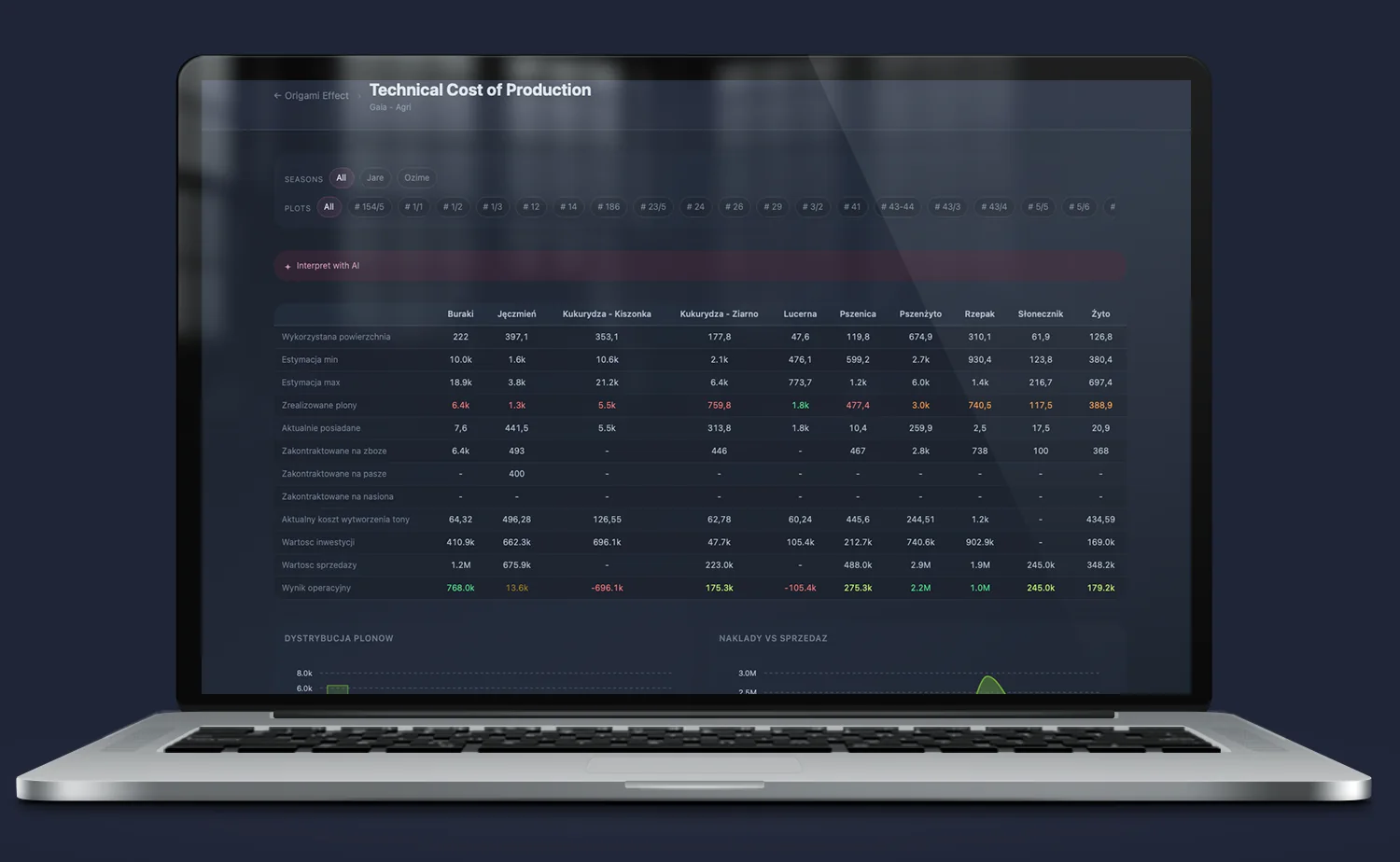
The most advanced view in the system. Iris combines operational costs from Gaia (fuel, materials, outsourcing), procurement prices from contracts, and actual yields from harvest records — and calculates the margin per ton for each crop and each plot separately. Filters: seasons (Spring / Winter / All), plots (30 plots by number), crops (Beets, Barley, Corn-Silage, Corn-Grain, Alfalfa, Wheat, Triticale, Rapeseed, Sunflower, Rye).
Main table: Utilized area, Min/max estimation, Achieved yields, Currently held, Contracted for grain/feed/seed, Current production cost per ton, Investment value, Sales value, Operating result.
Below: Yield distribution (bar chart per crop, plan vs actual) and Inputs vs Sales (area chart). The “Interpret with AI” button generates a natural language analysis of the results.
[/col] [/row] [row v_align=”middle”] [col span=”6″ span__sm=”12″ padding=”10px 0px 0px 0px”]Gaia: Activity Performance vs Target — operational verification of field costs
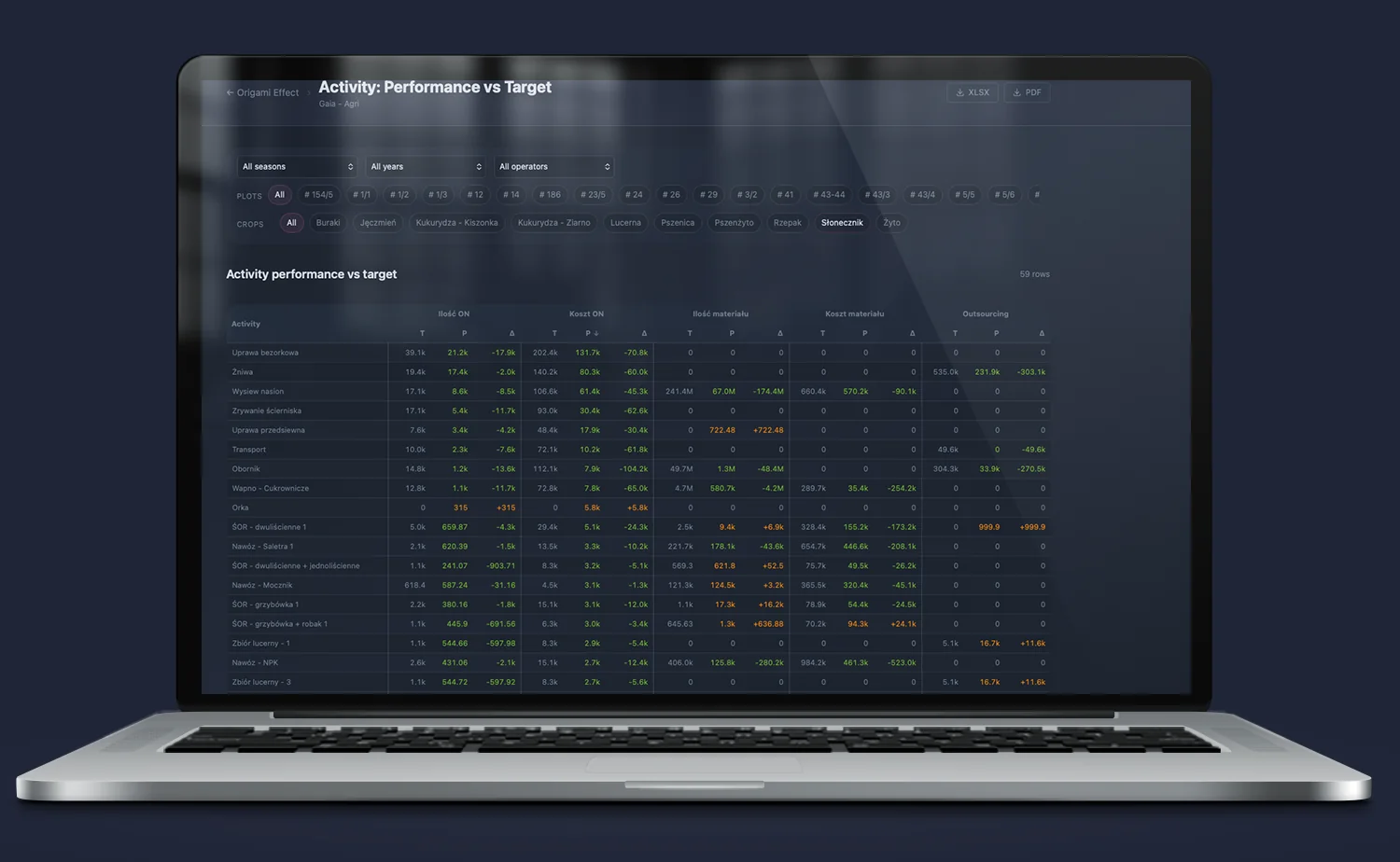
Large-scale agrotechnical management requires precise accounting of operations, where every liter of fuel and ton of fertilizer impacts the final result. This module is an automatic auditor of key field activities – from no-till farming, plowing, and sowing, through fertilizer and plant protection application, to harvesting and transport.
The system immediately matches agrotechnical assumptions with facts from the fields, eliminating the manual entry of work logs.
[/col] [col span=”6″ span__sm=”12″ padding=”10px 0px 0px 0px”] [ux_image id=”31631″] [/col] [col span__sm=”12″ padding=”10px 0px 0px 0px”]Automatic fuel management settlement (Diesel balance): For each treatment, the system simultaneously tracks diesel consumption in liters and its real cost in PLN (Target vs Performance). The mathematically calculated delta (Δ) instantly reveals anomalies: excessive fuel burning on specific plots, operator errors, or inefficient machinery travel routes.
Precise audit of material inputs and services: The module strictly accounts for the volume and cost of consumed raw materials (seeds, lime, manure, precise fertilizer types like NPK, ammonium nitrate, urea) and outsourcing inputs (external services). This allows for immediate verification of whether the dosage per hectare matched the agronomic plan and budget.
Multi-dimensional variance isolation: An extensive filter system (seasons, years, specific plots, crops, and machine operators) allows for rapid pinpointing of loss sources. The holding manager can check within seconds whether a cost overrun during harvest or plant protection treatments is a matter of crop specifics, an anomaly on a particular field, or a specific employee’s driving technique.
[/col] [/row] [/section] [section label=”FAQ” bg_color=”#202537″ dark=”true”] [row v_align=”middle”] [col span__sm=”12″ padding=”10px 0px 0px 0px”]Implementation Effects — what changes in practice
- The owner opens the dashboard on their phone in the morning before heading to the cowshed. They see yesterday’s milk production, the current procurement price, and the deviation from the plan — without opening a file, without asking the zootechnician.
- Margin per ton from every plot — without manual compilations. Information that previously required a week of an analyst’s work is available instantly — automatically combined from three data layers.
- Crop structure decisions based on hard numbers. Iris shows which triticale plots made money last season and which generated a loss. The decision to change the structure for the next year is based on data — not on the agronomist’s memory.
- Milk quality as a management indicator, not just a laboratory one. Fat and protein trends viewed alongside feeding costs and procurement results — in a single view — allow for herd diet optimization with a precision no spreadsheet can match.
- Vet events in the context of productivity. The correlation between herd illnesses and milk yield in the same cycle — visible without manual data compilation.
- Transparency for banks and investors. The complete financial structure of the farm — DCF, P&L, Cash Flow, CapEx, plan vs. execution — available in a clean interface. A single click generates a PDF or JSON AI export for a meeting with a bank or auditor.
- The agronomist and zootechnician do their job. The rest happens automatically. Gaia and Hebe record data as a natural result of operational work. Iris transforms this data into a management overview without any additional reporting steps.
Technology
Layer: Financial model | Technology: Demeter (Excel)
Layer: Dairy analytics | Technology: Hebe (Excel + external laboratory sources)
Layer: Operational recording | Technology: Gaia (Excel, API)
Layer: Data aggregation | Technology: Clio (Python, MySQL)
Layer: Visual layer | Technology: React, Recharts, D3.js
Layer: AI layer | Technology: Claude API (Anthropic)
Layer: Export | Technology: XLSX, PDF, JSON AI with a single click
Layer: API | Technology: REST, JSON
Layer: Hosting | Technology: Cloud, responsive (phone / tablet / desktop)
Layer: Data update | Technology: With every change in the model or operational registration
FAQ
[accordion] [accordion-item title=”How does data from three systems get into a single dashboard?”]Clio is the central aggregator. It automatically fetches data from the Demeter model (Excel), Gaia records, and Hebe data, cleanses it, and loads it into a structured NoSQL database.
Iris connects to the Clio API and renders data from all three layers simultaneously. The user does not see this complexity — they see one cohesive image.
[/accordion-item] [accordion-item title=”Do I need to change the way the agronomist or zootechnician works?”]No. Gaia and Hebe record data in spreadsheets in a way that is natural for the people who maintain them. The change does not affect the data entry process — it affects what happens to it afterward. Iris turns this data into a management overview without any additional reporting steps.
[/accordion-item] [accordion-item title=”Does Iris work on a mobile phone?”]Yes. Iris is built in React with a responsive layout. The owner opens the dashboard on their phone before heading to the cowshed — the view is identical to the monitor in the office.
[/accordion-item] [accordion-item title=”How many dashboards does the system have?”]In the presented configuration: 7 Demeter dashboards + 9 Hebe dashboards + 4 Gaia dashboards.
The system is expandable — every new data area can receive its own view.