


Financial Model for a Mobile Application
The financial model was created in 2014
Project goal:
Development of a Proof of Concept for an innovative mobile application connected to a car’s computer, enabling:
- Vehicle error analysis (computer diagnostics),
- Digital vehicle maintenance log,
- Tips and optimization of driving style in the spirit of eco-driving.
The financial model took into account all aspects of product development, preparing the project for discussions with investors, including the National Capital Fund (KFK).
Technological and financial assumptions
- Application based on cloud solutions, with dynamic simulation of AWS (Amazon Web Services) costs.
- Detailed modeling of software development costs and operating costs along with project scale growth.
- Revenue forecasting based on various monetization models: fees, subscriptions, service charges.
- Building a financial model resistant to market changes thanks to built-in scenario analysis.
General parameters – model and assumption configuration
The model allowed dynamic definition of key project parameters:
- number of users,
- unit revenues,
- unit costs,
- growth rate.
This enabled adaptation of the entire financial model to changing market and strategic assumptions.
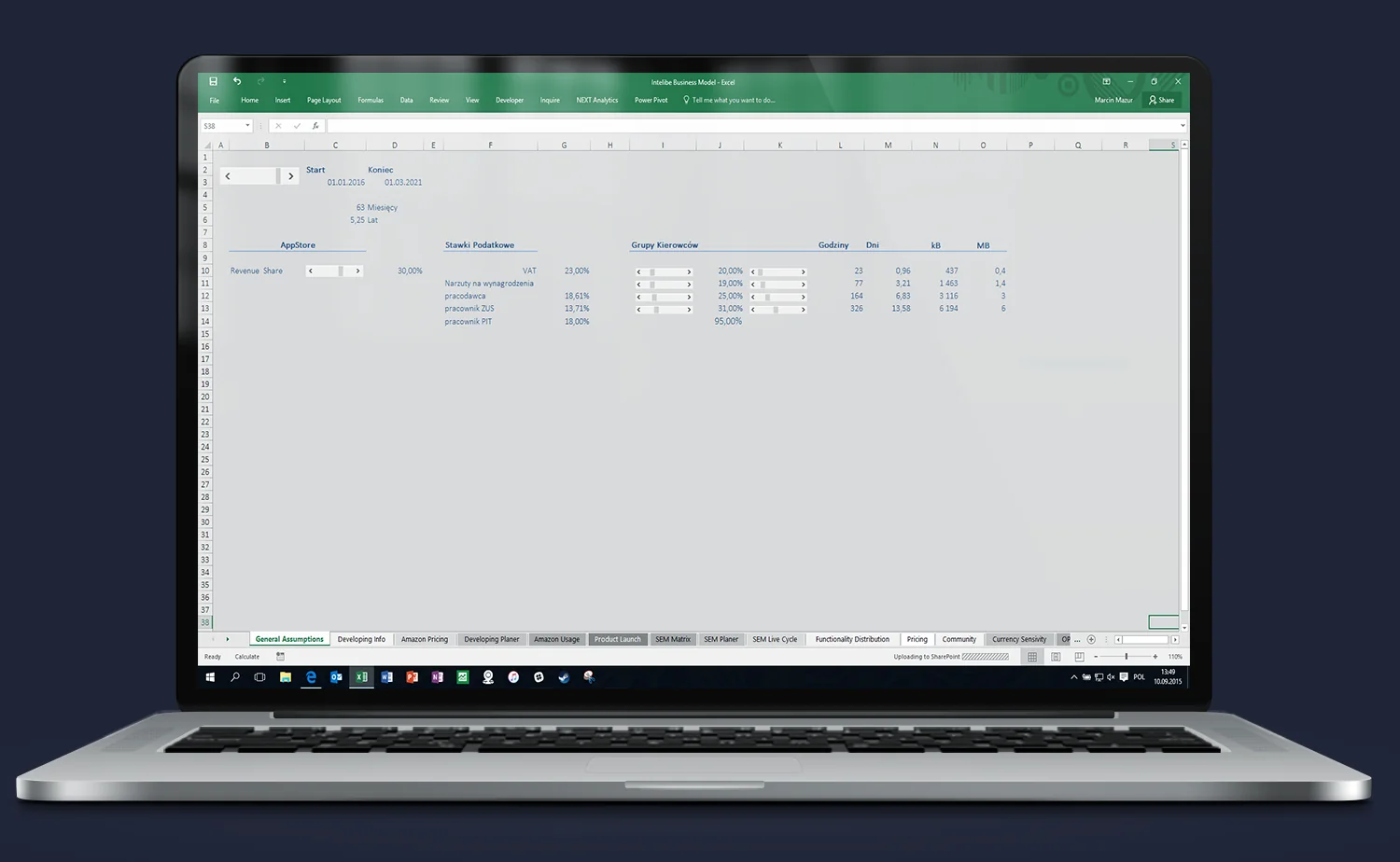
Detailed mapping of cloud service costs based on current price lists.
Taking into account various options for using the infrastructure:
- standard instances (On-Demand),
- reserved instances at low, medium and high utilization (Reserved Instances – Light, Medium, Heavy).
- Separate calculations for the EU and US regions, taking into account price differences.
- Modeling of data storage costs (Storage) and data transfer (Monthly Transfer Pricing).
- Simulation of costs depending on the number of users and application scale.
Significance for the project:
Thanks to this module it was possible to:
- realistically estimate infrastructure costs in every development scenario,
- build precise operational budgets,
- eliminate the risk of underestimating expenses for servers, data storage and data transfer,
- increase the credibility of the financial model in the eyes of investors.
Simulation of exchange rate fluctuations and currency sensitivity analysis
Analysis of the impact of exchange rate changes on project results
The “Currency Sensitivity” module in the Intelibe model enabled:
- Taking into account the impact of changes in EUR, USD and PLN exchange rates on project revenues and operating costs.
- Entering both actual and simulated exchange rates for the entire forecast period.
- Dynamic analysis of quarterly exchange rate change scenarios, based on historical data and own assumptions.
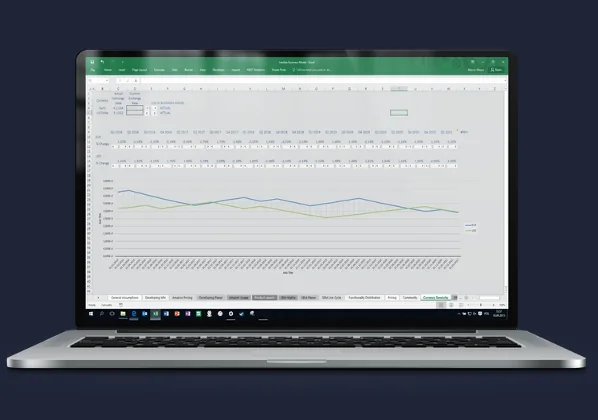
The project had a global character — part of the revenues and costs were to be generated in EUR and USD, while incurring expenses in PLN.
Thanks to this module it was possible to:
- determine how sensitive the project’s financial result is to exchange rate changes,
- prepare for currency risk already at the planning stage,
- build more resilient financial scenarios.
DEVELOPMENT INFO – system functionalities and architecture
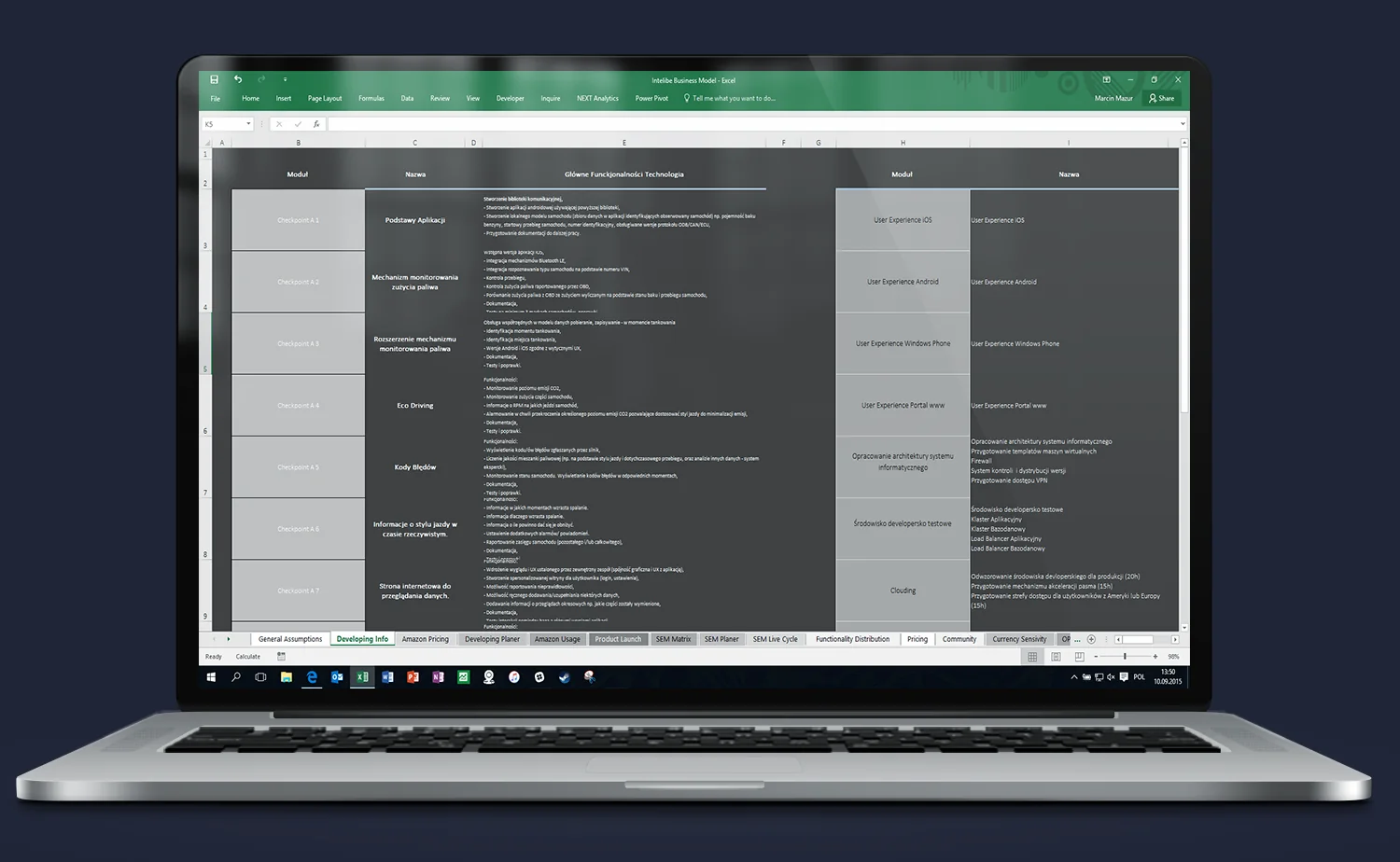
The “Development Info” module in the Intelibe financial model included, among others:
- A detailed list of planned application functionalities, divided into modules (e.g. eco-driving analysis, fuel consumption monitoring, OBD error diagnostics, user portal).
- Assignment of main tasks to individual project development stages (“Checkpoints”), along with specification of technological requirements.
- Taking into account requirements for various operating systems (iOS, Android, Windows Phone) and the web portal.
KPI and investment staging control
Project and KPI management – effective development planning.
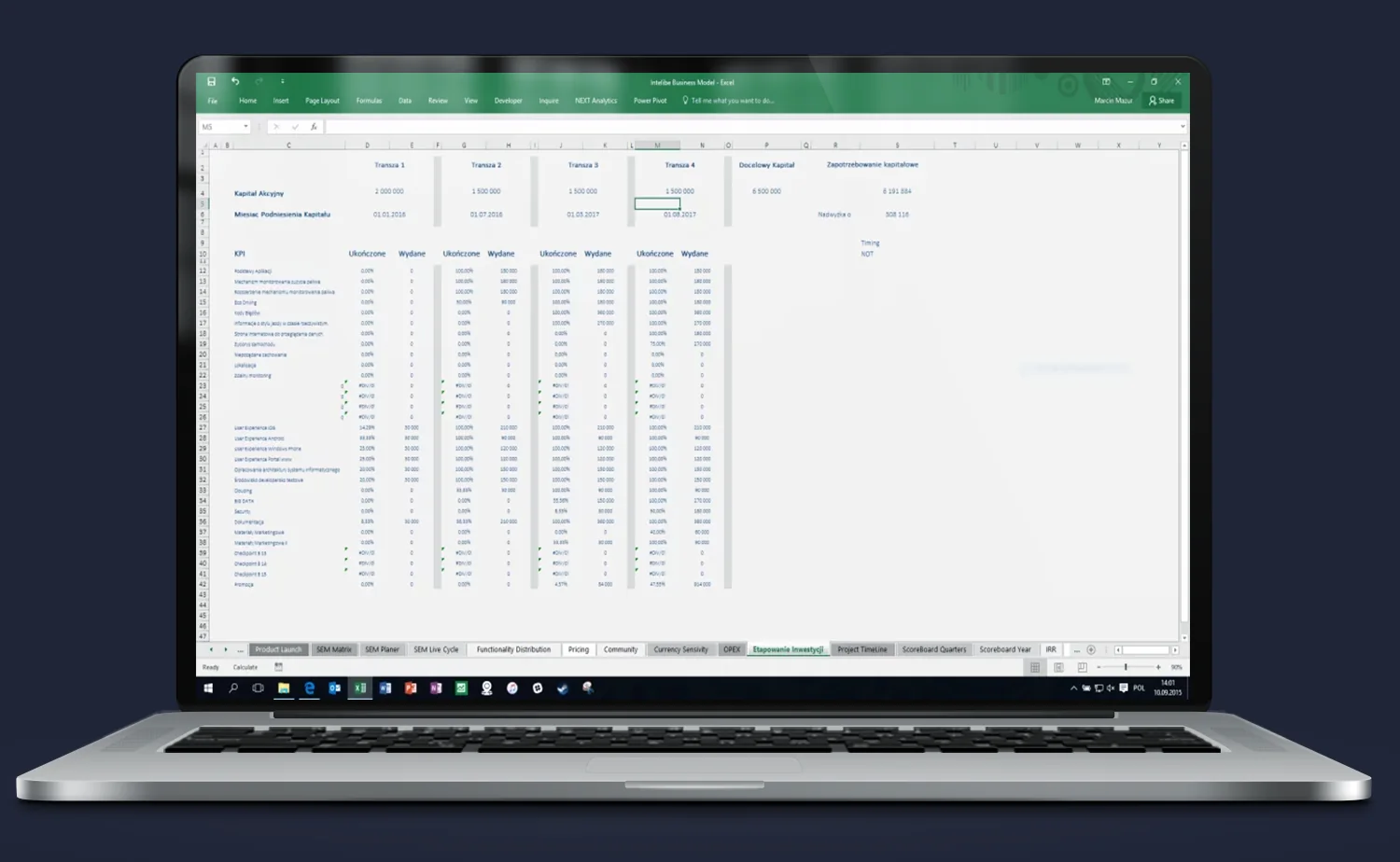
The financial model for the Intelibe project integrated project planning and KPIs, supporting:
- control of operational activity efficiency,
- analysis of the degree of implementation of key projects,
- effective management of resources and budget.
PLANNING OF PROGRAMMING WORK
Programming work schedule – project implementation control.
Built-in developer task schedule (Gantt):
- enabled planning and control of key application development stages,
- helped manage the project budget,
- minimized the risk of delays and cost overruns.
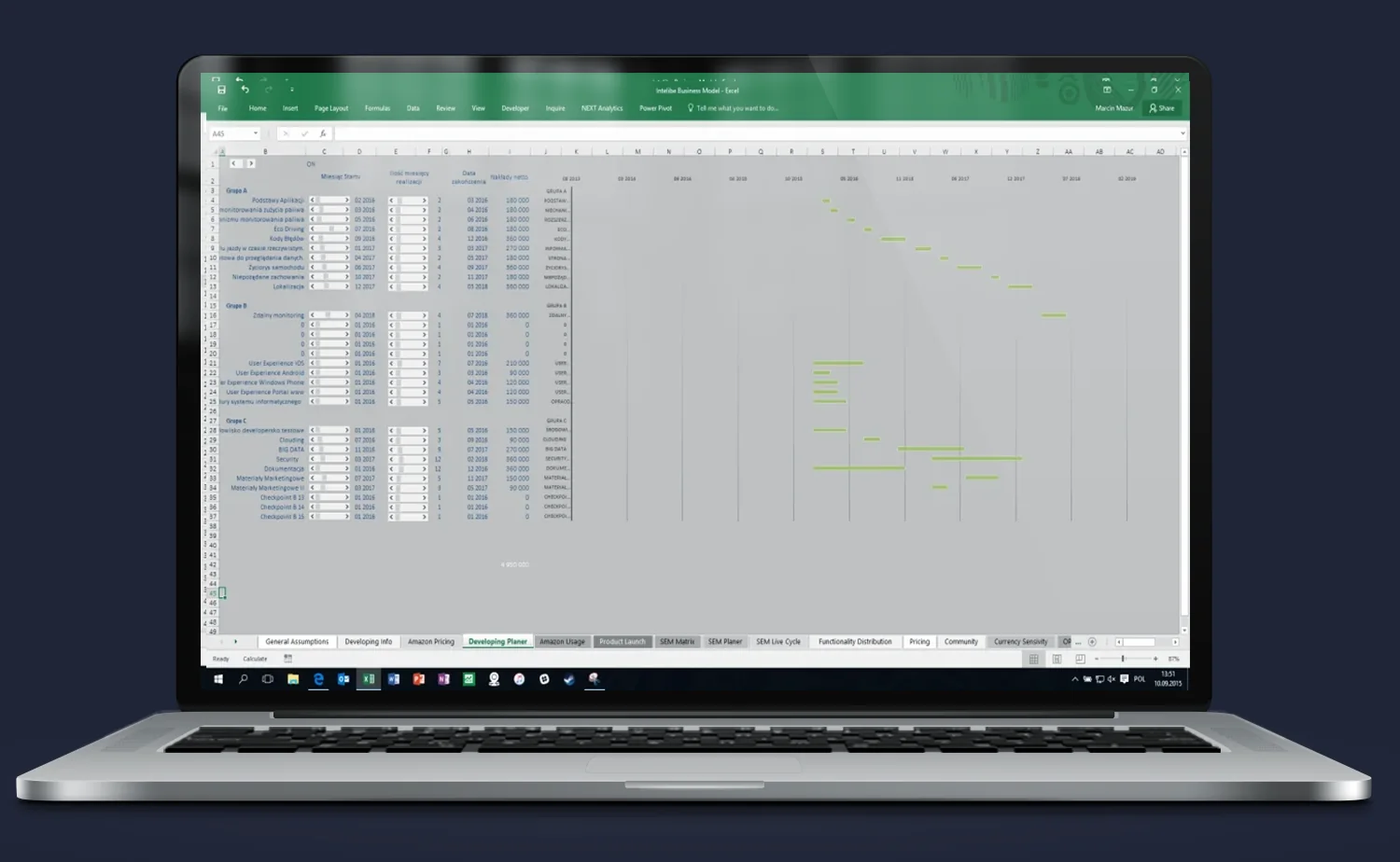
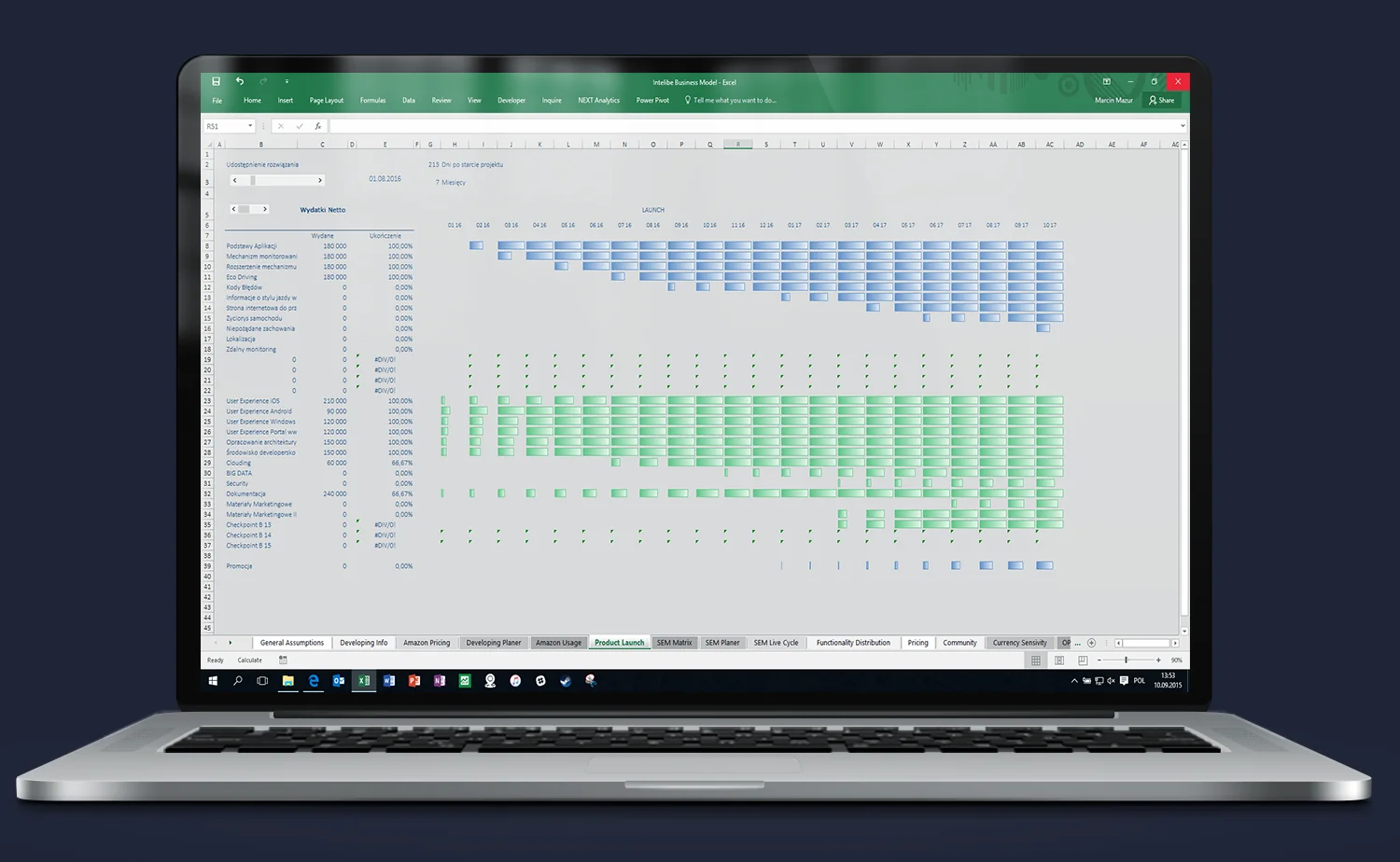
VISUALIZATION OF EXPENDITURES ON PROGRAMMING WORK
Visualization of investment expenditures on technology development
The model included a detailed analysis of:
- the distribution of expenditures on individual software development stages,
- monitoring of R&D budget utilization,
- optimization of investments in terms of the application’s functional goals.
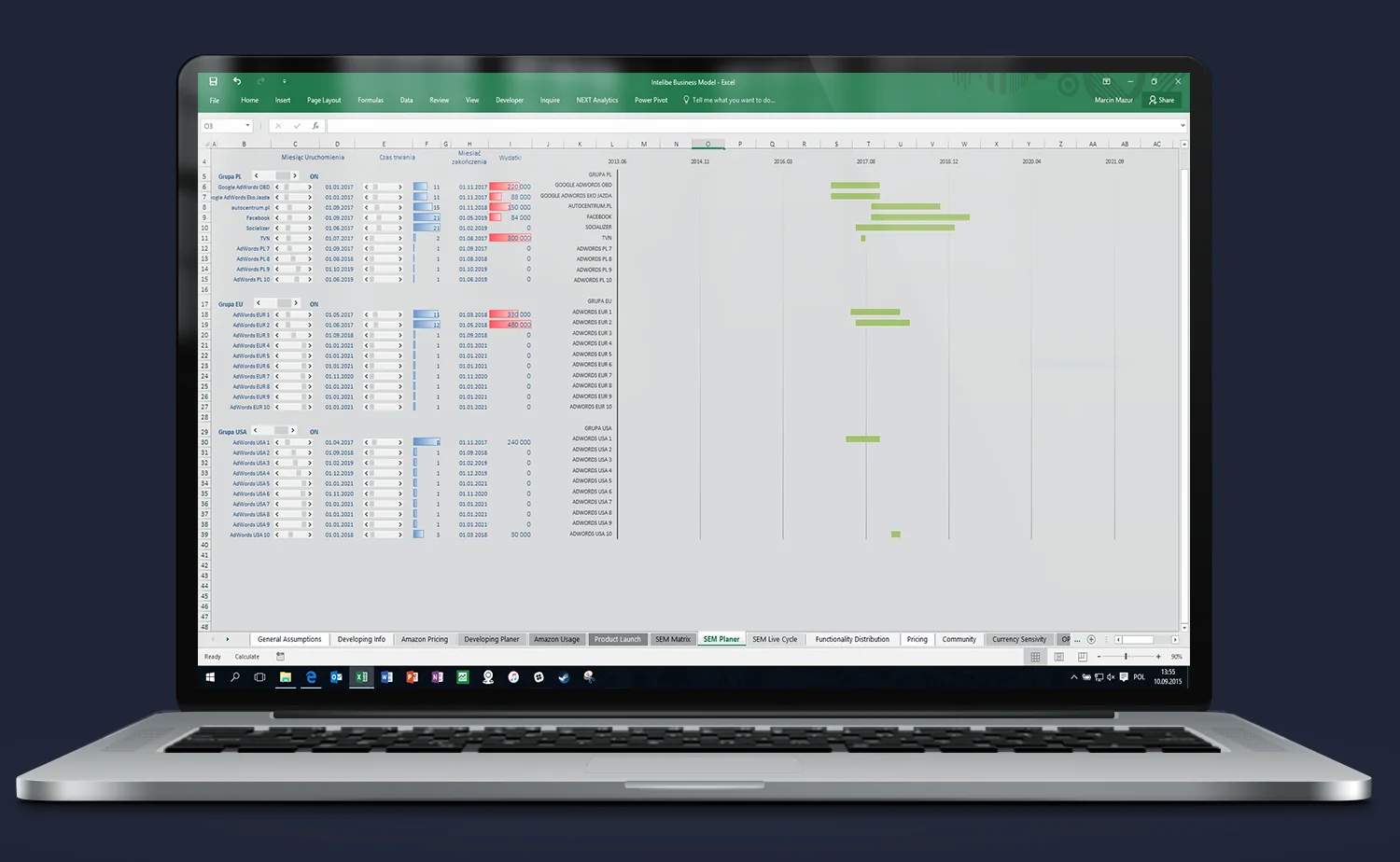
PLANNING OF MARKETING CAMPAIGNS
Marketing campaign planning – support for user growth:
The model included:
- marketing campaign schedule,
- budgeting of promotional activities,
- analysis of marketing expenditure efficiency in relation to user acquisition and revenues.
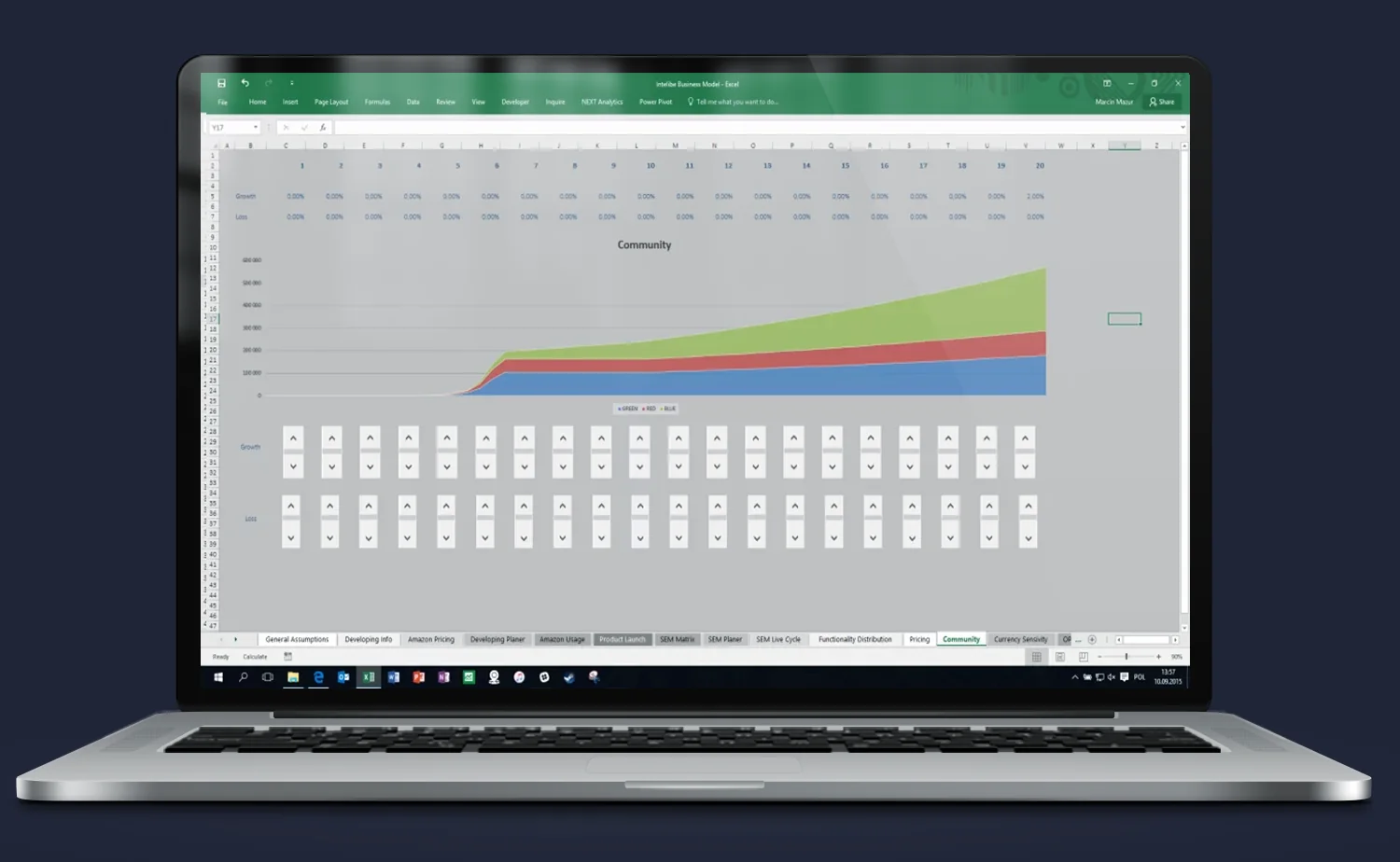
MODELING OF PRODUCT/SERVICE SHARE
Dynamic modeling of service popularity and impact on financial results
Thanks to this module it was possible to:
- realistically reflect customer behavior and market dynamics,
- predict changes in revenue structure depending on offer development strategy,
- prepare a financial model resistant to changes in user preferences,
- increase the value of the project in the eyes of investors thanks to a flexible approach to revenue planning.
The “Functionality Distribution” module in the Intelibe financial model enabled:
- Dynamic simulation of the percentage share of individual services or packages (e.g. basic version, premium, subscriptions) in the total user base.
- Defining scenarios for the growth or decline in popularity of individual offers over time.
- Analysis of the impact of changes in user structure on project revenues and profitability.
- Quick testing of various marketing and pricing strategies to maximize revenues.
Modeling of product/service share
The “Functionality Distribution” module in the Intelibe model enabled:
- Dynamic simulation of the percentage share of individual services or packages (e.g. basic version, premium, subscriptions) in the total user base.
- Defining scenarios for the growth or decline in popularity of individual offers over time.
- Analysis of the impact of changes in user structure on project revenues and profitability.
- Quick testing of various marketing and pricing strategies to maximize revenues.
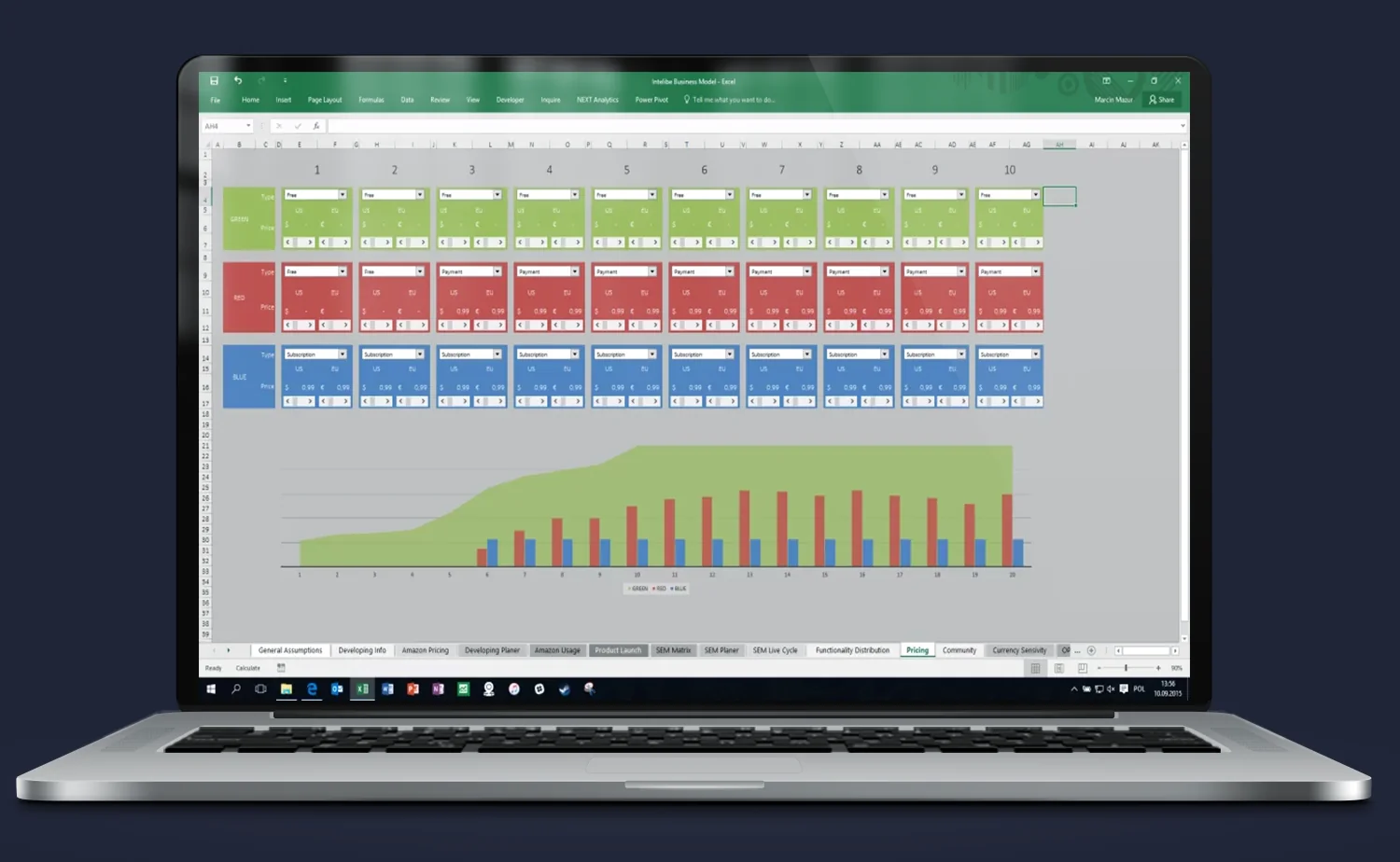
The model contained a dynamic tool for creating and simulating service price lists.
It enabled:
- defining various revenue models (e.g. one-time fees, subscriptions),
- testing the impact of price levels on sales dynamics and financial results,
- quick adaptation of pricing strategy to changing market conditions.
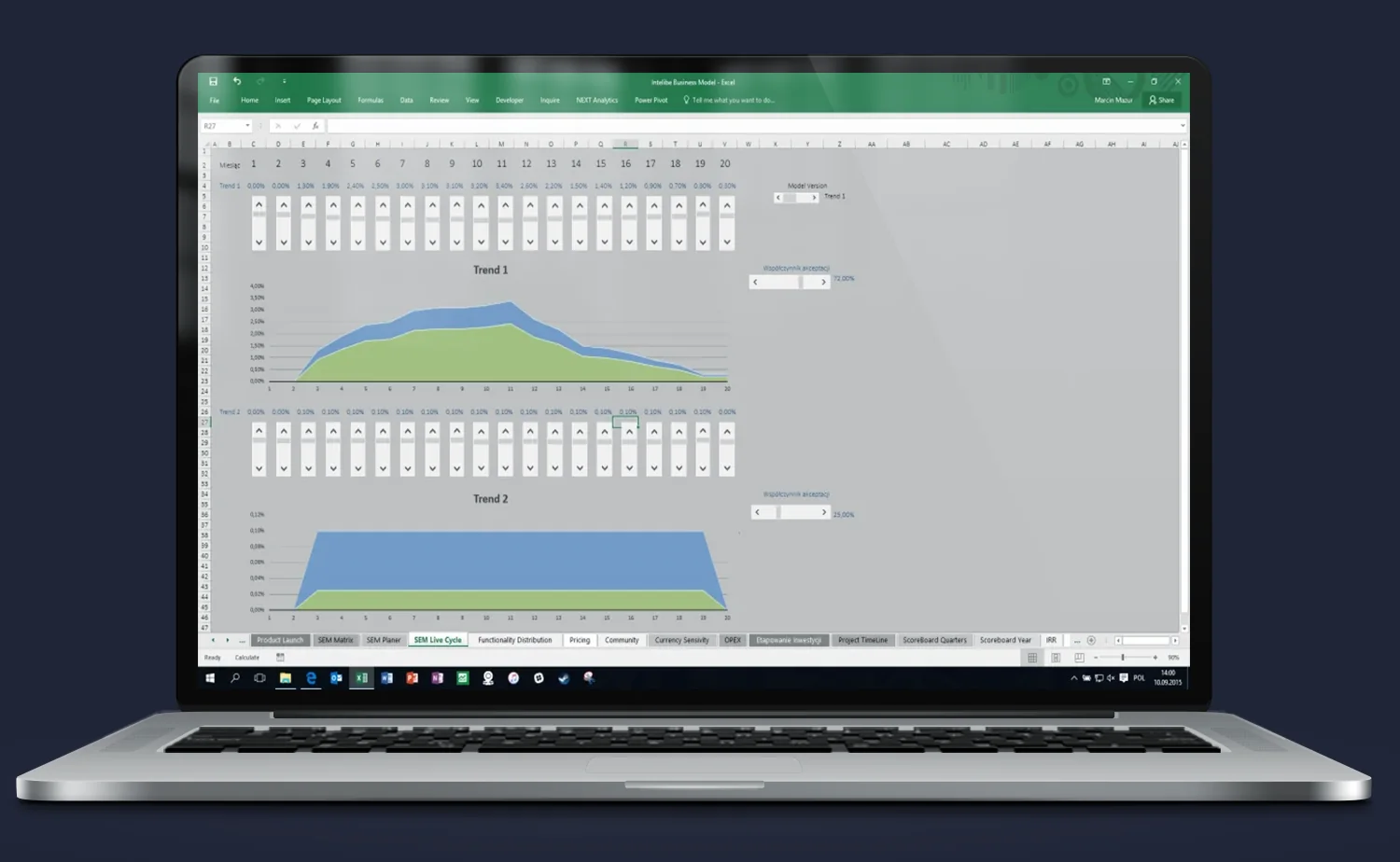
SEM LIVE CYCLE – Modeling of user growth trends.
Simulation of user growth dynamics and conversion analysis. The “SEM Live Cycle” module in the Intelibe model enabled:
- Dynamic modeling of various user growth trends over time (e.g. Trend 1, Trend 2),
- Controlling the growth rate by individually setting monthly increases (% change in number of users),
-
Taking into account the acceptance rate (adoption rate), i.e. the percentage of users who go through the entire registration or product activation process,
-
Quick analysis of the impact of various adoption and growth dynamics scenarios on the project’s financial results.
Significance for the project:
The model allowed realistic mapping of user growth curves, which is crucial when forecasting revenues in SaaS and mobile applications.
It provided the ability to build both optimistic, realistic, and cautious user growth scenarios.
It supported decisions on the pace of investment in marketing and product development depending on market growth pace.
In summary:
Thanks to SEM Live Cycle, the Intelibe project gained a flexible and accurate tool for simulating the future development of the customer base, which significantly increased the credibility of the financial model in the eyes of investors.
Dynamic OPEX modeling
Dynamic OPEX – control of operating costs
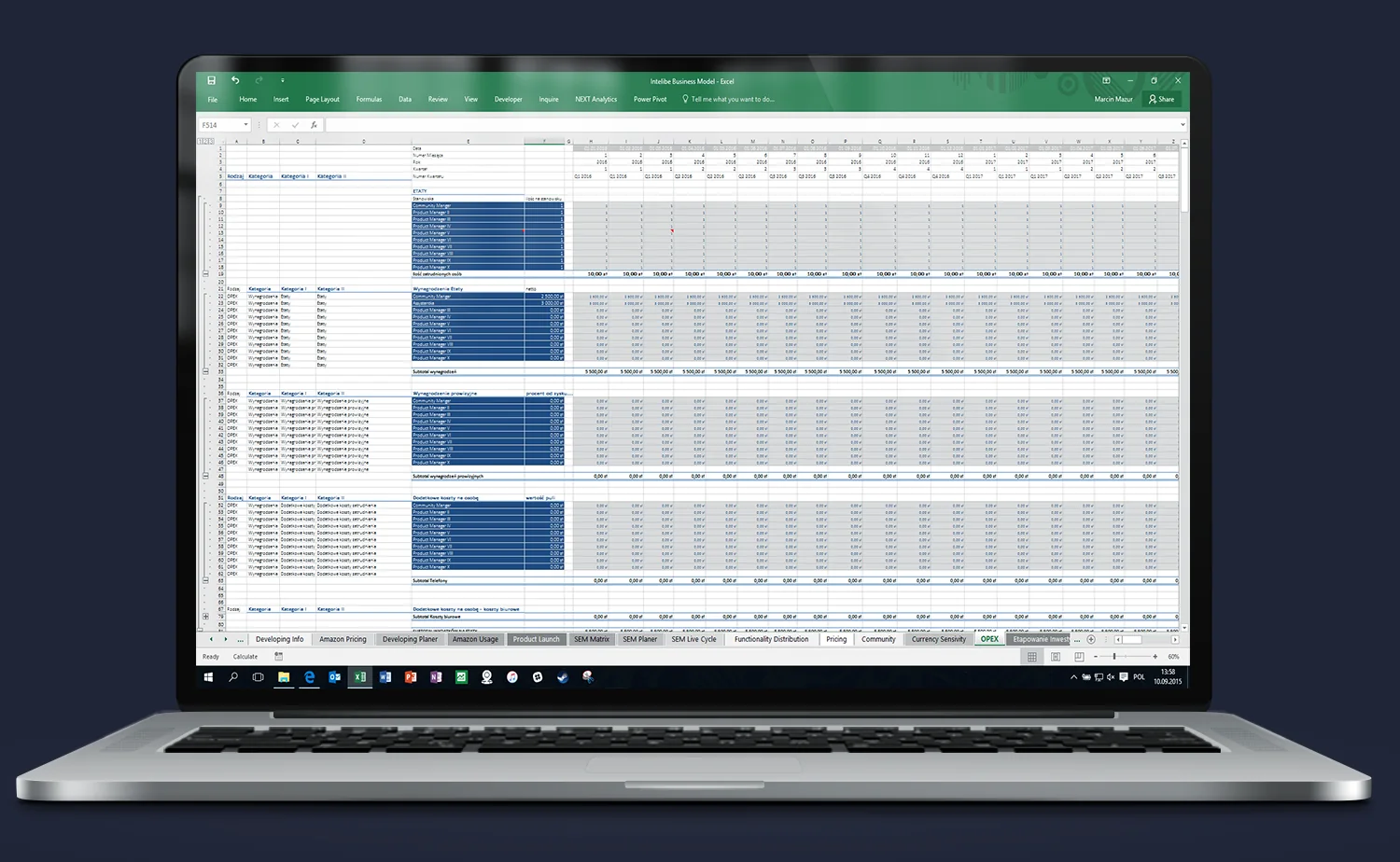
The OPEX module enabled:
- detailed planning and updating of operating costs over time,
- flexible analysis of the impact of individual cost items on the financial result,
- preparation of operational budgets adapted to various growth scenarios.
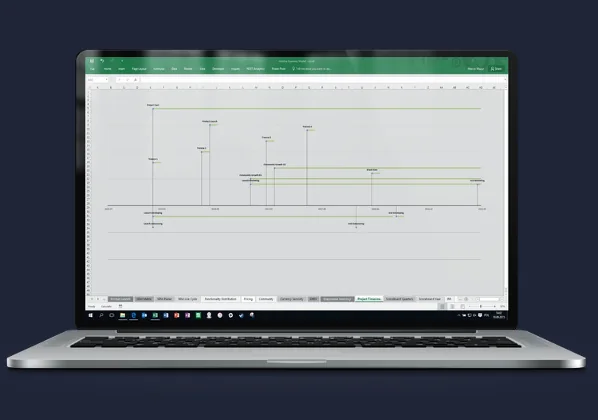
MILESTONES VISUALIZATION
Key milestones – project and risk management.
The model included:
- schedule of key product development stages,
- control of the implementation of set goals over time,
- minimizing the risk of cost and deadline overruns.
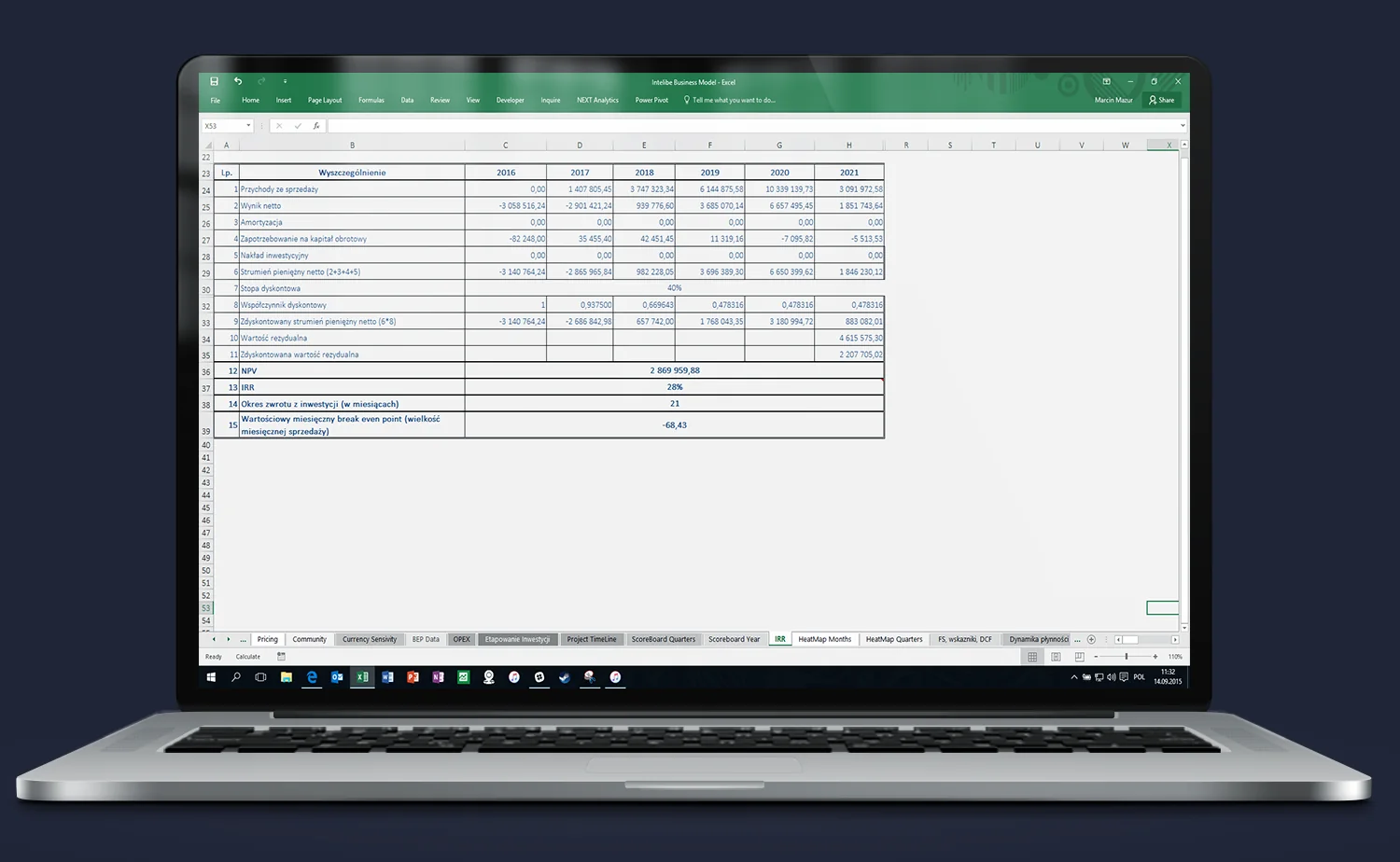
DCF Valuation
Project valuation using the DCF method – investment value analysis.
The model included a DCF (Discounted Cash Flow) valuation module, allowing:
- calculation of the project’s net present value (NPV),
- determination of the internal rate of return (IRR),
- analysis of the investment payback period.
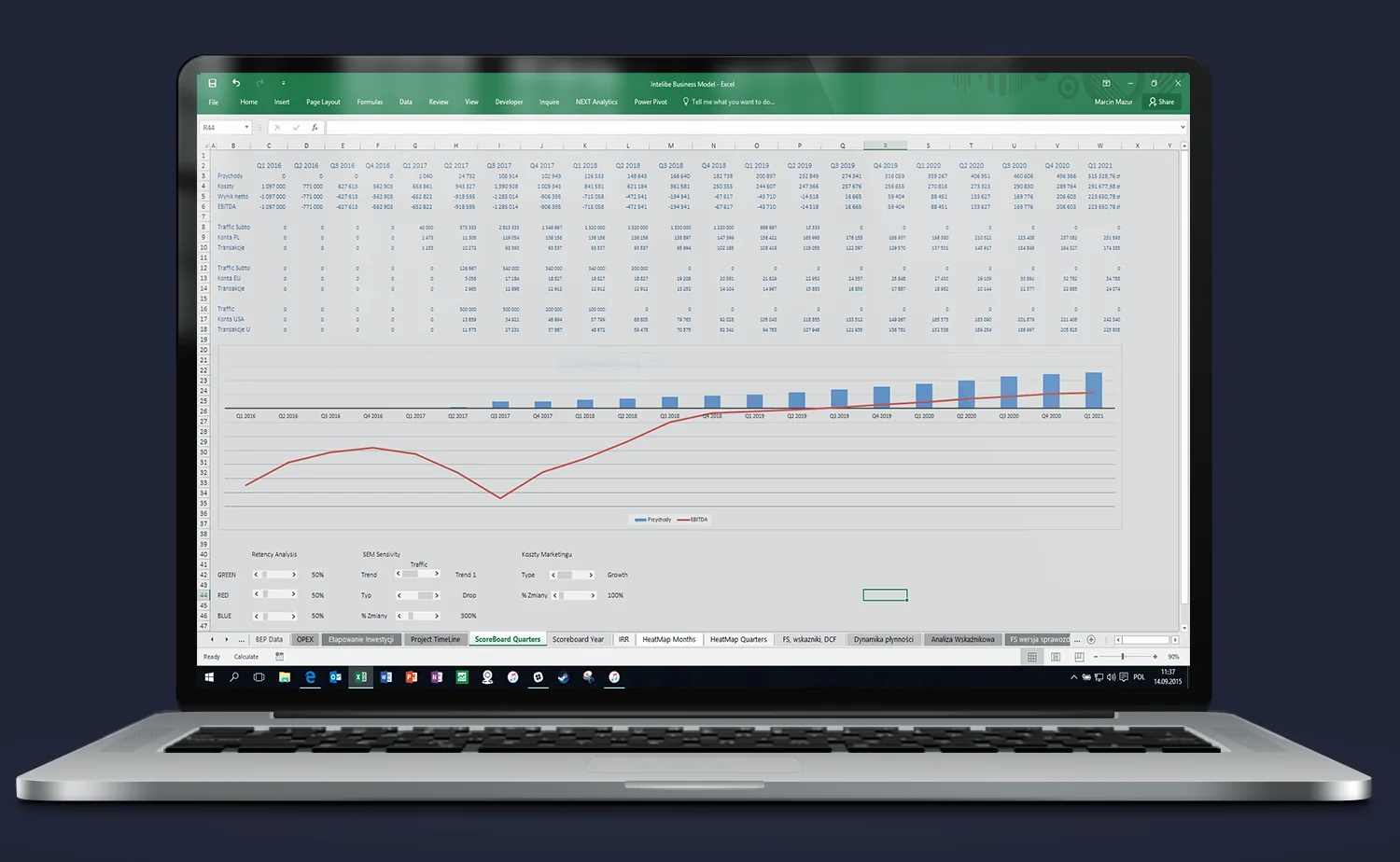
Operating cost analysis and scalability
Operating cost analysis and scalability.
The model allowed for:
- dynamic simulation of the impact of costs on the financial result,
- testing scenarios for cost scaling with user growth,
- preparation of operational budgets adapted to company development.
The financial model included:
- simulation of various user base growth scenarios,
- analysis of the impact of revenue and cost changes on EBITDA and cash flow,
- the ability to quickly test various business strategies.
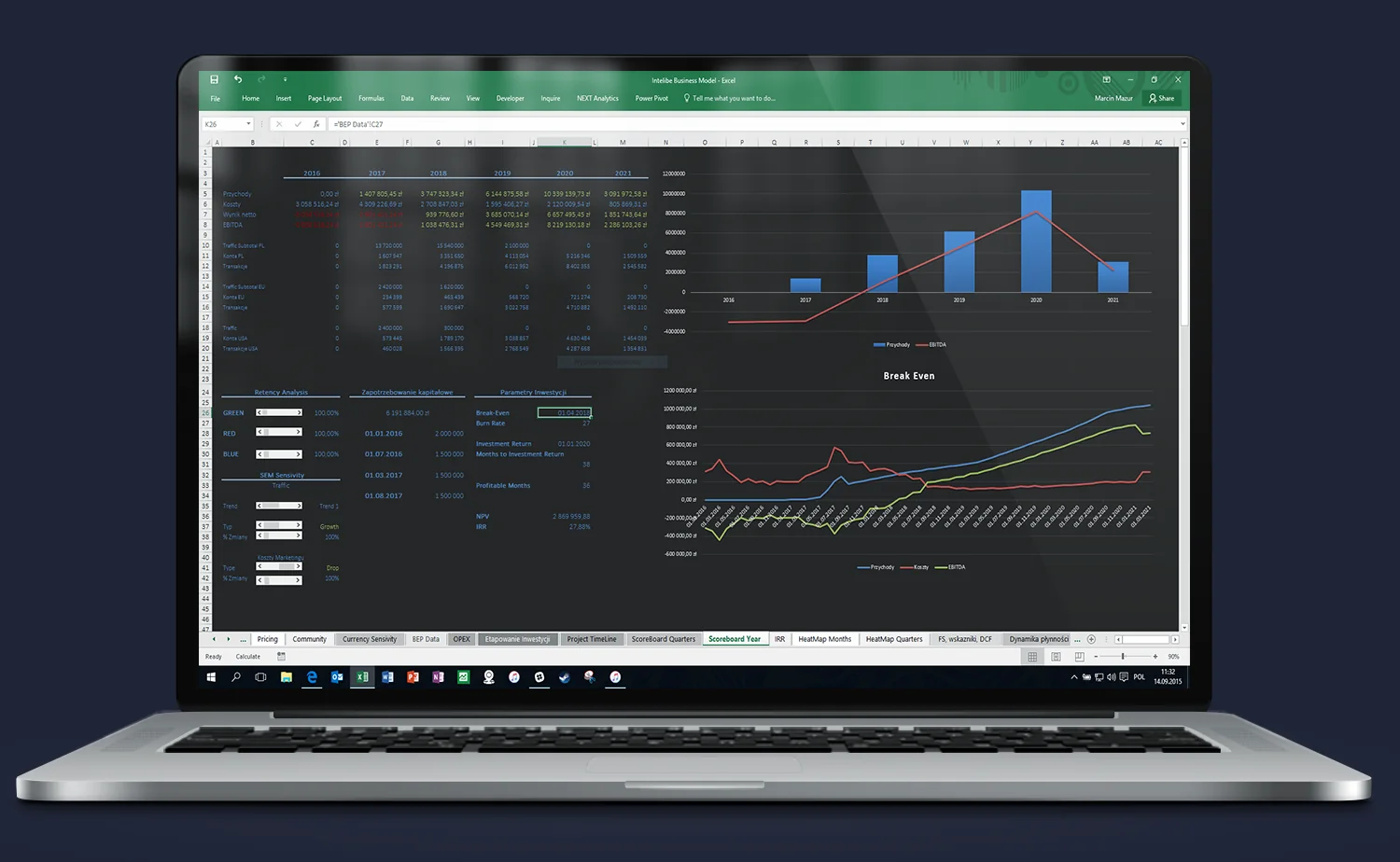
FINANCIAL DASHBOARD AND SCENARIO ANALYSIS
Financial dashboard – real-time performance analysis
The interactive dashboard presented key financial indicators of the project, such as:
- revenue and cost dynamics,
- EBITDA, EBIT, net profit,
- simulations of the impact of user traffic changes and server costs on project profitability.
This allowed investors to immediately assess the impact of various business and market decisions on the financial result.
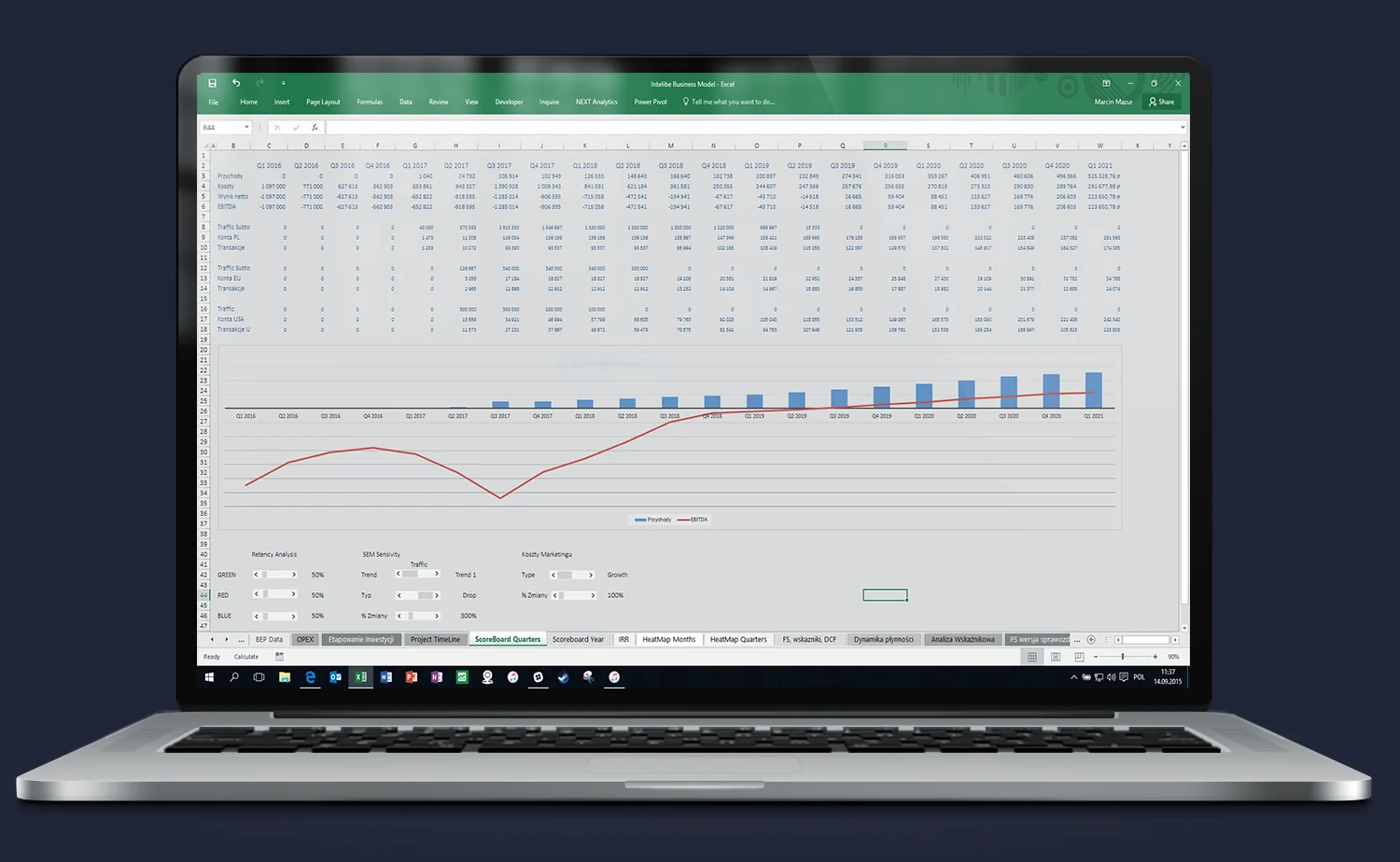
The next section of the dashboard allowed:
- analysis of the impact of various monetization strategies and costs on EBITDA and net result,
- quick modeling of changes in user volume, ARPU (average revenue per user) and acquisition costs,
- support for data-driven management decisions.
Advanced results projection included:
- modeling of several market development scenarios,
- analysis of user base and revenue growth pace,
- indication of profitability thresholds under various cost conditions.
P&L – comprehensive project profitability analysis
The model included a full profit and loss account for subsequent years, allowing for:
- analysis of gross margin and operating margin,
- assessment of the impact of pricing and cost strategy on net profit,
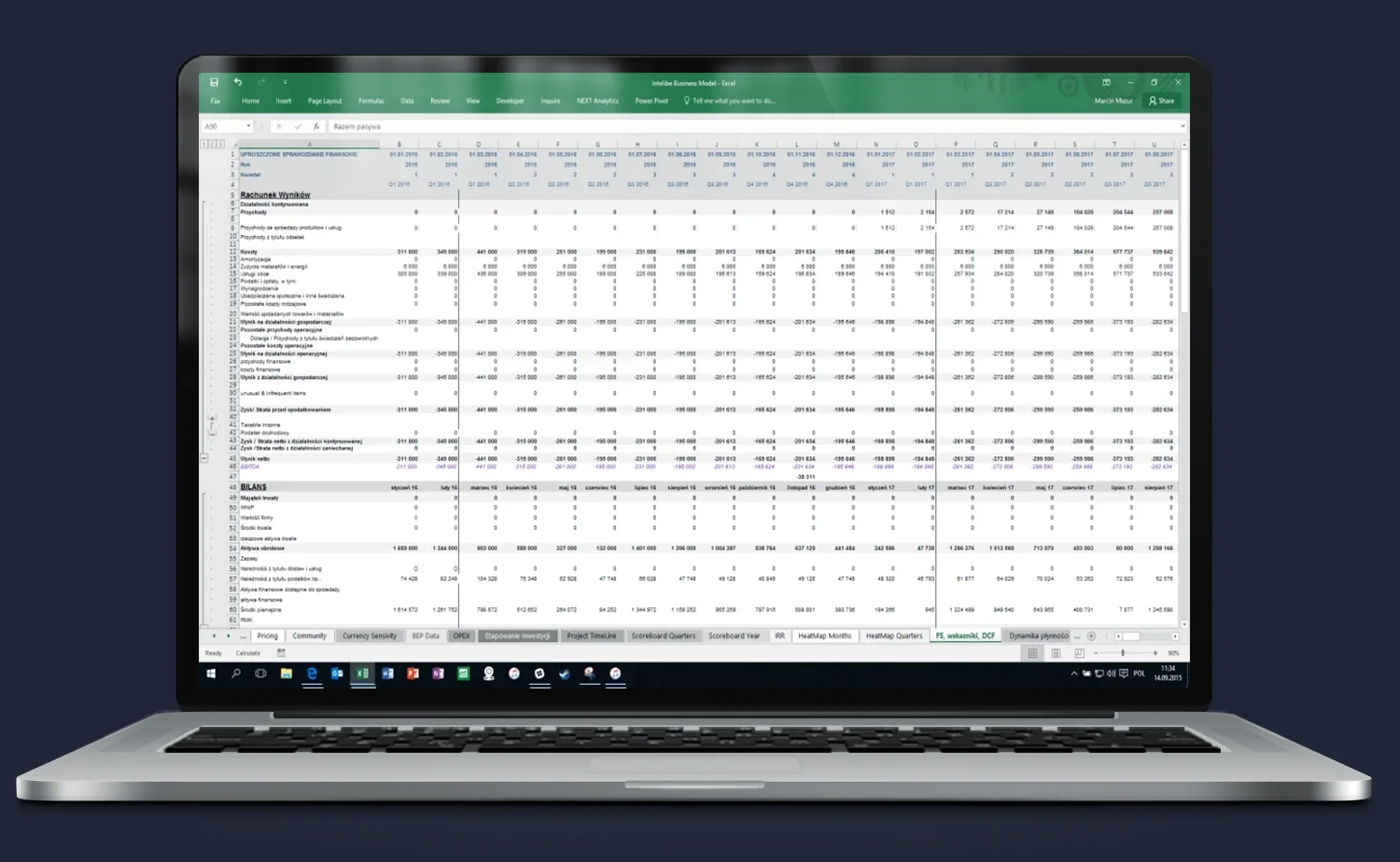
Balance sheet and financial result
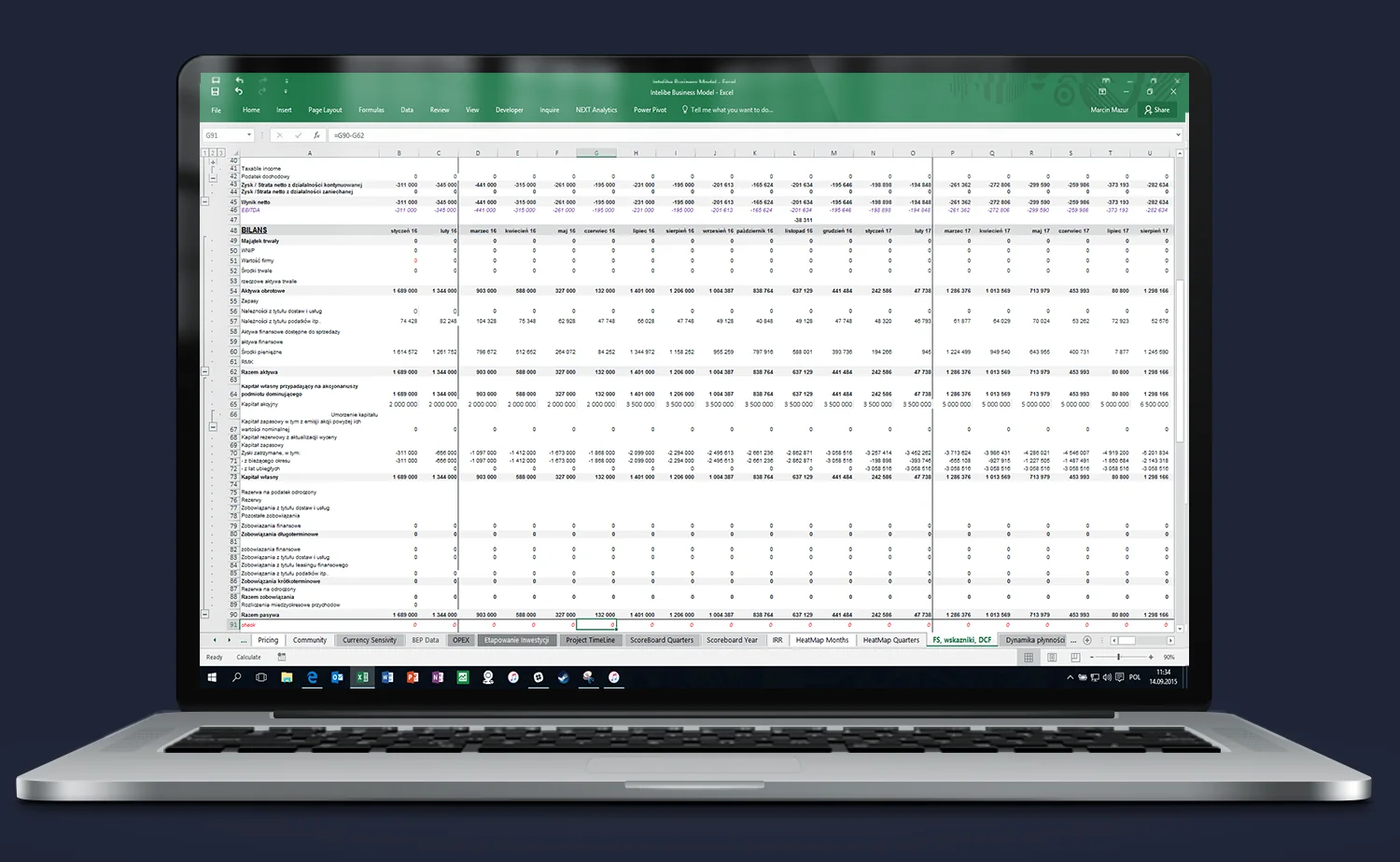
Balance sheet and profit and loss account – the foundation of financial forecasting
The model included a full balance sheet and profit and loss statement, based on realistic operational data.
Thanks to integration with other model modules (revenues, costs, investments, financing), it enabled:
- dynamic tracking of project profitability in various development scenarios,
- analysis of liquidity and financing structure at every stage of the project.
Do you need someone who instantly understands the problem — and knows what to do with it?
Most companies have data. What’s missing is the idea of what to do with it — and someone who will actually execute it. Origami Effect provides both.