

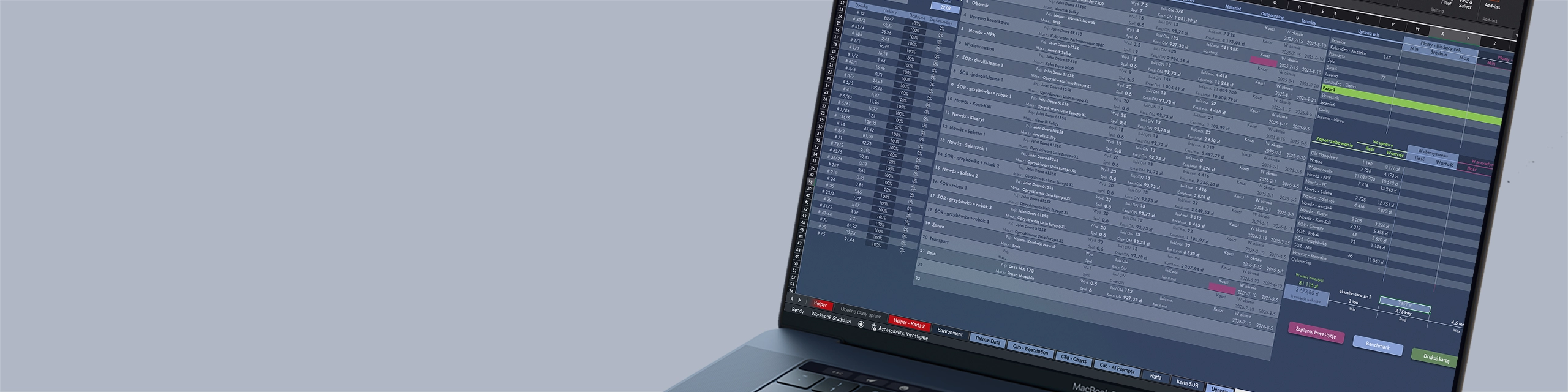
Gaia – Planning, Recording and Controlling
Gaia – The New Generation of the SmartField System: Advanced Planning, Recording and Controlling
The Gaia system addresses the need to combine intelligent budget planning with precise cost and performance control. It is a direct evolution and a significantly more advanced version of the SmartField application. Although Gaia remains a standalone application for budget and field operations management in daily use, its architecture has been integrated into a modern data exchange ecosystem.
The key change is full integration with the Clio data engine, which handles automatic data orchestration, and with the Iris system, which serves as the interactive visual layer. Thanks to this, comprehensive reporting, advanced business analytics, and management data consolidation take place smoothly at the strategic level, without burdening the agronomist’s daily operational work.
The system operates on a proven cycle: from intelligent calculation of inputs and creation of a budget at the individual field level, through meticulous recording of actual field activities, to automatic controlling and deviation analysis presented on central dashboards.
Implementation 2026
GAIA – CENTRAL DATA BASE AND ECOSYSTEM ARCHITECTURE
The system operates in an integrated environment that guarantees smooth information flow between the application’s calculation core, the database, and the external visual presentation layer for management and investors.
Data Orchestration in the Clio Module
All operations on data from the standalone application, its secure storage in MongoDB architecture, and automatic distribution are handled by the Clio backend. This module ensures:
- Automatic feeding of financial models with current farm recording data.
- Pulling external market information (current prices of crops, fertilizers, fuels, and plant protection products).
- An organized structure of historical data: from field mapping and land use classes to harvest history and agrotechnical treatments from previous years.
Comprehensive reporting and analytics in Iris panels
While Gaia handles daily operations and data entry, advanced technical-economic summaries and global reporting are carried out in the Iris module. This modern React-based dashboard enables:
- Instant, mobile access to key performance indicators (KPIs) and budget execution levels for the entire agricultural holding.
- Multidimensional, interactive analysis of cost structure broken down by crops, varieties, and specific field sections.
- Presentation of actual expenditure deviations from the plan in real time, facilitating strategic financial decision-making.
GAIA – INTELLIGENT BUDGETING AND PLANNING
The planning module automatically adapts its logic and layout to the biological specifics of the selected crop.
This enables the creation of an extremely precise operational budget at the individual field level. For every field operation, the system accurately calculates the demand for raw materials, machinery, and external services.
Automatic adaptation to crop specifics
Selecting a specific crop (e.g. corn for silage or consumption wheat) immediately defines the appropriate technological sequence and input parameters. The user focuses only on variables relevant to that crop, which eliminates planning errors and shortens the time needed to prepare assumptions.
Cost calculation based on machinery fleet
Budgeting of each operation (ploughing, fertilization, spraying, harvesting) is based on hard technical data. Assigning a specific set (tractor + machine) allows the system to automatically calculate diesel demand, operating costs, operator labor input, or estimate the need for outsourcing.
Resource planning and pure component balancing
Based on entered rates, the system automatically aggregates global demand for seed material, pure fertilizer components, and active substances of plant protection products. This allows precise determination of delivery dates, optimization of logistics costs, and preparation of accurate commercial orders.
Margin and investment value forecasting
The calculation engine allows comparison of planned costs with yield forecasts in three variants (minimum, average, and maximum) and with current purchase prices. The result is clear information about the estimated margin per hectare, which facilitates profitability assessment before physical work begins.
GAIA – EXECUTION RECORDING AND CONTROLLING
Current recording of operational facts in the standalone application and automatic comparison with the approved plan is the foundation of financial control in the Gaia system.
Data on performed operations flows directly to the Clio database, from where it immediately feeds the analytical module and updates interactive reporting cockpits in Iris.
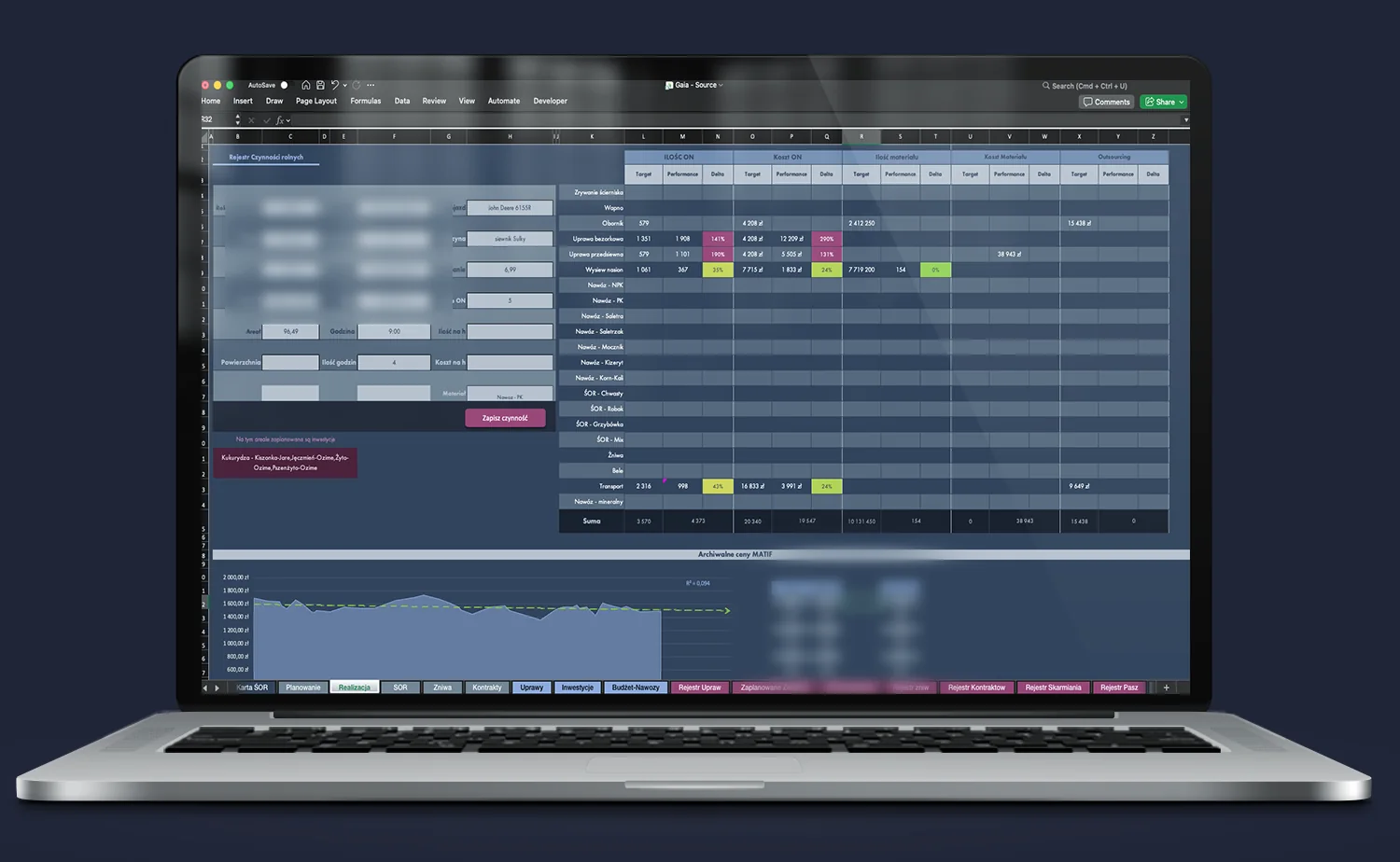
Detailed recording of agricultural operations
The system enables precise recording of every field event. The entry includes date, location (field), execution status, purpose of the operation, as well as operator personal data and used equipment resources.
Monitoring of fuel consumption and working time
Recording of actual machine working time and real fuel consumption allows immediate verification of machinery fleet efficiency. Management gains insight into equipment utilization efficiency and can easily identify areas generating unjustified losses.
Automatic comparison with the plan and deviation analysis
The most important controlling function of the system. Every reported cost or material consumption is immediately compared with budget assumptions. The system automatically isolates quantitative deviations (e.g. excessive use of chemicals) from price deviations (e.g. more expensive raw material purchase), precisely indicating the source of budget overrun.
Current control of material and service costs
The module aggregates expenditures on purchased fertilizers, seeds, plant protection products, and invoices for external services (outsourcing). This enables ongoing monitoring of cash flow and assessment of how current capital commitment relates to the overall budget planned for the season.
GAIA – HARVEST RECORDING AND YIELD SETTLEMENT
Precise closure of the production cycle at the harvest stage.
This module is responsible for meticulous documentation of harvested crop flow, examination of quality parameters, and optimization of warehouse logistics.
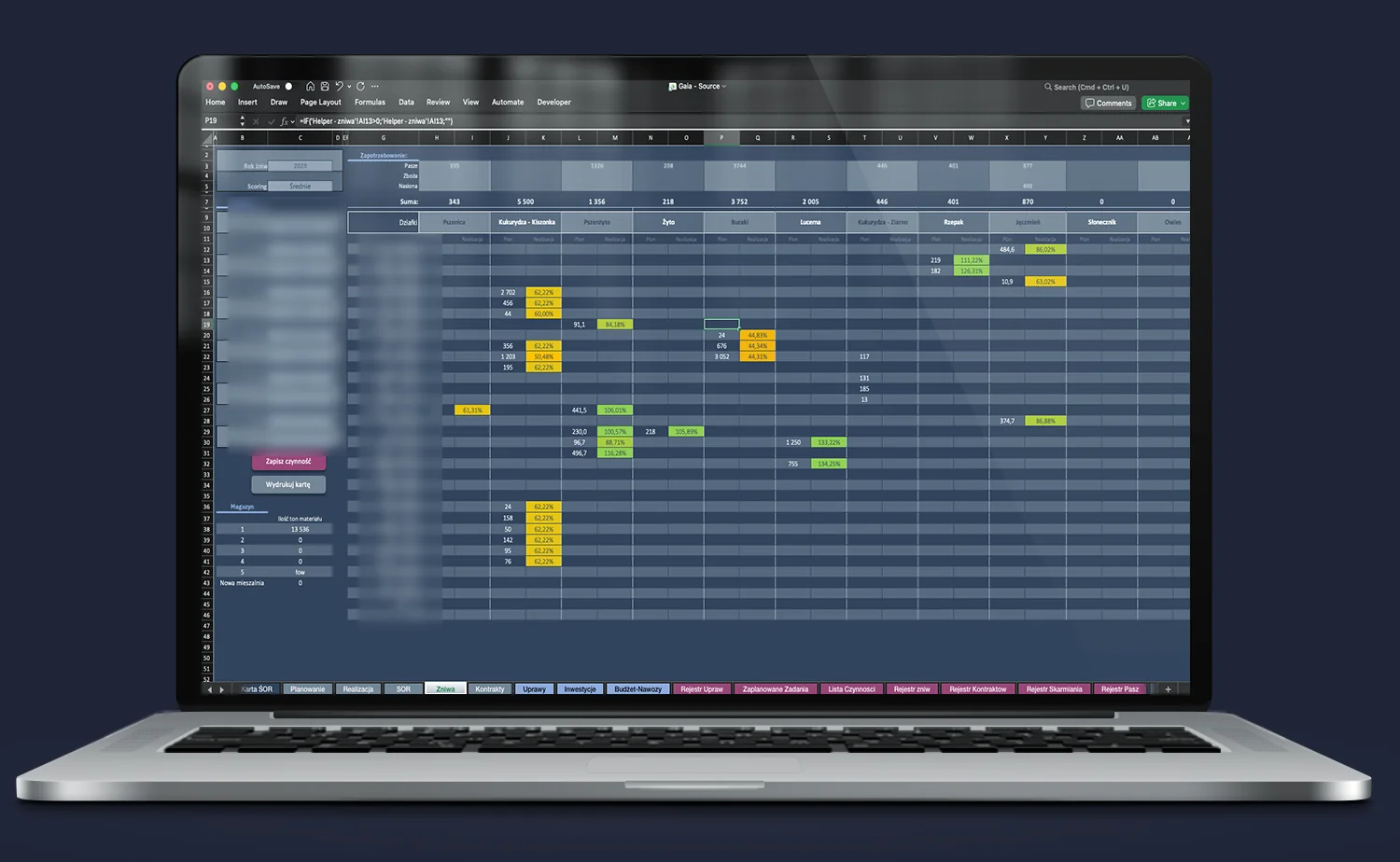
Accurate tonnage recording from fields
The system records the weight and quality parameters (e.g. moisture, contamination, protein) of each batch brought from a specific field. This allows precise assignment of the production result to the micro-location.
Performance scoring and historical analysis
Based on collected data, the system creates an advanced field scoring. Comparing yield size and quality with historical data from previous years and incurred financial inputs allows clear assessment of which cultivation technologies proved most effective.
Elevator logistics and transport management
The module supports transport organization and warehouse recording. It tracks the path of raw material from field to weighbridge, and then to a specific silo (divided into quality fractions: feed, consumption) or directly to an external recipient, optimizing logistics costs.
Reporting and knowledge transfer in Iris
Harvest results are automatically aggregated and pushed to the Iris module. Data presentation in the form of interactive pivot tables and charts facilitates immediate season summary and drawing of agronomic and financial conclusions at the level of the entire agricultural enterprise.
GAIA – CONTRACT SETTLEMENT AND MARGIN
Linking physical yield with signed commercial contracts is the final stage of verifying the farm’s economic success.
This module allows ongoing monitoring of forward contract execution and assessment of the final financial result in relation to incurred investment expenditures.
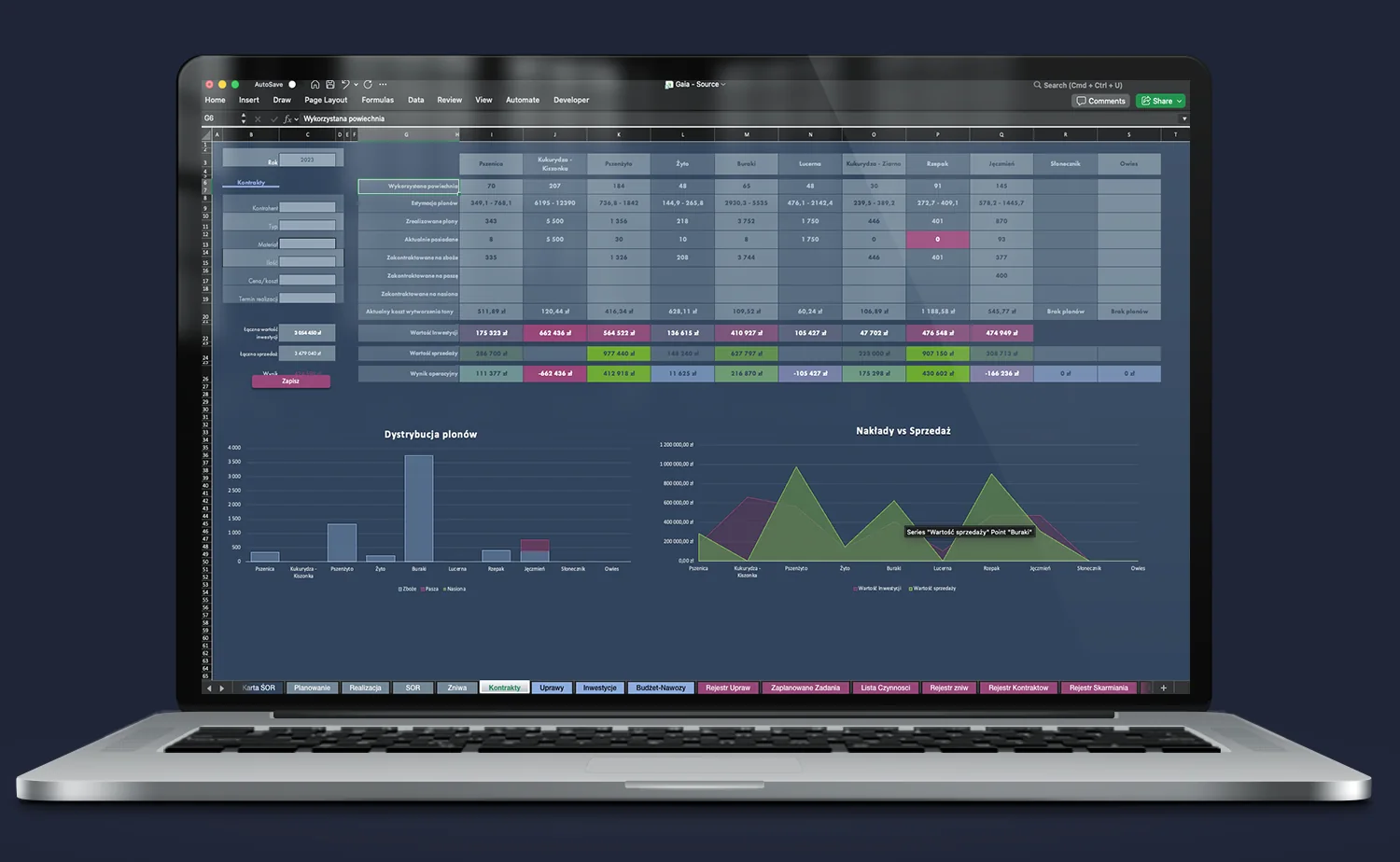
Commercial contract portfolio management
Recording of commercial contract details: from counterparty data, through volumes and negotiated prices, to delivery dates and terms. Assigning contracts to specific crops allows ongoing control of the degree of sales hedging for produced raw material.
Dynamic calculation of real cost per ton
Based on booked operational costs and actual harvested tonnage, the system’s mathematical engine instantly calculates the real cost of producing one ton (Cost per Ton) for each field and crop. This is a key indicator for traders, determining the safe profitability threshold when concluding new transactions.
Operating result and financial margin analysis
The system automatically generates the final financial settlement, comparing revenues from sales (or inventory valuation) with full budget and operational costs. The financial result (profit/loss) can be precisely analyzed at the level of the entire farm, a specific special purpose company, a particular crop species, or even an individual registered field.
Distribution and input visualization
Advanced graphical reports in Iris clearly present the relationship between incurred investment expenditures and sales revenues, as well as the structure of yield distribution (commercial goods, feed stock, seed material), providing management with transparent facts for planning business strategy for the next year.
Do you need someone who instantly understands the problem — and knows what to do with it?
Most companies have data. What’s missing is the idea of what to do with it — and someone who will actually execute it. Origami Effect provides both.