


Quantis Logistics – Inventory and Order Planning
The system acts as a complement to existing solutions. It supports inventory and order planning as well as sales forecasting in trading companies. It uses data that already exists and processes it automatically to generate concrete recommendations using modern technologies.
Its main goal is to significantly shorten the time between needs analysis and placing an optimized order with the supplier.
Implementation: 2025
It is part of the comprehensive analytical system QUANTIS
Technology Used:
- Automation: Python, M, VBA, SQL
- Database: MySQL
- Visualization and analysis: MS Excel
- Machine Learning: XGBoost, Facebook Prophet, Pandas
The system was designed by a person with over 15 years of experience in creating financial and operational models for the Private Equity sector.
SYSTEM FEATURES
Who is this solution for?
- Trading and import companies
- Companies with multiple warehouses or high inventory turnover
- Purchasing, logistics, and operations teams
- Organizations that want to plan orders and inventory more effectively
- Businesses that need reliable data for accurate decision-making
- Companies that want to combine planning, analysis, and operations in one system
Problems it solves:
- Lack of visibility into inventory levels over time
- Manual order planning
- Difficulty in predicting consumption
- Scattered data
Quantis combines data in one tool and supports decision-making
SUPPLIER DATA (SUPPLIERS – DATA)
The supplier module gathers all key information needed to automate and control the purchasing process: minimum order thresholds, contact details, geographic locations, and assigned account managers.
Benefits for the user:
- Verification that the order meets the supplier’s minimum requirements
- Optimized communication paths (emails to the right people)
- Ready-to-send orders without switching to Outlook
- Division by regions and warehouses enables segmented purchasing
Product Parameters (Products – Parameters)
Each product in the system has a complete set of logistical and purchasing parameters: lead time, delivery time, packaging, dimensions, volume, weight, units per pallet, source warehouse.
Benefits for the user:
- Accurate volume and weight calculations for transport optimization
- Assignment to source warehouse simplifies space planning
- Data is automatically used when generating orders
QUANTIS calculates not only quantity, but also space and weight – ready for loading.
WAREHOUSE CAPACITY MODULE
The module enables warehouse space management based on geometric data (length, width, height, space utilization factor).
Benefits for the user:
- Alerts about potential overstocking
- Ability to simulate scenarios considering physical constraints
- Warehouse data used in order and delivery analyses
Quantis calculates not only what to order – but also where it will fit.
SALES FORECAST MODULE
QUANTIS provides several types of predictive models – each tailored to different data characteristics, including:
- Prophet (Meta/Facebook) – detects seasonality, trends, and anomalies
- XGBoost – advanced decision tree model that automatically analyzes multiple product features and its environment, detecting complex relationships
The user selects the model that best fits a specific product
For each product, Quantis creates forecasts based on its own sales history
- Uses Machine Learning models that learn patterns of seasonality, spikes, and trends
- The user can manually adjust the forecast: for each month individually or globally for the whole year
Forecasts are recalculated cyclically and automatically.
Quantis analyzes historical data and automatically predicts future sales for every product.
Continuous forecast updating – You always work with the most current and predicted demand.
- Every new sale, return, or order change affects the forecast.
- Forecasts are updated cyclically and automatically.
Better purchasing decisions
- You know exactly how much you need to buy.
- You avoid over-investing in slow-moving items and stockouts of bestsellers.
- You reduce storage costs and the risk of obsolescence.
INVENTORY AND REPLENISHMENT MODULE
Dynamic inventory grid over time for two selected years
- Color-coded alerts for shortages and decisions on replenishment
- Sorting and filtering by suppliers
- Full visualization of inventory levels
Everything on one screen. No switching. Full context.
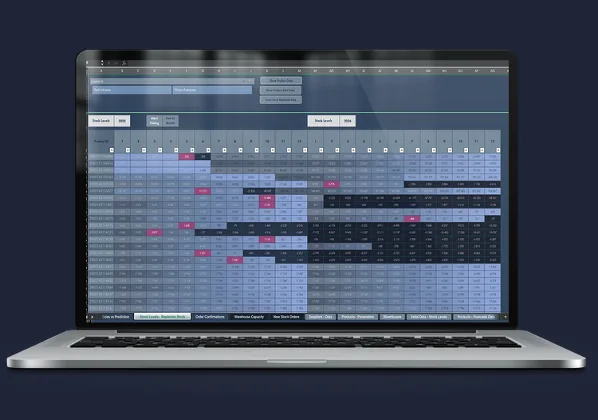
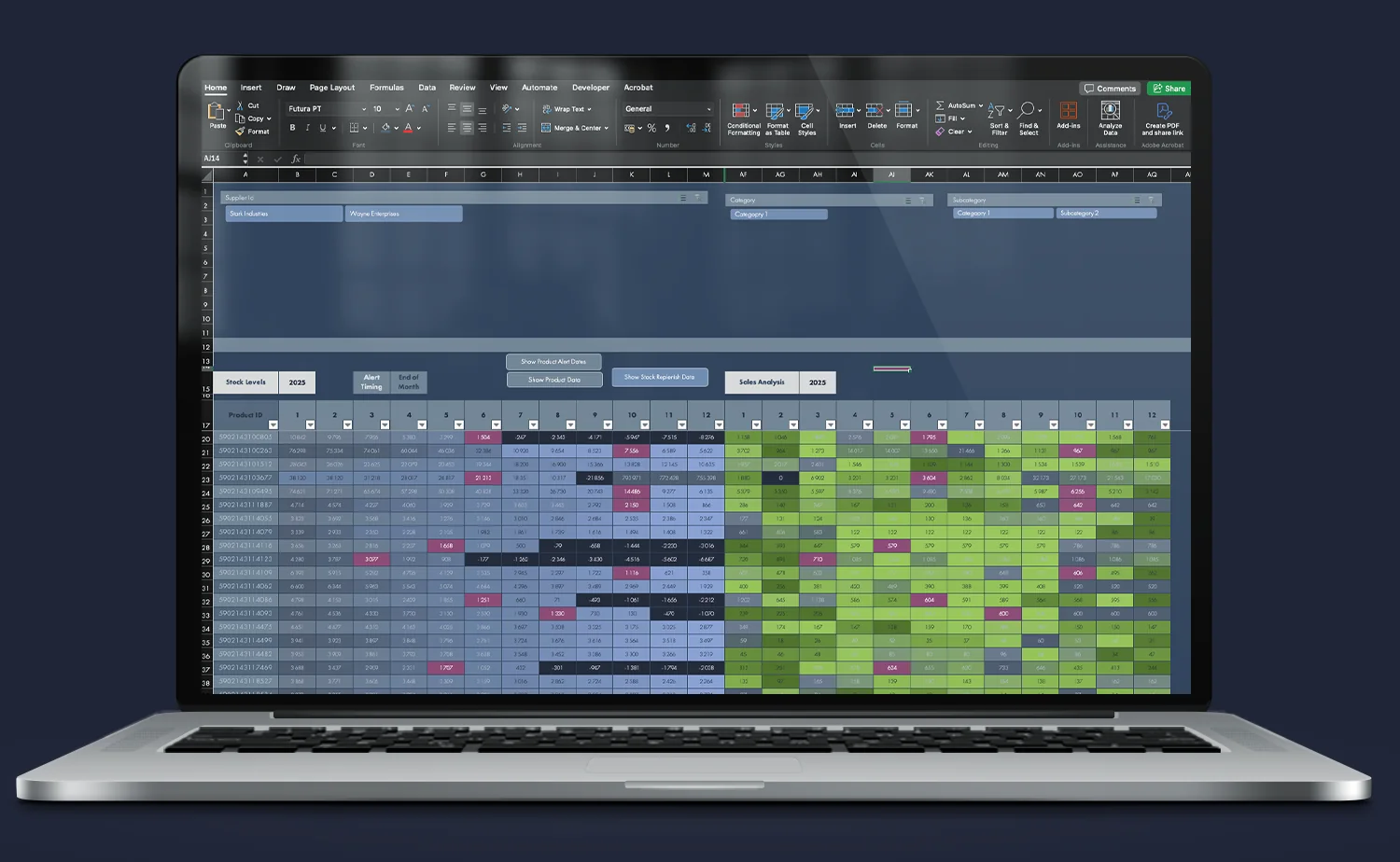
The inventory view shows how much stock is left and in which month it will run out.
The sales view shows how quickly and intensively a product is moving.
Together they provide the full picture — turnover rate, popularity, and risk. QUANTIS shows both – side by side, in the same structure.
You can quickly identify bestsellers and items at risk of stockout, not just those “with low stock.”
Full data synergy – one screen, two perspectives.
Order creation process:
- The user filters products by supplier and sees which items will run out in the coming months.
- They can choose for how many months they want to secure stock for a given product.
- QUANTIS automatically calculates quantities for specific demand months.
- The system recognizes shortage months and takes only real needs into account.
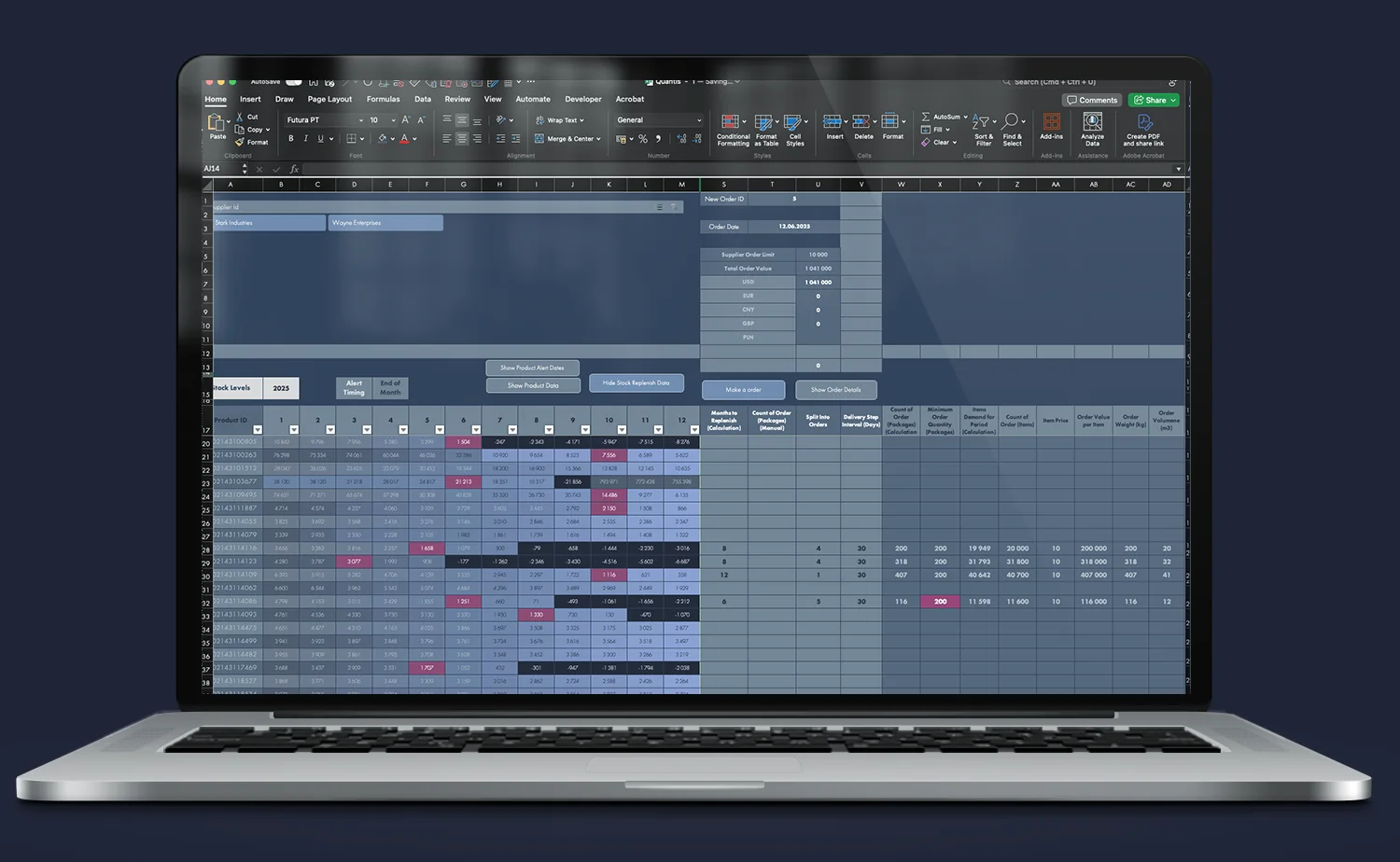
The system also allows splitting orders into smaller batches delivered at logistic intervals.
- The user can decide how many parts the order should be split into and how long the intervals between deliveries should be.
- Each batch has its own dates, values, and volume – everything is calculated automatically.
- QUANTIS shows the impact of each delivery batch on warehouse coverage, schedules, cash flow, and warehouse load.
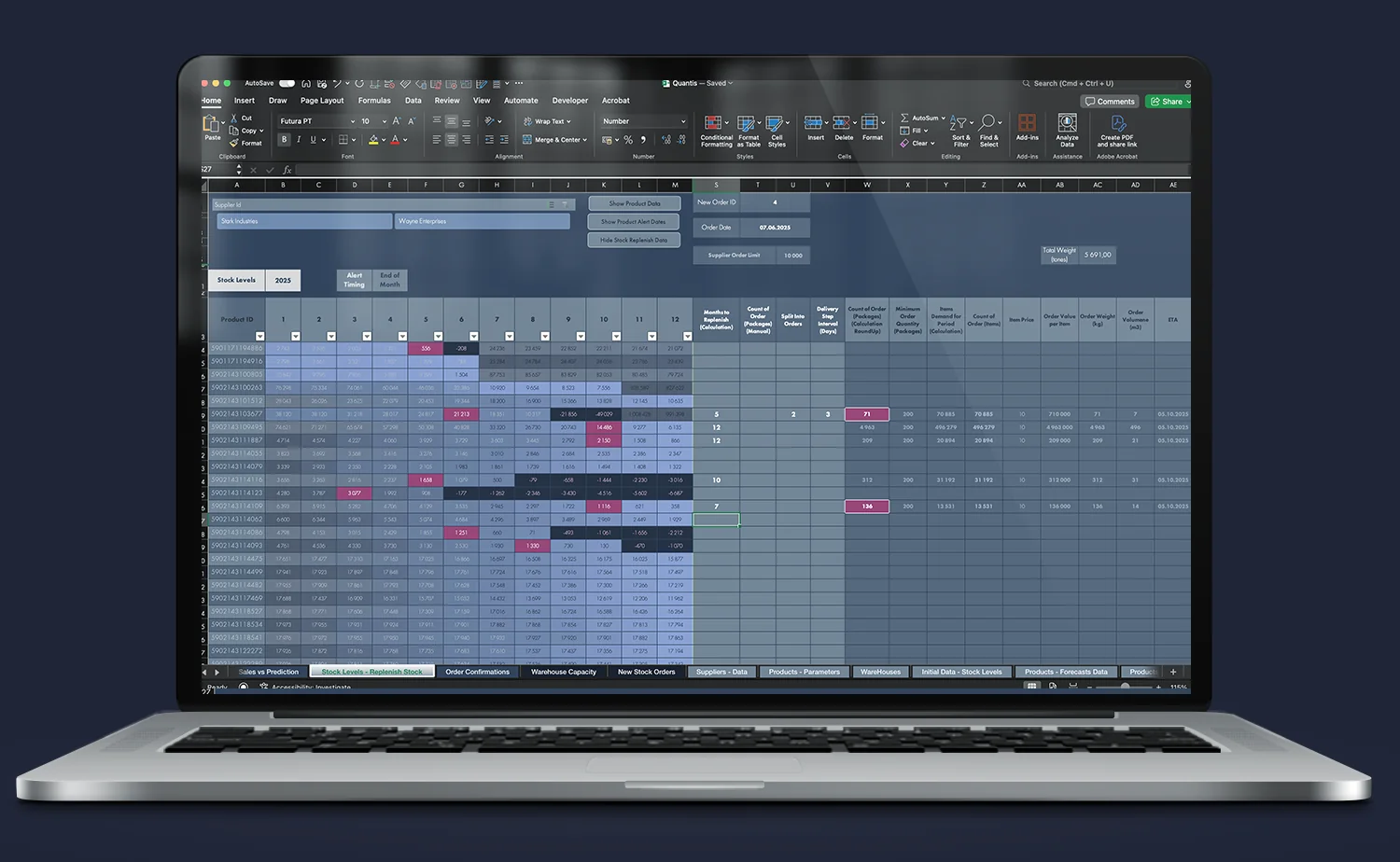
- Calculations take minimum order thresholds into account
- QUANTIS automatically summarizes the weight and volume of the entire order
- It calculates total cash requirements, including previously placed orders.
- After accepting the order parameters, QUANTIS automatically generates an email to the supplier with PDF and XLS attachments.
QUANTIS doesn’t just suggest what to order – it calculates everything for you.
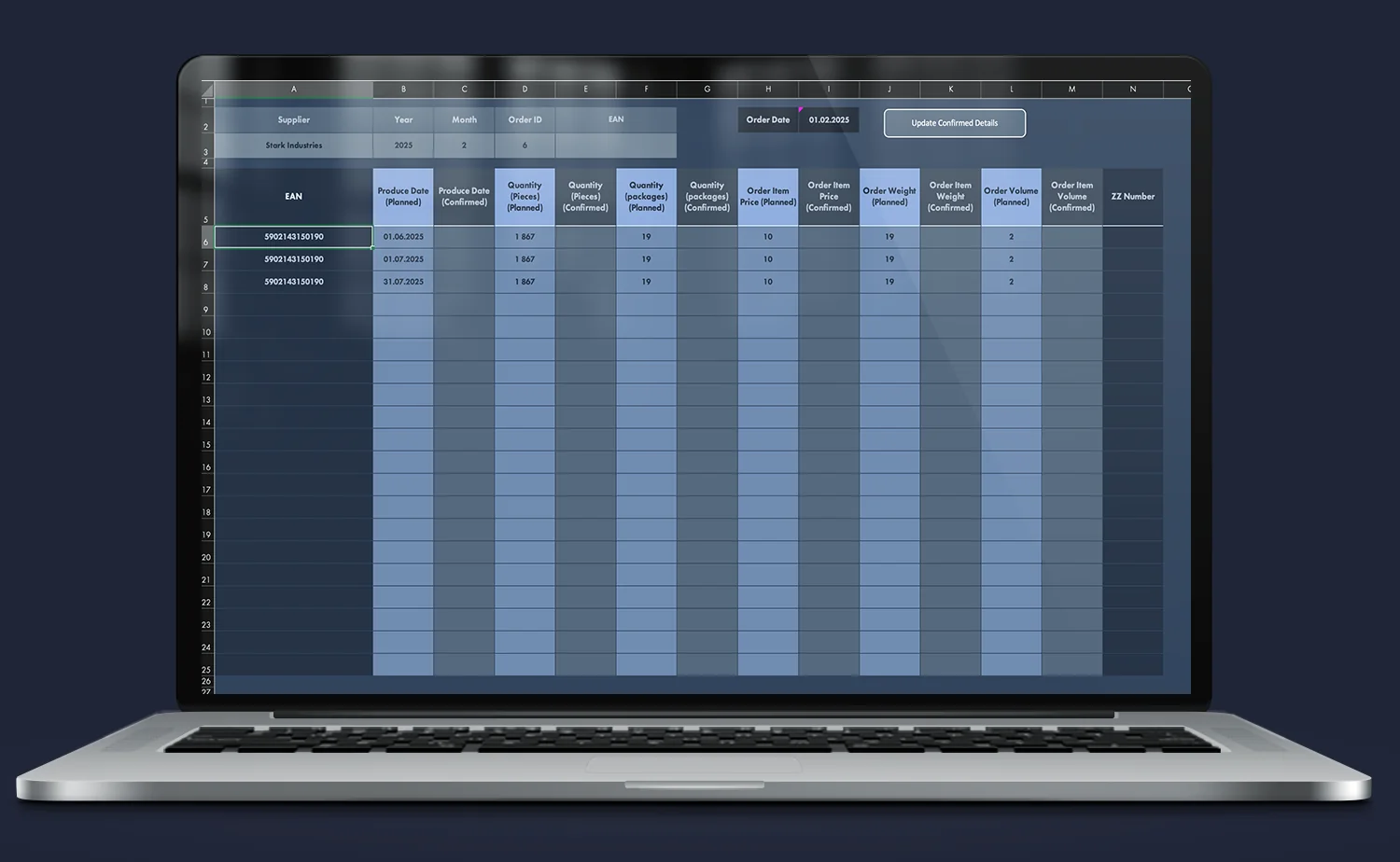
ORDER CONFIRMATION MODULE
The module allows recording confirmed delivery dates and quantities received from suppliers.
The system supports both 1:1 confirmations and split confirmations into batches.
Each confirmation automatically updates:
- warehouse coverage,
- delivery schedule,
- cash requirements
QUANTIS does not treat confirmation as a formality. It treats it as a new operational reality.
Methodology
Traditional ERP and WMS systems use simplified methods for calculating inventory coverage, usually based on a simple formula: stock divided by average sales. Quantis applies an approach that goes beyond the standard: inventory coverage is modeled month by month, enabling precise simulation of stock over time.
In classic systems, deliveries are often entered manually or omitted, making full availability analysis difficult. Quantis includes them automatically – even when split into delivery batches – making forecasts much closer to reality.
Every change in data – whether order confirmation, new forecast, or sales update – triggers immediate recalculation in Quantis. In a typical ERP, the user must remember to recalculate manually or work with outdated data.
Instead of a single number representing “coverage,” Quantis users receive a full timeline with visualization of stock, deliveries, and forecasts. The system immediately reacts to supplier confirmations – updating not only inventory levels but also impact on cash flow, logistics, and goods availability.
While standard systems rely on simple formulas, Quantis uses machine learning models and business rules – delivering intelligent, adaptive analyses that support real operational decisions.
CONFIRMED AND PLANNED CURRENCY ORDERS
Quantis automatically generates summaries of liabilities and planned purchases in foreign currencies – both confirmed and forecasted.
Thanks to this, the finance department can:
- know future currency needs resulting from approved and planned orders.
- select appropriate hedging instruments (forwards, NDFs, options).
Intelligent management of currency orders thanks to cost context enables:
- comparison of new orders with already planned and confirmed ones,
- real-time calculation of total currency requirements,
- conscious splitting of orders into batches to spread currency risk and match liquidity.
Benefits:
- Ability to shift part of an order to the next month if currency exposure is too high.
- Conscious decision: place the full order now or split it into installments, taking into account:
- already approved expenses,
- upcoming transactions,
- available funds in a given currency.
- support for dynamic hedging and negotiations with suppliers.
Do you need someone who instantly understands the problem — and knows exactly what to do with it?
Most companies have data. What’s missing is the idea of what to do with it — and someone who will actually execute it. Origami Effect delivers both.